Event submissions
Published
This submission belongs to the session S5. Poster Session of the event The 1st International Online Conference on Biomimetics
Published date
15 May, 2024
Academic Editor
'%3e%3cpath%20d='M12.6657%2010.9104C12.4185%2010.325%2012.0599%209.79327%2011.6097%209.34482C11.1609%208.89508%2010.6293%208.5365%2010.0442%208.28888C10.0389%208.28626%2010.0337%208.28495%2010.0285%208.28233C10.8446%207.69279%2011.3752%206.73249%2011.3752%205.64904C11.3752%203.8542%209.92103%202.39999%208.1262%202.39999C6.33136%202.39999%204.87715%203.8542%204.87715%205.64904C4.87715%206.73249%205.40774%207.69279%206.22393%208.28364C6.21869%208.28626%206.21345%208.28757%206.20821%208.29019C5.62129%208.5378%205.09463%208.89284%204.64265%209.34613C4.1929%209.79493%203.83432%2010.3266%203.58671%2010.9117C3.34345%2011.4845%203.21226%2012.0987%203.20023%2012.7209C3.19988%2012.7349%203.20233%2012.7488%203.20744%2012.7619C3.21255%2012.7749%203.22022%2012.7867%203.22998%2012.7968C3.23975%2012.8068%203.25142%2012.8147%203.26431%2012.8202C3.2772%2012.8256%203.29105%2012.8284%203.30504%2012.8284H4.09109C4.14874%2012.8284%204.19459%2012.7825%204.1959%2012.7262C4.2221%2011.7148%204.62823%2010.7676%205.34617%2010.0497C6.08899%209.30683%207.0755%208.89808%208.1262%208.89808C9.17689%208.89808%2010.1634%209.30683%2010.9062%2010.0497C11.6242%2010.7676%2012.0303%2011.7148%2012.0565%2012.7262C12.0578%2012.7838%2012.1037%2012.8284%2012.1613%2012.8284H12.9474C12.9613%2012.8284%2012.9752%2012.8256%2012.9881%2012.8202C13.001%2012.8147%2013.0126%2012.8068%2013.0224%2012.7968C13.0322%2012.7867%2013.0398%2012.7749%2013.0449%2012.7619C13.0501%2012.7488%2013.0525%2012.7349%2013.0522%2012.7209C13.0391%2012.0947%2012.9094%2011.4855%2012.6657%2010.9104ZM8.1262%207.9024C7.52486%207.9024%206.9589%207.6679%206.53312%207.24211C6.10733%206.81633%205.87283%206.25037%205.87283%205.64904C5.87283%205.0477%206.10733%204.48174%206.53312%204.05596C6.9589%203.63018%207.52486%203.39567%208.1262%203.39567C8.72753%203.39567%209.29349%203.63018%209.71927%204.05596C10.1451%204.48174%2010.3796%205.0477%2010.3796%205.64904C10.3796%206.25037%2010.1451%206.81633%209.71927%207.24211C9.29349%207.6679%208.72753%207.9024%208.1262%207.9024Z'%20fill='%235D1EE1'/%3e%3c/g%3e%3c/svg%3e) Xu Hou
Xu HouCitation
Izabela Dziedzic, Kamil Dydek, Alona Voronkina, Valentin Kovalchuk, Hermann Ehrlich, Biomimetic application of Ianthella basta demosponge capillary structured chitin scaffolds, in Proceedings of The 1st International Online Conference on Biomimetics, 15 May–17 May 2024, MDPI: Basel, Switzerland
Share
Email
Facebook
Twitter
LinkedIn
Biomimetic application of Ianthella basta demosponge capillary structured chitin scaffolds
'%3e%3cpath%20d='M12.6647%2010.9104C12.4176%2010.325%2012.0589%209.7933%2011.6088%209.34485C11.16%208.89511%2010.6283%208.53653%2010.0432%208.28891C10.038%208.28629%2010.0327%208.28498%2010.0275%208.28236C10.8437%207.69282%2011.3743%206.73252%2011.3743%205.64907C11.3743%203.85423%209.92005%202.40002%208.12522%202.40002C6.33038%202.40002%204.87618%203.85423%204.87618%205.64907C4.87618%206.73252%205.40677%207.69282%206.22296%208.28367C6.21772%208.28629%206.21248%208.2876%206.20724%208.29022C5.62031%208.53783%205.09365%208.89287%204.64167%209.34616C4.19192%209.79496%203.83334%2010.3266%203.58573%2010.9117C3.34247%2011.4846%203.21128%2012.0987%203.19925%2012.721C3.1989%2012.735%203.20135%2012.7489%203.20646%2012.7619C3.21157%2012.7749%203.21924%2012.7868%203.22901%2012.7968C3.23877%2012.8068%203.25045%2012.8148%203.26334%2012.8202C3.27623%2012.8256%203.29007%2012.8284%203.30406%2012.8284H4.09012C4.14776%2012.8284%204.19362%2012.7825%204.19493%2012.7262C4.22113%2011.7148%204.62726%2010.7676%205.34519%2010.0497C6.08802%209.30686%207.07452%208.89811%208.12522%208.89811C9.17592%208.89811%2010.1624%209.30686%2010.9052%2010.0497C11.6232%2010.7676%2012.0293%2011.7148%2012.0555%2012.7262C12.0568%2012.7839%2012.1027%2012.8284%2012.1603%2012.8284H12.9464C12.9604%2012.8284%2012.9742%2012.8256%2012.9871%2012.8202C13%2012.8148%2013.0117%2012.8068%2013.0214%2012.7968C13.0312%2012.7868%2013.0389%2012.7749%2013.044%2012.7619C13.0491%2012.7489%2013.0515%2012.735%2013.0512%2012.721C13.0381%2012.0947%2012.9084%2011.4856%2012.6647%2010.9104ZM8.12522%207.90243C7.52388%207.90243%206.95792%207.66793%206.53214%207.24215C6.10636%206.81636%205.87185%206.2504%205.87185%205.64907C5.87185%205.04773%206.10636%204.48177%206.53214%204.05599C6.95792%203.63021%207.52388%203.3957%208.12522%203.3957C8.72655%203.3957%209.29252%203.63021%209.7183%204.05599C10.1441%204.48177%2010.3786%205.04773%2010.3786%205.64907C10.3786%206.2504%2010.1441%206.81636%209.7183%207.24215C9.29252%207.66793%208.72655%207.90243%208.12522%207.90243Z'%20fill='%235D1EE1'/%3e%3c/g%3e%3c/svg%3e)
Izabela Dziedzic 1,2
Kamil Dydek 2

Alona Voronkina 3
Valentin Kovalchuk 4

Hermann Ehrlich 2,5
1. Adam Mickiewicz University, Faculty of Chemistry, Uniwersytetu Poznańskiego 8, 61-614 Poznan, Poland
2. Adam Mickiewicz University, Center of Advanced Technology, Uniwersytetu Poznańskiego 10, 61-614 Poznan, Poland
3. National Pirogov Memorial Medical University, Vinnytsya, Department of Pharmacy, Pirogov street 56, 21018, Vinnytsia, Ukraine
4. National Pirogov Memorial Medical University, Vinnytsya, Department of Microbiology, Pirogov street 56, 21018, Vinnytsia, Ukraine
5. Institute of Chemical Technology and Engineering, Faculty of Chemical Technology, Poznan University of Technology, Berdychowo 4, 60-965 Poznan, Poland
Abstract
Introduction
Macroporous chitinous scaffolds, derived from marine demosponges like Ianthella basta, have garnered significant interest in interdisciplinary research, particularly within the biomedical scientific community. This is primarily due to evolutionarily distinctive designs and their renewability due to the high level of chitinous tissue regeneration in this sponge. Recently, these biocompatible chitinous scaffolds have been successfully used in the tissue engineering of human mesenchymal stromal cells [1].
Methods
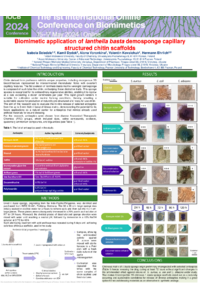
In this study, we investigated the characteristics of 3D microtubular I. basta sponge chitin, assessing its potential as a derived capillary system [2]. Various model liquids, including corresponding solutions of brilliant green (Fig.1), gentian violet, rivanol, iodine, potassium permanganate, decamethoxine, polyhexanide, as well as sea buckthorn oil and bromotyrosine—glycerin extract, were selected due to their antibacterial properties. The scaffolds, treated with these solutions, were evaluated against clinical Gram-positive and Gram-negative bacterial strains, as well as fungi.
Results
The results showed zones of growth retardation for brilliant green, gentian violet, decamethoxine, and polyhexanide solutions. Notably, chitin matrices impregnated with antiseptic solutions retained their antibacterial properties for more than 72 hours and effectively transmitted these properties to fresh microbial cultures.
Conclusions
The results with diverse antiseptics impregnated with chitin scaffolds demonstrate considerable potential as an innovative material for wound dressing applications and controlled drug release.
Keywords
chitin scaffolds
capillary actions
antiseptics
wound dressing
Poster
Dziedzic Izabela poster Biomimetics conference.pdf
Microstructure and Hydrophobicity of the Wing Surface of Some Moths
Extreme biomimetic approach: melting of steel and copper on carbonised 3D spongin scaffolds