Event submissions
Published
This submission belongs to the session S3. Biomimetic Surfaces and Interfaces of the event The 1st International Online Conference on Biomimetics
Published date
15 May, 2024
Academic Editor
'%3e%3cpath%20d='M12.6657%2010.9104C12.4185%2010.325%2012.0599%209.79327%2011.6097%209.34482C11.1609%208.89508%2010.6293%208.5365%2010.0442%208.28888C10.0389%208.28626%2010.0337%208.28495%2010.0285%208.28233C10.8446%207.69279%2011.3752%206.73249%2011.3752%205.64904C11.3752%203.8542%209.92103%202.39999%208.1262%202.39999C6.33136%202.39999%204.87715%203.8542%204.87715%205.64904C4.87715%206.73249%205.40774%207.69279%206.22393%208.28364C6.21869%208.28626%206.21345%208.28757%206.20821%208.29019C5.62129%208.5378%205.09463%208.89284%204.64265%209.34613C4.1929%209.79493%203.83432%2010.3266%203.58671%2010.9117C3.34345%2011.4845%203.21226%2012.0987%203.20023%2012.7209C3.19988%2012.7349%203.20233%2012.7488%203.20744%2012.7619C3.21255%2012.7749%203.22022%2012.7867%203.22998%2012.7968C3.23975%2012.8068%203.25142%2012.8147%203.26431%2012.8202C3.2772%2012.8256%203.29105%2012.8284%203.30504%2012.8284H4.09109C4.14874%2012.8284%204.19459%2012.7825%204.1959%2012.7262C4.2221%2011.7148%204.62823%2010.7676%205.34617%2010.0497C6.08899%209.30683%207.0755%208.89808%208.1262%208.89808C9.17689%208.89808%2010.1634%209.30683%2010.9062%2010.0497C11.6242%2010.7676%2012.0303%2011.7148%2012.0565%2012.7262C12.0578%2012.7838%2012.1037%2012.8284%2012.1613%2012.8284H12.9474C12.9613%2012.8284%2012.9752%2012.8256%2012.9881%2012.8202C13.001%2012.8147%2013.0126%2012.8068%2013.0224%2012.7968C13.0322%2012.7867%2013.0398%2012.7749%2013.0449%2012.7619C13.0501%2012.7488%2013.0525%2012.7349%2013.0522%2012.7209C13.0391%2012.0947%2012.9094%2011.4855%2012.6657%2010.9104ZM8.1262%207.9024C7.52486%207.9024%206.9589%207.6679%206.53312%207.24211C6.10733%206.81633%205.87283%206.25037%205.87283%205.64904C5.87283%205.0477%206.10733%204.48174%206.53312%204.05596C6.9589%203.63018%207.52486%203.39567%208.1262%203.39567C8.72753%203.39567%209.29349%203.63018%209.71927%204.05596C10.1451%204.48174%2010.3796%205.0477%2010.3796%205.64904C10.3796%206.25037%2010.1451%206.81633%209.71927%207.24211C9.29349%207.6679%208.72753%207.9024%208.1262%207.9024Z'%20fill='%235D1EE1'/%3e%3c/g%3e%3c/svg%3e) Yongmei Zheng
Yongmei ZhengCitation
Pimpet Sratong-on, Kanyarat Puttawongsakul, Nawin Kantawee, The growth of mycelium covering with sufficient oxygen permeation of PVC plastic food wrap, in Proceedings of The 1st International Online Conference on Biomimetics, 15 May–17 May 2024, MDPI: Basel, Switzerland
Share
Email
Facebook
Twitter
LinkedIn
The growth of mycelium covering with sufficient oxygen permeation of PVC plastic food wrap
'%3e%3cpath%20d='M12.6647%2010.9104C12.4176%2010.325%2012.0589%209.7933%2011.6088%209.34485C11.16%208.89511%2010.6283%208.53653%2010.0432%208.28891C10.038%208.28629%2010.0327%208.28498%2010.0275%208.28236C10.8437%207.69282%2011.3743%206.73252%2011.3743%205.64907C11.3743%203.85423%209.92005%202.40002%208.12522%202.40002C6.33038%202.40002%204.87618%203.85423%204.87618%205.64907C4.87618%206.73252%205.40677%207.69282%206.22296%208.28367C6.21772%208.28629%206.21248%208.2876%206.20724%208.29022C5.62031%208.53783%205.09365%208.89287%204.64167%209.34616C4.19192%209.79496%203.83334%2010.3266%203.58573%2010.9117C3.34247%2011.4846%203.21128%2012.0987%203.19925%2012.721C3.1989%2012.735%203.20135%2012.7489%203.20646%2012.7619C3.21157%2012.7749%203.21924%2012.7868%203.22901%2012.7968C3.23877%2012.8068%203.25045%2012.8148%203.26334%2012.8202C3.27623%2012.8256%203.29007%2012.8284%203.30406%2012.8284H4.09012C4.14776%2012.8284%204.19362%2012.7825%204.19493%2012.7262C4.22113%2011.7148%204.62726%2010.7676%205.34519%2010.0497C6.08802%209.30686%207.07452%208.89811%208.12522%208.89811C9.17592%208.89811%2010.1624%209.30686%2010.9052%2010.0497C11.6232%2010.7676%2012.0293%2011.7148%2012.0555%2012.7262C12.0568%2012.7839%2012.1027%2012.8284%2012.1603%2012.8284H12.9464C12.9604%2012.8284%2012.9742%2012.8256%2012.9871%2012.8202C13%2012.8148%2013.0117%2012.8068%2013.0214%2012.7968C13.0312%2012.7868%2013.0389%2012.7749%2013.044%2012.7619C13.0491%2012.7489%2013.0515%2012.735%2013.0512%2012.721C13.0381%2012.0947%2012.9084%2011.4856%2012.6647%2010.9104ZM8.12522%207.90243C7.52388%207.90243%206.95792%207.66793%206.53214%207.24215C6.10636%206.81636%205.87185%206.2504%205.87185%205.64907C5.87185%205.04773%206.10636%204.48177%206.53214%204.05599C6.95792%203.63021%207.52388%203.3957%208.12522%203.3957C8.72655%203.3957%209.29252%203.63021%209.7183%204.05599C10.1441%204.48177%2010.3786%205.04773%2010.3786%205.64907C10.3786%206.2504%2010.1441%206.81636%209.7183%207.24215C9.29252%207.66793%208.72655%207.90243%208.12522%207.90243Z'%20fill='%235D1EE1'/%3e%3c/g%3e%3c/svg%3e)
Pimpet Sratong-on 1
Kanyarat Puttawongsakul 1
Nawin Kantawee 1
1. Composite Materials and Lightweight Structures Laboratory, Faculty of Engineering, Thai-Nichi Institute of Technology, Bangkok 10250 Thailand.
Abstract
Mycelium-based composite (MBC) consists of the filamentous fungi of mushrooms, mycelium, forming a network with biodegradable agro-waste particles. MBC can be shaped in plastic molds; however, a higher density of mycelium was observed at the MBC surface exposed to the air (MBC/Air) than the MBC contact with plastic mold (MBC/Mold). Consequently, MBC was demolded to obtain uniform growth of mycelium on the substrate. This study investigated the effect of the oxygen transmission rate (OTR) of two different thin film materials, PVC plastic food wrap and stencil paper, on the growth of the mycelium of oyster mushrooms on sawdust. Each thin film was covered between the MBC and polypropylene (PP) mold in configurations of MBC/Film/PP Mold. The OTR of thin films was measured according to ASTM D3985. The results were compared with the OTR of a rigid PVC tube, PET-G, and PP cast, which were used as molds for shaping the MBC in previous literature. It was found that the mycelium was of a higher density in MBC/PVC film/PP and MBC/stencil paper/PP than the top surface of MBC/Air. The OTRs of stencil paper and PVC film were 11,777.78 cc-mm/m2/day and 143.88 cc-mm/m2/day, respectively, which were higher than those of the rigid PVC tube (3 cc-mm/m2/day), PET-G (9.7 cc-mm/m2/day), and PP cast (76 cc-mm/m2/day). Despite the higher OTR found in stencil paper than in PVC film, the mycelium at MBC/PVC film/PP was denser than MBC/stencil paper/PP. This suggested that sufficient oxygen transmission through film contact with the MBC surface was necessary for the mycelium to grow homogeneously. Shaping the complex geometry of MBC can be possible without using the rigid plastic mold, yet only PVC plastic wrap is acceptable. The mechanical properties of MBC will be further investigated.
Keywords
Mycelium-based composite
Oxygen transmission rate
Thin film
Bio-based materials
Fungal biocomposite
Poster
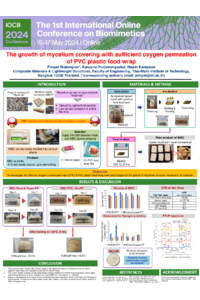
Pimpet-poster-IOCB2024.pdf
Bio-inspired design of lightweight and high-strength fiber-reinforced polymer composites for structural applications
Biomimetic approaches for design of antimicrobial paper barrier coatings with hierarchical surface structure