Event submissions
Published
This submission belongs to the session S2. Biomimetic Design, Constructions and Devices of the event The 1st International Online Conference on Biomimetics
Published date
15 May, 2024
Academic Editor
'%3e%3cpath%20d='M12.6657%2010.9104C12.4185%2010.325%2012.0599%209.79327%2011.6097%209.34482C11.1609%208.89508%2010.6293%208.5365%2010.0442%208.28888C10.0389%208.28626%2010.0337%208.28495%2010.0285%208.28233C10.8446%207.69279%2011.3752%206.73249%2011.3752%205.64904C11.3752%203.8542%209.92103%202.39999%208.1262%202.39999C6.33136%202.39999%204.87715%203.8542%204.87715%205.64904C4.87715%206.73249%205.40774%207.69279%206.22393%208.28364C6.21869%208.28626%206.21345%208.28757%206.20821%208.29019C5.62129%208.5378%205.09463%208.89284%204.64265%209.34613C4.1929%209.79493%203.83432%2010.3266%203.58671%2010.9117C3.34345%2011.4845%203.21226%2012.0987%203.20023%2012.7209C3.19988%2012.7349%203.20233%2012.7488%203.20744%2012.7619C3.21255%2012.7749%203.22022%2012.7867%203.22998%2012.7968C3.23975%2012.8068%203.25142%2012.8147%203.26431%2012.8202C3.2772%2012.8256%203.29105%2012.8284%203.30504%2012.8284H4.09109C4.14874%2012.8284%204.19459%2012.7825%204.1959%2012.7262C4.2221%2011.7148%204.62823%2010.7676%205.34617%2010.0497C6.08899%209.30683%207.0755%208.89808%208.1262%208.89808C9.17689%208.89808%2010.1634%209.30683%2010.9062%2010.0497C11.6242%2010.7676%2012.0303%2011.7148%2012.0565%2012.7262C12.0578%2012.7838%2012.1037%2012.8284%2012.1613%2012.8284H12.9474C12.9613%2012.8284%2012.9752%2012.8256%2012.9881%2012.8202C13.001%2012.8147%2013.0126%2012.8068%2013.0224%2012.7968C13.0322%2012.7867%2013.0398%2012.7749%2013.0449%2012.7619C13.0501%2012.7488%2013.0525%2012.7349%2013.0522%2012.7209C13.0391%2012.0947%2012.9094%2011.4855%2012.6657%2010.9104ZM8.1262%207.9024C7.52486%207.9024%206.9589%207.6679%206.53312%207.24211C6.10733%206.81633%205.87283%206.25037%205.87283%205.64904C5.87283%205.0477%206.10733%204.48174%206.53312%204.05596C6.9589%203.63018%207.52486%203.39567%208.1262%203.39567C8.72753%203.39567%209.29349%203.63018%209.71927%204.05596C10.1451%204.48174%2010.3796%205.0477%2010.3796%205.64904C10.3796%206.25037%2010.1451%206.81633%209.71927%207.24211C9.29349%207.6679%208.72753%207.9024%208.1262%207.9024Z'%20fill='%235D1EE1'/%3e%3c/g%3e%3c/svg%3e) Marc Weissburg
Marc WeissburgCitation
Ahmed Fatimi, Biomimetic hydrogel-based electronic skin: An overview based on patent analysis, in Proceedings of The 1st International Online Conference on Biomimetics, 15 May–17 May 2024, MDPI: Basel, Switzerland
Share
Email
Facebook
Twitter
LinkedIn
Biomimetic hydrogel-based electronic skin: An overview based on patent analysis

Ahmed Fatimi 1
1. Chemical Science and Engineering Research Team (ERSIC), Department of Chemistry, Polydisciplinary Faculty of Beni Mellal (FPBM), Sultan Moulay Slimane University (USMS), Mghila, Beni Mellal 23000, Morocco
Abstract
Introduction
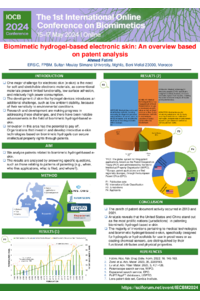
One major challenge for electronic skin (e-skin) is the need for soft and stretchable electronic materials, as conventional materials present limited functionality, low surface adhesion, and relatively high power consumption. The development of skin-like hydrogel devices introduces additional challenges, such as low ambient stability, because of their sensitivity to environmental conditions. Research and development are making progress in addressing these challenges, and there have been notable advancements in the field of biomimetic hydrogel-based e-skin. Innovations in this area have the potential to pay off. Organizations that invest in and develop innovative e-skin technologies based on biomimetic hydrogels can secure intellectual property rights through patents. In this regard, this work is dedicated to reviewing the state-of-the-art by presenting what has been patented in regards to biomimetic hydrogel-based e-skin.
Methods
Different patent databases were employed, utilizing diverse sets of keywords and associated terms. Searches were carried out based on patent titles, abstracts, and claims to ensure the comprehensive coverage and retrieval of relevant information. The search was then filtered regarding publication year, jurisdiction, and patent classifications.
Results
The inception of biomimetic hydrogel-based e-skin patenting can be precisely traced back to the earliest priority date, pinpointing 1988 as the commencement year. Notably, the zenith of patent document activity occurred in 2013 and 2021. Analysis reveals that the United States and China stand out as the most prolific nations in patenting biomimetic hydrogel-based e-skin. The majority of inventions pertaining to biomimetic hydrogel-based e-skin, specifically designed for hydrogels or hydrocolloids for use in prostheses or as coating chemical sensors, are distinguished by their functional attributes and physical properties.
Conclusions
This work, which offers a competitive analysis spanning trends in biomimetic hydrogel-based e-skin, provides several recommendations aimed at guiding the formulation of innovative research strategies.
Keywords
e-skin
hydrogels
biomimicry
innovation
patent
Poster
IOCB 2024_ppt_e-skin.pdf
Enhancing grasping abilities through a novel and affordable hybrid exoskeleton glove for hand rehabilitation
Analyzing the tribological combination of microstructure and lubricant in beetle joints for the development of environmentally friendly lubricants