Event submissions
Published
This submission belongs to the session S1. Biomimetics of Materials and Structures of the event The 1st International Online Conference on Biomimetics
Published date
15 May, 2024
Academic Editor
'%3e%3cpath%20d='M12.6657%2010.9104C12.4185%2010.325%2012.0599%209.79327%2011.6097%209.34482C11.1609%208.89508%2010.6293%208.5365%2010.0442%208.28888C10.0389%208.28626%2010.0337%208.28495%2010.0285%208.28233C10.8446%207.69279%2011.3752%206.73249%2011.3752%205.64904C11.3752%203.8542%209.92103%202.39999%208.1262%202.39999C6.33136%202.39999%204.87715%203.8542%204.87715%205.64904C4.87715%206.73249%205.40774%207.69279%206.22393%208.28364C6.21869%208.28626%206.21345%208.28757%206.20821%208.29019C5.62129%208.5378%205.09463%208.89284%204.64265%209.34613C4.1929%209.79493%203.83432%2010.3266%203.58671%2010.9117C3.34345%2011.4845%203.21226%2012.0987%203.20023%2012.7209C3.19988%2012.7349%203.20233%2012.7488%203.20744%2012.7619C3.21255%2012.7749%203.22022%2012.7867%203.22998%2012.7968C3.23975%2012.8068%203.25142%2012.8147%203.26431%2012.8202C3.2772%2012.8256%203.29105%2012.8284%203.30504%2012.8284H4.09109C4.14874%2012.8284%204.19459%2012.7825%204.1959%2012.7262C4.2221%2011.7148%204.62823%2010.7676%205.34617%2010.0497C6.08899%209.30683%207.0755%208.89808%208.1262%208.89808C9.17689%208.89808%2010.1634%209.30683%2010.9062%2010.0497C11.6242%2010.7676%2012.0303%2011.7148%2012.0565%2012.7262C12.0578%2012.7838%2012.1037%2012.8284%2012.1613%2012.8284H12.9474C12.9613%2012.8284%2012.9752%2012.8256%2012.9881%2012.8202C13.001%2012.8147%2013.0126%2012.8068%2013.0224%2012.7968C13.0322%2012.7867%2013.0398%2012.7749%2013.0449%2012.7619C13.0501%2012.7488%2013.0525%2012.7349%2013.0522%2012.7209C13.0391%2012.0947%2012.9094%2011.4855%2012.6657%2010.9104ZM8.1262%207.9024C7.52486%207.9024%206.9589%207.6679%206.53312%207.24211C6.10733%206.81633%205.87283%206.25037%205.87283%205.64904C5.87283%205.0477%206.10733%204.48174%206.53312%204.05596C6.9589%203.63018%207.52486%203.39567%208.1262%203.39567C8.72753%203.39567%209.29349%203.63018%209.71927%204.05596C10.1451%204.48174%2010.3796%205.0477%2010.3796%205.64904C10.3796%206.25037%2010.1451%206.81633%209.71927%207.24211C9.29349%207.6679%208.72753%207.9024%208.1262%207.9024Z'%20fill='%235D1EE1'/%3e%3c/g%3e%3c/svg%3e) Giuseppe Carbone
Giuseppe CarboneCitation
Noelia Laura D'Elía, Javier Sartuqui, Damian Placente, Pablo Postemsky, Paula Messina, A bioinspired material for bone tissue regeneration: The use of Ganoderma sessile mycelium as a microstructure director, in Proceedings of The 1st International Online Conference on Biomimetics, 15 May–17 May 2024, MDPI: Basel, Switzerland
Share
Email
Facebook
Twitter
LinkedIn
A bioinspired material for bone tissue regeneration: The use of Ganoderma sessile mycelium as a microstructure director
'%3e%3cpath%20d='M12.6647%2010.9104C12.4176%2010.325%2012.0589%209.7933%2011.6088%209.34485C11.16%208.89511%2010.6283%208.53653%2010.0432%208.28891C10.038%208.28629%2010.0327%208.28498%2010.0275%208.28236C10.8437%207.69282%2011.3743%206.73252%2011.3743%205.64907C11.3743%203.85423%209.92005%202.40002%208.12522%202.40002C6.33038%202.40002%204.87618%203.85423%204.87618%205.64907C4.87618%206.73252%205.40677%207.69282%206.22296%208.28367C6.21772%208.28629%206.21248%208.2876%206.20724%208.29022C5.62031%208.53783%205.09365%208.89287%204.64167%209.34616C4.19192%209.79496%203.83334%2010.3266%203.58573%2010.9117C3.34247%2011.4846%203.21128%2012.0987%203.19925%2012.721C3.1989%2012.735%203.20135%2012.7489%203.20646%2012.7619C3.21157%2012.7749%203.21924%2012.7868%203.22901%2012.7968C3.23877%2012.8068%203.25045%2012.8148%203.26334%2012.8202C3.27623%2012.8256%203.29007%2012.8284%203.30406%2012.8284H4.09012C4.14776%2012.8284%204.19362%2012.7825%204.19493%2012.7262C4.22113%2011.7148%204.62726%2010.7676%205.34519%2010.0497C6.08802%209.30686%207.07452%208.89811%208.12522%208.89811C9.17592%208.89811%2010.1624%209.30686%2010.9052%2010.0497C11.6232%2010.7676%2012.0293%2011.7148%2012.0555%2012.7262C12.0568%2012.7839%2012.1027%2012.8284%2012.1603%2012.8284H12.9464C12.9604%2012.8284%2012.9742%2012.8256%2012.9871%2012.8202C13%2012.8148%2013.0117%2012.8068%2013.0214%2012.7968C13.0312%2012.7868%2013.0389%2012.7749%2013.044%2012.7619C13.0491%2012.7489%2013.0515%2012.735%2013.0512%2012.721C13.0381%2012.0947%2012.9084%2011.4856%2012.6647%2010.9104ZM8.12522%207.90243C7.52388%207.90243%206.95792%207.66793%206.53214%207.24215C6.10636%206.81636%205.87185%206.2504%205.87185%205.64907C5.87185%205.04773%206.10636%204.48177%206.53214%204.05599C6.95792%203.63021%207.52388%203.3957%208.12522%203.3957C8.72655%203.3957%209.29252%203.63021%209.7183%204.05599C10.1441%204.48177%2010.3786%205.04773%2010.3786%205.64907C10.3786%206.2504%2010.1441%206.81636%209.7183%207.24215C9.29252%207.66793%208.72655%207.90243%208.12522%207.90243Z'%20fill='%235D1EE1'/%3e%3c/g%3e%3c/svg%3e)
Noelia Laura D'Elía 1
Javier Sartuqui 1
Damian Placente 1
Pablo Postemsky 2
Paula Messina 1
1. INQUISUR─CONICET, Department of Chemistry, Universidad Nacional del Sur, CPB B8000 Bahía Blanca, Argentina
2. Laboratory of Biotechnology of Edible and Medicinal Mushrooms, Centro de Recursos Naturales Renovables de la Zona Semiárida (CERZOS-UNS/CONICET), Camino de La Carrindaga Km7, 8000 Bahía Blanca, Buenos Aires, Argentina.
Abstract
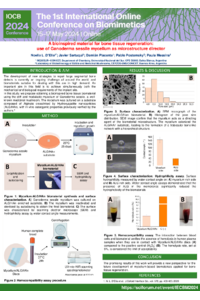
Introduction. The development of new strategies to repair large segmental bone defects is currently an ongoing challenge all around the world, and biomaterials suitable for dealing with this are in high demand. An important aim in this field is to achieve simultaneously both the mechanical and biological requirements of the implant site.
Methodology. In this study, we propose obtaining a bioinspired bone tissue substitute using the stiff and modulable mycelium of Ganoderma sessile. The mycelium was cultured on a substrate composed of alginate crosslinked by hydroxyapatite nanoparticles (ALG-HAn), with in vitro osteogenic properties previously verified by the authors. Then, the mycelium was inactivated and sterilized by autoclaving to obtain the final biomaterial.
Results. Using scanning electron microscopy (SEM), it was possible to confirm that the mycelium acts as a directing agent of the biomaterial microstructure. The mycelium colonized the ALG-HAn substrate, leading to the formation of a trabecular bone-like network with a hierarchical structure. Moreover, static water contact angle assays demonstrated that the presence of ALG in the membranes significantly reduced the hydrophobicity of the biomaterials. Finally, to test the interaction between blood cells and biomaterial, we verify the lack of hemolysis in human plasma samples.
Conclusion. The promising results of this work will provide a new perspective for the future development of mycelium-based biomaterials applied for bone tissue regeneration.
Keywords
Mycelium
alginate
hydroxyapatite
Ganoderma
Poster
2024 POSTER D'Elía et al. The 1st International Online Conference on Biomimetics.pdf
Influence of Bionic Leading-edge Protuberances on the Horizontal Axis Wind Turbine
Tailoring Wettability Control of Superhydrophobic Metallic Surface via Sustainable Fabrication Approach