Event submissions
Published
This submission belongs to the session D. Chemical Processes and Systems of the event The 3rd International Electronic Conference on Processes
Published date
27 May, 2024
Academic Editor
'%3e%3cpath%20d='M12.6657%2010.9104C12.4185%2010.325%2012.0599%209.79327%2011.6097%209.34482C11.1609%208.89508%2010.6293%208.5365%2010.0442%208.28888C10.0389%208.28626%2010.0337%208.28495%2010.0285%208.28233C10.8446%207.69279%2011.3752%206.73249%2011.3752%205.64904C11.3752%203.8542%209.92103%202.39999%208.1262%202.39999C6.33136%202.39999%204.87715%203.8542%204.87715%205.64904C4.87715%206.73249%205.40774%207.69279%206.22393%208.28364C6.21869%208.28626%206.21345%208.28757%206.20821%208.29019C5.62129%208.5378%205.09463%208.89284%204.64265%209.34613C4.1929%209.79493%203.83432%2010.3266%203.58671%2010.9117C3.34345%2011.4845%203.21226%2012.0987%203.20023%2012.7209C3.19988%2012.7349%203.20233%2012.7488%203.20744%2012.7619C3.21255%2012.7749%203.22022%2012.7867%203.22998%2012.7968C3.23975%2012.8068%203.25142%2012.8147%203.26431%2012.8202C3.2772%2012.8256%203.29105%2012.8284%203.30504%2012.8284H4.09109C4.14874%2012.8284%204.19459%2012.7825%204.1959%2012.7262C4.2221%2011.7148%204.62823%2010.7676%205.34617%2010.0497C6.08899%209.30683%207.0755%208.89808%208.1262%208.89808C9.17689%208.89808%2010.1634%209.30683%2010.9062%2010.0497C11.6242%2010.7676%2012.0303%2011.7148%2012.0565%2012.7262C12.0578%2012.7838%2012.1037%2012.8284%2012.1613%2012.8284H12.9474C12.9613%2012.8284%2012.9752%2012.8256%2012.9881%2012.8202C13.001%2012.8147%2013.0126%2012.8068%2013.0224%2012.7968C13.0322%2012.7867%2013.0398%2012.7749%2013.0449%2012.7619C13.0501%2012.7488%2013.0525%2012.7349%2013.0522%2012.7209C13.0391%2012.0947%2012.9094%2011.4855%2012.6657%2010.9104ZM8.1262%207.9024C7.52486%207.9024%206.9589%207.6679%206.53312%207.24211C6.10733%206.81633%205.87283%206.25037%205.87283%205.64904C5.87283%205.0477%206.10733%204.48174%206.53312%204.05596C6.9589%203.63018%207.52486%203.39567%208.1262%203.39567C8.72753%203.39567%209.29349%203.63018%209.71927%204.05596C10.1451%204.48174%2010.3796%205.0477%2010.3796%205.64904C10.3796%206.25037%2010.1451%206.81633%209.71927%207.24211C9.29349%207.6679%208.72753%207.9024%208.1262%207.9024Z'%20fill='%235D1EE1'/%3e%3c/g%3e%3c/svg%3e) Blaž Likozar
Blaž LikozarCitation
Isaya Thaveesangsakulthai, Sorrawit Songsathitmetha, Nafisat Lawal, Chadin Kulsing, Development of Electrocoagulation system of fuel using supporting medium for identification of volatile compound products, in Proceedings of The 3rd International Electronic Conference on Processes, 29 May–31 May 2024, MDPI: Basel, Switzerland
Share
Email
Facebook
Twitter
LinkedIn
Development of Electrocoagulation system of fuel using supporting medium for identification of volatile compound products
'%3e%3cpath%20d='M12.6647%2010.9104C12.4176%2010.325%2012.0589%209.7933%2011.6088%209.34485C11.16%208.89511%2010.6283%208.53653%2010.0432%208.28891C10.038%208.28629%2010.0327%208.28498%2010.0275%208.28236C10.8437%207.69282%2011.3743%206.73252%2011.3743%205.64907C11.3743%203.85423%209.92005%202.40002%208.12522%202.40002C6.33038%202.40002%204.87618%203.85423%204.87618%205.64907C4.87618%206.73252%205.40677%207.69282%206.22296%208.28367C6.21772%208.28629%206.21248%208.2876%206.20724%208.29022C5.62031%208.53783%205.09365%208.89287%204.64167%209.34616C4.19192%209.79496%203.83334%2010.3266%203.58573%2010.9117C3.34247%2011.4846%203.21128%2012.0987%203.19925%2012.721C3.1989%2012.735%203.20135%2012.7489%203.20646%2012.7619C3.21157%2012.7749%203.21924%2012.7868%203.22901%2012.7968C3.23877%2012.8068%203.25045%2012.8148%203.26334%2012.8202C3.27623%2012.8256%203.29007%2012.8284%203.30406%2012.8284H4.09012C4.14776%2012.8284%204.19362%2012.7825%204.19493%2012.7262C4.22113%2011.7148%204.62726%2010.7676%205.34519%2010.0497C6.08802%209.30686%207.07452%208.89811%208.12522%208.89811C9.17592%208.89811%2010.1624%209.30686%2010.9052%2010.0497C11.6232%2010.7676%2012.0293%2011.7148%2012.0555%2012.7262C12.0568%2012.7839%2012.1027%2012.8284%2012.1603%2012.8284H12.9464C12.9604%2012.8284%2012.9742%2012.8256%2012.9871%2012.8202C13%2012.8148%2013.0117%2012.8068%2013.0214%2012.7968C13.0312%2012.7868%2013.0389%2012.7749%2013.044%2012.7619C13.0491%2012.7489%2013.0515%2012.735%2013.0512%2012.721C13.0381%2012.0947%2012.9084%2011.4856%2012.6647%2010.9104ZM8.12522%207.90243C7.52388%207.90243%206.95792%207.66793%206.53214%207.24215C6.10636%206.81636%205.87185%206.2504%205.87185%205.64907C5.87185%205.04773%206.10636%204.48177%206.53214%204.05599C6.95792%203.63021%207.52388%203.3957%208.12522%203.3957C8.72655%203.3957%209.29252%203.63021%209.7183%204.05599C10.1441%204.48177%2010.3786%205.04773%2010.3786%205.64907C10.3786%206.2504%2010.1441%206.81636%209.7183%207.24215C9.29252%207.66793%208.72655%207.90243%208.12522%207.90243Z'%20fill='%235D1EE1'/%3e%3c/g%3e%3c/svg%3e)
Isaya Thaveesangsakulthai 1
Sorrawit Songsathitmetha 2
Nafisat Lawal 1
Chadin Kulsing 1
1. Department of Chemistry, Faculty of Science, Chulalongkorn University
2. Department of Pathology, Faculty of Veterinary Science, Chulalongkorn University, Bangkok, Thailand
Abstract
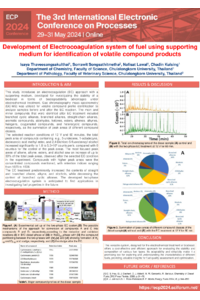
This study introduces an electrocoagulation (EC) approach with a supporting medium, developed for investigating the stability of a biodiesel in terms of biodegradability advantages under electrochemical treatment. Gas chromatography–mass spectrometry (GC-MS) was utilized for volatile compound profile identification to analyze samples before and after the EC reaction. The main and minor compounds that were identified after EC treatment included branched cyclic alkanes, branched alkanes, straight-chain alkanes, aromatic compounds, aldehydes, ketones, esters, alkenes, alkynes, halogens, oxygenated compounds, and heterocyclic compounds, respectively, as the summation of peak areas of different compound classes.
Under the selected reaction conditions of 12 V and 60 minutes, the total peak area of compounds containing, e.g., 5-undecene, 1-octadecyne, dodecanoic acid methyl ester, and 2,4-Dichloro-5-fluorobenzyl alcohol increased significantly to 1.8 to 5.5×10⁹ counts per/s, compared with 0 counts/s for the control of the peak areas. The most focused peak areas of alkene, alkyne, esters, and alcohol saw an increase of up to 33% of the total peak areas, observed after the selected EC condition in the experiment. Compounds with higher peak areas were the concentrated compounds mentioned, with retention indices ranging from 1073 to 1506.
The EC treatment predominantly increased the contents of straight and branched alkene, alkyne, and alcohols, while decreasing the content of branched cyclic alkanes. The developed two-phase electrocoagulation system is anticipated to find applications in investigating fuel properties in the future. This versatile system, designed for the electrochemical treatment of biodiesel, offers a cost-effective and efficient approach for evaluating the stability and composition of various fuel types. Its adaptability and simplicity make it a promising tool for exploring and understanding the characteristics of different fuels, providing valuable insights for fuel quality assessment and optimization.
Keywords
Electrocoagulation
fuel
volatile compounds
HS-SPME
GC-MS
Poster
ECP 2024 – Confirmed Poster for Gallery - sciforum-088211.pdf
Sensors in Alternative Samples: A Powerful Tool in Forensic Toxicology
ROBUST ZINC METAL–ORGANIC FRAMEWORK-5 FOR SELECTIVE LANDFILL METHANE CAPTURE: SYNTHESIS AND PHYSICOCHEMICAL PROPERTY ANALYSIS