Event submissions
Published
This submission belongs to the session A. Environmental and Green Processes of the event The 3rd International Electronic Conference on Processes
Published date
27 May, 2024
Academic Editor
'%3e%3cpath%20d='M12.6657%2010.9104C12.4185%2010.325%2012.0599%209.79327%2011.6097%209.34482C11.1609%208.89508%2010.6293%208.5365%2010.0442%208.28888C10.0389%208.28626%2010.0337%208.28495%2010.0285%208.28233C10.8446%207.69279%2011.3752%206.73249%2011.3752%205.64904C11.3752%203.8542%209.92103%202.39999%208.1262%202.39999C6.33136%202.39999%204.87715%203.8542%204.87715%205.64904C4.87715%206.73249%205.40774%207.69279%206.22393%208.28364C6.21869%208.28626%206.21345%208.28757%206.20821%208.29019C5.62129%208.5378%205.09463%208.89284%204.64265%209.34613C4.1929%209.79493%203.83432%2010.3266%203.58671%2010.9117C3.34345%2011.4845%203.21226%2012.0987%203.20023%2012.7209C3.19988%2012.7349%203.20233%2012.7488%203.20744%2012.7619C3.21255%2012.7749%203.22022%2012.7867%203.22998%2012.7968C3.23975%2012.8068%203.25142%2012.8147%203.26431%2012.8202C3.2772%2012.8256%203.29105%2012.8284%203.30504%2012.8284H4.09109C4.14874%2012.8284%204.19459%2012.7825%204.1959%2012.7262C4.2221%2011.7148%204.62823%2010.7676%205.34617%2010.0497C6.08899%209.30683%207.0755%208.89808%208.1262%208.89808C9.17689%208.89808%2010.1634%209.30683%2010.9062%2010.0497C11.6242%2010.7676%2012.0303%2011.7148%2012.0565%2012.7262C12.0578%2012.7838%2012.1037%2012.8284%2012.1613%2012.8284H12.9474C12.9613%2012.8284%2012.9752%2012.8256%2012.9881%2012.8202C13.001%2012.8147%2013.0126%2012.8068%2013.0224%2012.7968C13.0322%2012.7867%2013.0398%2012.7749%2013.0449%2012.7619C13.0501%2012.7488%2013.0525%2012.7349%2013.0522%2012.7209C13.0391%2012.0947%2012.9094%2011.4855%2012.6657%2010.9104ZM8.1262%207.9024C7.52486%207.9024%206.9589%207.6679%206.53312%207.24211C6.10733%206.81633%205.87283%206.25037%205.87283%205.64904C5.87283%205.0477%206.10733%204.48174%206.53312%204.05596C6.9589%203.63018%207.52486%203.39567%208.1262%203.39567C8.72753%203.39567%209.29349%203.63018%209.71927%204.05596C10.1451%204.48174%2010.3796%205.0477%2010.3796%205.64904C10.3796%206.25037%2010.1451%206.81633%209.71927%207.24211C9.29349%207.6679%208.72753%207.9024%208.1262%207.9024Z'%20fill='%235D1EE1'/%3e%3c/g%3e%3c/svg%3e) Rafal Gieleciak
Rafal GieleciakCitation
Dragica Đurđević-Milošević, Andrijana Miodrag Petrović, Vesna Kalaba, Milka Stijepić, Gordana Jovanović, SELECTED ASPECTS OF THE ANTIBACTERIAL USE OF LACTIC ACID IN FOOD PROCESSING, in Proceedings of The 3rd International Electronic Conference on Processes, 29 May–31 May 2024, MDPI: Basel, Switzerland
Share
Email
Facebook
Twitter
LinkedIn
SELECTED ASPECTS OF THE ANTIBACTERIAL USE OF LACTIC ACID IN FOOD PROCESSING

Dragica Đurđević-Milošević 1
'%3e%3cpath%20d='M12.6647%2010.9104C12.4176%2010.325%2012.0589%209.7933%2011.6088%209.34485C11.16%208.89511%2010.6283%208.53653%2010.0432%208.28891C10.038%208.28629%2010.0327%208.28498%2010.0275%208.28236C10.8437%207.69282%2011.3743%206.73252%2011.3743%205.64907C11.3743%203.85423%209.92005%202.40002%208.12522%202.40002C6.33038%202.40002%204.87618%203.85423%204.87618%205.64907C4.87618%206.73252%205.40677%207.69282%206.22296%208.28367C6.21772%208.28629%206.21248%208.2876%206.20724%208.29022C5.62031%208.53783%205.09365%208.89287%204.64167%209.34616C4.19192%209.79496%203.83334%2010.3266%203.58573%2010.9117C3.34247%2011.4846%203.21128%2012.0987%203.19925%2012.721C3.1989%2012.735%203.20135%2012.7489%203.20646%2012.7619C3.21157%2012.7749%203.21924%2012.7868%203.22901%2012.7968C3.23877%2012.8068%203.25045%2012.8148%203.26334%2012.8202C3.27623%2012.8256%203.29007%2012.8284%203.30406%2012.8284H4.09012C4.14776%2012.8284%204.19362%2012.7825%204.19493%2012.7262C4.22113%2011.7148%204.62726%2010.7676%205.34519%2010.0497C6.08802%209.30686%207.07452%208.89811%208.12522%208.89811C9.17592%208.89811%2010.1624%209.30686%2010.9052%2010.0497C11.6232%2010.7676%2012.0293%2011.7148%2012.0555%2012.7262C12.0568%2012.7839%2012.1027%2012.8284%2012.1603%2012.8284H12.9464C12.9604%2012.8284%2012.9742%2012.8256%2012.9871%2012.8202C13%2012.8148%2013.0117%2012.8068%2013.0214%2012.7968C13.0312%2012.7868%2013.0389%2012.7749%2013.044%2012.7619C13.0491%2012.7489%2013.0515%2012.735%2013.0512%2012.721C13.0381%2012.0947%2012.9084%2011.4856%2012.6647%2010.9104ZM8.12522%207.90243C7.52388%207.90243%206.95792%207.66793%206.53214%207.24215C6.10636%206.81636%205.87185%206.2504%205.87185%205.64907C5.87185%205.04773%206.10636%204.48177%206.53214%204.05599C6.95792%203.63021%207.52388%203.3957%208.12522%203.3957C8.72655%203.3957%209.29252%203.63021%209.7183%204.05599C10.1441%204.48177%2010.3786%205.04773%2010.3786%205.64907C10.3786%206.2504%2010.1441%206.81636%209.7183%207.24215C9.29252%207.66793%208.72655%207.90243%208.12522%207.90243Z'%20fill='%235D1EE1'/%3e%3c/g%3e%3c/svg%3e)
Andrijana Miodrag Petrović 1
Vesna Kalaba 2
Milka Stijepić 2

Gordana Jovanović 3
1. Institute of Chemistry, Technology and Microbiology, Belgrade, Serbia
2. College of Health Sciences Prijedor, Prijedor, Bosnia and Herzegovina
3. Academy of Professional Strudy Šabac, Šabac, Serbia
Abstract
Lactic acid is well known in food technology as a preservative in naturally fermented products or as a technological additive E (270) without quantity restriction. L(+)-lactic acid is authorised as an active substance for biocidal products, with applications in the fields of veterinary hygiene, food, and animal feed. Several factors can influence the antimicrobial effect of lactic acid, including the applied concentration of lactic acid, the contact time, and the organic soling of the surface to which it was applied.
The aim of this study was to evaluate the bactericidal activity of 5% (v/v) and 1% (v/v) lactic acid solutions on test bacteria: the Gram-negative strain Salmonella enterica subsp. enterica serovar Typhimurium (ATCC 14028) and the Gram-positive Staphylococcus aureus subsp. aureus (ATCC 33592), which is a strain that is resistant to gentamicin and methicillin (MRSA). A dilution–naturalization method was used, based on EN 1276, a quantitative suspension test for the evaluation of the bactericidal activity of chemical disinfectants and antiseptics used in the food, industrial, domestic, and institutional areas, with the bacterial activity being modified in part of the obligatory test organisms.
The obtained results showed no difference in the results of the tests under simulated clean and dirty conditions. Both tested concentrations of lactic acid showed a 5 lg reduction in Salmonella Typhimurium. For the tested strain Staphylococcus aureus, the required reduction of 5 lg was not achieved. These results contribute to a better understanding and rational use of lactic acid for antibacterial purposes.
Keywords
antibacterial activity
lactic acid
Salmonella Typhimurium
Staphylococcus aureus (MRSA)
Poster
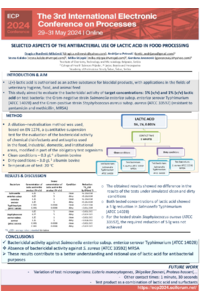
ECP 2024 – Confirmed Poster for Gallery - sciforum-090554.pdf
ROBUST ZINC METAL–ORGANIC FRAMEWORK-5 FOR SELECTIVE LANDFILL METHANE CAPTURE: SYNTHESIS AND PHYSICOCHEMICAL PROPERTY ANALYSIS
Fatty acid profile, total fat, protein, moisture and ash in different edible parts of Albacore tuna (Thunnus alalunga Bonnaterre, 1788) – Preliminary Results