Event submissions
Published
This submission belongs to the session F. Nanomaterials and Smart Surfaces in Biosensors of the event The 4th International Electronic Conference on Biosensors
Published date
28 May, 2024
Academic Editor
'%3e%3cpath%20d='M12.6657%2010.9104C12.4185%2010.325%2012.0599%209.79327%2011.6097%209.34482C11.1609%208.89508%2010.6293%208.5365%2010.0442%208.28888C10.0389%208.28626%2010.0337%208.28495%2010.0285%208.28233C10.8446%207.69279%2011.3752%206.73249%2011.3752%205.64904C11.3752%203.8542%209.92103%202.39999%208.1262%202.39999C6.33136%202.39999%204.87715%203.8542%204.87715%205.64904C4.87715%206.73249%205.40774%207.69279%206.22393%208.28364C6.21869%208.28626%206.21345%208.28757%206.20821%208.29019C5.62129%208.5378%205.09463%208.89284%204.64265%209.34613C4.1929%209.79493%203.83432%2010.3266%203.58671%2010.9117C3.34345%2011.4845%203.21226%2012.0987%203.20023%2012.7209C3.19988%2012.7349%203.20233%2012.7488%203.20744%2012.7619C3.21255%2012.7749%203.22022%2012.7867%203.22998%2012.7968C3.23975%2012.8068%203.25142%2012.8147%203.26431%2012.8202C3.2772%2012.8256%203.29105%2012.8284%203.30504%2012.8284H4.09109C4.14874%2012.8284%204.19459%2012.7825%204.1959%2012.7262C4.2221%2011.7148%204.62823%2010.7676%205.34617%2010.0497C6.08899%209.30683%207.0755%208.89808%208.1262%208.89808C9.17689%208.89808%2010.1634%209.30683%2010.9062%2010.0497C11.6242%2010.7676%2012.0303%2011.7148%2012.0565%2012.7262C12.0578%2012.7838%2012.1037%2012.8284%2012.1613%2012.8284H12.9474C12.9613%2012.8284%2012.9752%2012.8256%2012.9881%2012.8202C13.001%2012.8147%2013.0126%2012.8068%2013.0224%2012.7968C13.0322%2012.7867%2013.0398%2012.7749%2013.0449%2012.7619C13.0501%2012.7488%2013.0525%2012.7349%2013.0522%2012.7209C13.0391%2012.0947%2012.9094%2011.4855%2012.6657%2010.9104ZM8.1262%207.9024C7.52486%207.9024%206.9589%207.6679%206.53312%207.24211C6.10733%206.81633%205.87283%206.25037%205.87283%205.64904C5.87283%205.0477%206.10733%204.48174%206.53312%204.05596C6.9589%203.63018%207.52486%203.39567%208.1262%203.39567C8.72753%203.39567%209.29349%203.63018%209.71927%204.05596C10.1451%204.48174%2010.3796%205.0477%2010.3796%205.64904C10.3796%206.25037%2010.1451%206.81633%209.71927%207.24211C9.29349%207.6679%208.72753%207.9024%208.1262%207.9024Z'%20fill='%235D1EE1'/%3e%3c/g%3e%3c/svg%3e) Michael Thompson
Michael ThompsonCitation
Raffaella Signorini, Thomas Pretto, Marina Franca, Veronica Zani, Roberto Pilot, Silvia Gross, Emil Milan, Eros Radicchi, adolfo Speghini, Raman and Luminescent thermometers for determining local temperatures at the nanoscale., in Proceedings of The 4th International Electronic Conference on Biosensors, 20 May–22 May 2024, MDPI: Basel, Switzerland
Share
Email
Facebook
Twitter
LinkedIn
Raman and Luminescent thermometers for determining local temperatures at the nanoscale.

Raffaella Signorini 1,2
'%3e%3cpath%20d='M12.6647%2010.9104C12.4176%2010.325%2012.0589%209.7933%2011.6088%209.34485C11.16%208.89511%2010.6283%208.53653%2010.0432%208.28891C10.038%208.28629%2010.0327%208.28498%2010.0275%208.28236C10.8437%207.69282%2011.3743%206.73252%2011.3743%205.64907C11.3743%203.85423%209.92005%202.40002%208.12522%202.40002C6.33038%202.40002%204.87618%203.85423%204.87618%205.64907C4.87618%206.73252%205.40677%207.69282%206.22296%208.28367C6.21772%208.28629%206.21248%208.2876%206.20724%208.29022C5.62031%208.53783%205.09365%208.89287%204.64167%209.34616C4.19192%209.79496%203.83334%2010.3266%203.58573%2010.9117C3.34247%2011.4846%203.21128%2012.0987%203.19925%2012.721C3.1989%2012.735%203.20135%2012.7489%203.20646%2012.7619C3.21157%2012.7749%203.21924%2012.7868%203.22901%2012.7968C3.23877%2012.8068%203.25045%2012.8148%203.26334%2012.8202C3.27623%2012.8256%203.29007%2012.8284%203.30406%2012.8284H4.09012C4.14776%2012.8284%204.19362%2012.7825%204.19493%2012.7262C4.22113%2011.7148%204.62726%2010.7676%205.34519%2010.0497C6.08802%209.30686%207.07452%208.89811%208.12522%208.89811C9.17592%208.89811%2010.1624%209.30686%2010.9052%2010.0497C11.6232%2010.7676%2012.0293%2011.7148%2012.0555%2012.7262C12.0568%2012.7839%2012.1027%2012.8284%2012.1603%2012.8284H12.9464C12.9604%2012.8284%2012.9742%2012.8256%2012.9871%2012.8202C13%2012.8148%2013.0117%2012.8068%2013.0214%2012.7968C13.0312%2012.7868%2013.0389%2012.7749%2013.044%2012.7619C13.0491%2012.7489%2013.0515%2012.735%2013.0512%2012.721C13.0381%2012.0947%2012.9084%2011.4856%2012.6647%2010.9104ZM8.12522%207.90243C7.52388%207.90243%206.95792%207.66793%206.53214%207.24215C6.10636%206.81636%205.87185%206.2504%205.87185%205.64907C5.87185%205.04773%206.10636%204.48177%206.53214%204.05599C6.95792%203.63021%207.52388%203.3957%208.12522%203.3957C8.72655%203.3957%209.29252%203.63021%209.7183%204.05599C10.1441%204.48177%2010.3786%205.04773%2010.3786%205.64907C10.3786%206.2504%2010.1441%206.81636%209.7183%207.24215C9.29252%207.66793%208.72655%207.90243%208.12522%207.90243Z'%20fill='%235D1EE1'/%3e%3c/g%3e%3c/svg%3e)
Thomas Pretto 3
Marina Franca 3
Veronica Zani 2,3

Roberto Pilot 2,3

Silvia Gross 2,3,4
Emil Milan 5

Eros Radicchi 5

adolfo Speghini 5
1. Department of Chemical Science, University of Padova, Via Marzolo 1, I-35131 Padova, Italy
2. Consorzio INSTM
3. Department of Chemical Science, University of Padova
4. Institute for Chemical Technology and Polymer Chemistry (ITCP)
5. Department of Biotechnology, University of Verona
Abstract
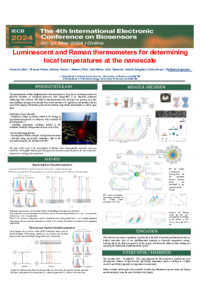
The ability to control and understand the temperature at the nanoscale is fundamental for manipulating physical, chemical, and biological processes.
Nanothermometry is a crucial aspect of scientific and technological applications ranging from electronics to biological systems. The development of well-defined protocols for precise temperature determination is essential for advancing research and applications in nanotechnology. Accurate nanoscale temperature measurements involve the integration of various strategies, including the design and fabrication of new materials, the implementation of detection techniques, and the testing of prototypes for real-world applications.
The utilization of optical techniques, such as fluorescence and Raman spectroscopy, enables the efficient characterization of different materials. The ability to synthesize and test materials using these techniques allows researchers to identify the most suitable and sensitive nanothermometry materials. This is particularly important when prototype devices are developed for biomedical applications, where biocompatibility and non-invasiveness are essential.
This presentation will focus on Raman and luminescent nanostructures. The Raman active material is TiO2, anatase, while lanthanides, such as Yb3+ and Er3+, are used as luminescent materials; they are both characterized by a signal strongly dependent on the local temperature.
Anatase nanoparticles are synthetized by MW-assisted (MW) and solvothermal procedures, while core@shell nanoparticles are realized by MW-assisted co-precipitation of CaCl3, YbCl3, and ErCl3 and sol–gel methods. Fluorescence and Raman measurements were conducted on sample powders in the visible and n-IR ranges. The sample, maintained at a defined temperature via a temperature controller, underwent laser beam focalization through a microscope. The signals were then collected through a triple monochromator and a liquidnitrogen-cooled CCD camera. Preliminary findings indicate the feasibility of obtaining reliable temperatures for characterizing the local temperature using fluorescence and Raman techniques.
The preliminary results indicate a reliable and accurate temperature characterization, paving the way for further advances in nanothermometry and its applications in diverse fields, including biomedicine.
Keywords
Temperature
sensor
core@shell nanoparticles
Raman
Luminescence
Poster
Poster_RSignorini.pdf
Development of A Laser Induced Graphene-based Sensor for Onsite Measurement of Soil Nitrogen.
Dipstick test for DNA-based identification of olive oil cultivar origin