Event submissions
Published
This submission belongs to the session F. Nanomaterials and Smart Surfaces in Biosensors of the event The 4th International Electronic Conference on Biosensors
Published date
28 May, 2024
Academic Editor
'%3e%3cpath%20d='M12.6657%2010.9104C12.4185%2010.325%2012.0599%209.79327%2011.6097%209.34482C11.1609%208.89508%2010.6293%208.5365%2010.0442%208.28888C10.0389%208.28626%2010.0337%208.28495%2010.0285%208.28233C10.8446%207.69279%2011.3752%206.73249%2011.3752%205.64904C11.3752%203.8542%209.92103%202.39999%208.1262%202.39999C6.33136%202.39999%204.87715%203.8542%204.87715%205.64904C4.87715%206.73249%205.40774%207.69279%206.22393%208.28364C6.21869%208.28626%206.21345%208.28757%206.20821%208.29019C5.62129%208.5378%205.09463%208.89284%204.64265%209.34613C4.1929%209.79493%203.83432%2010.3266%203.58671%2010.9117C3.34345%2011.4845%203.21226%2012.0987%203.20023%2012.7209C3.19988%2012.7349%203.20233%2012.7488%203.20744%2012.7619C3.21255%2012.7749%203.22022%2012.7867%203.22998%2012.7968C3.23975%2012.8068%203.25142%2012.8147%203.26431%2012.8202C3.2772%2012.8256%203.29105%2012.8284%203.30504%2012.8284H4.09109C4.14874%2012.8284%204.19459%2012.7825%204.1959%2012.7262C4.2221%2011.7148%204.62823%2010.7676%205.34617%2010.0497C6.08899%209.30683%207.0755%208.89808%208.1262%208.89808C9.17689%208.89808%2010.1634%209.30683%2010.9062%2010.0497C11.6242%2010.7676%2012.0303%2011.7148%2012.0565%2012.7262C12.0578%2012.7838%2012.1037%2012.8284%2012.1613%2012.8284H12.9474C12.9613%2012.8284%2012.9752%2012.8256%2012.9881%2012.8202C13.001%2012.8147%2013.0126%2012.8068%2013.0224%2012.7968C13.0322%2012.7867%2013.0398%2012.7749%2013.0449%2012.7619C13.0501%2012.7488%2013.0525%2012.7349%2013.0522%2012.7209C13.0391%2012.0947%2012.9094%2011.4855%2012.6657%2010.9104ZM8.1262%207.9024C7.52486%207.9024%206.9589%207.6679%206.53312%207.24211C6.10733%206.81633%205.87283%206.25037%205.87283%205.64904C5.87283%205.0477%206.10733%204.48174%206.53312%204.05596C6.9589%203.63018%207.52486%203.39567%208.1262%203.39567C8.72753%203.39567%209.29349%203.63018%209.71927%204.05596C10.1451%204.48174%2010.3796%205.0477%2010.3796%205.64904C10.3796%206.25037%2010.1451%206.81633%209.71927%207.24211C9.29349%207.6679%208.72753%207.9024%208.1262%207.9024Z'%20fill='%235D1EE1'/%3e%3c/g%3e%3c/svg%3e) Michael Thompson
Michael ThompsonCitation
Gabriela Pereira de Freitas, Estela Kerstner Baldin, Eduarda Baggio Paglia, Hernandes Faustino de Carvalho, Jorge Vicente Lopes da Silva, Marisa Masumi Beppu, Pretreatment Methods Enhance Cancer Detection Biosensor Performance via Optimized Deposition of Multilayer Chitosan and Hyaluronic Acid Films, in Proceedings of The 4th International Electronic Conference on Biosensors, 20 May–22 May 2024, MDPI: Basel, Switzerland
Share
Email
Facebook
Twitter
LinkedIn
Pretreatment Methods Enhance Cancer Detection Biosensor Performance via Optimized Deposition of Multilayer Chitosan and Hyaluronic Acid Films
'%3e%3cpath%20d='M12.6647%2010.9104C12.4176%2010.325%2012.0589%209.7933%2011.6088%209.34485C11.16%208.89511%2010.6283%208.53653%2010.0432%208.28891C10.038%208.28629%2010.0327%208.28498%2010.0275%208.28236C10.8437%207.69282%2011.3743%206.73252%2011.3743%205.64907C11.3743%203.85423%209.92005%202.40002%208.12522%202.40002C6.33038%202.40002%204.87618%203.85423%204.87618%205.64907C4.87618%206.73252%205.40677%207.69282%206.22296%208.28367C6.21772%208.28629%206.21248%208.2876%206.20724%208.29022C5.62031%208.53783%205.09365%208.89287%204.64167%209.34616C4.19192%209.79496%203.83334%2010.3266%203.58573%2010.9117C3.34247%2011.4846%203.21128%2012.0987%203.19925%2012.721C3.1989%2012.735%203.20135%2012.7489%203.20646%2012.7619C3.21157%2012.7749%203.21924%2012.7868%203.22901%2012.7968C3.23877%2012.8068%203.25045%2012.8148%203.26334%2012.8202C3.27623%2012.8256%203.29007%2012.8284%203.30406%2012.8284H4.09012C4.14776%2012.8284%204.19362%2012.7825%204.19493%2012.7262C4.22113%2011.7148%204.62726%2010.7676%205.34519%2010.0497C6.08802%209.30686%207.07452%208.89811%208.12522%208.89811C9.17592%208.89811%2010.1624%209.30686%2010.9052%2010.0497C11.6232%2010.7676%2012.0293%2011.7148%2012.0555%2012.7262C12.0568%2012.7839%2012.1027%2012.8284%2012.1603%2012.8284H12.9464C12.9604%2012.8284%2012.9742%2012.8256%2012.9871%2012.8202C13%2012.8148%2013.0117%2012.8068%2013.0214%2012.7968C13.0312%2012.7868%2013.0389%2012.7749%2013.044%2012.7619C13.0491%2012.7489%2013.0515%2012.735%2013.0512%2012.721C13.0381%2012.0947%2012.9084%2011.4856%2012.6647%2010.9104ZM8.12522%207.90243C7.52388%207.90243%206.95792%207.66793%206.53214%207.24215C6.10636%206.81636%205.87185%206.2504%205.87185%205.64907C5.87185%205.04773%206.10636%204.48177%206.53214%204.05599C6.95792%203.63021%207.52388%203.3957%208.12522%203.3957C8.72655%203.3957%209.29252%203.63021%209.7183%204.05599C10.1441%204.48177%2010.3786%205.04773%2010.3786%205.64907C10.3786%206.2504%2010.1441%206.81636%209.7183%207.24215C9.29252%207.66793%208.72655%207.90243%208.12522%207.90243Z'%20fill='%235D1EE1'/%3e%3c/g%3e%3c/svg%3e)
Gabriela Pereira de Freitas 1
Estela Kerstner Baldin 2
Eduarda Baggio Paglia 1

Hernandes Faustino de Carvalho 3

Jorge Vicente Lopes da Silva 2
Marisa Masumi Beppu 1
1. Department of Materials and Bioprocesses Engineering/School of Chemical Engineering/University of Campinas, Brazil
2. Renato Archer Information Technology Center /Campinas, Brazil
3. Department of Cell Biology /Institute of Biology/ University of Campinas, Brazil
Abstract
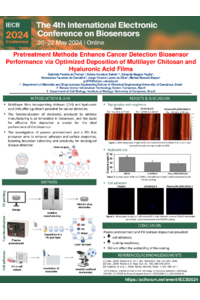
Introduction: Multilayer films incorporating chitosan (CHI) and hyaluronic acid (HA) offer significant potential for diverse biotechnological applications, particularly in early cancer detection, owing to the interaction between HA and the CD44 receptor, commonly overexpressed on circulating tumor cells (CTCs). This study pioneers the utilization of such films to enhance CTC adhesion on TI6Al4V alloy electrodes, manufactured through additive manufacturing for the development of biosensors. Therefore, establishing an effective deposition methodology for these films on electrodes is essential to optimize biosensor performance. The investigation of plasma pretreatment and a polyethyleneimine (PEI) film precursor layer on electrodes aims to improve the adhesion of multilayer coatings and surface properties, and consequently increase the selectivity and sensitivity of the biosensor for the detection of oncological diseases.
Methods: Ti6Al4V samples were mechanically sanded and cleaned, with certain electrodes undergoing additional plasma treatment and deposition of a PEI pre-layer. Multilayer films were deposited using the layer-by-layer technique. Surface characteristics of the Ti6Al4V electrodes before and after coating were evaluated, focusing on water affinity and topography relevant to cellular interaction. PC3 cells were cultured for adhesion studies on the electrodes.
Results: The application of the coating increased hydrophilicity, attributed to the well-known properties of HA. AFM analysis revealed a reduction in surface roughness after coating, possibly due to the filling of grooves by HA and CHI. Electrodes subjected to plasma pretreatment and PEI pre-layer deposition showed an intermediate roughness value, suggesting improved adhesion properties. The coated electrodes exhibited superior adhesion of PC3 prostate cancer cells, particularly those with pretreatments, consistent with the interaction of HA with CD44 receptors.
Conclusions: Plasma pretreatment and PEI pre-layer deposition further enhanced cell adhesion by facilitating effective polyelectrolyte deposition, resulting in increased roughness and potentially benefiting PC3 cell adhesion given their contact cell nature.
Keywords
plasma pretreatment
polyethyleneimine
PC3 cell adhesion
additive manufacturing
Poster
Poster IECB 2024 - Gabriela Pereira de Freitas.pdf
Conductive Mesh Electrodes for Electrochemical Biosensors
The Validation of Smartphone-Based Point-of-Care Urinalysis Vivoo App