Event submissions
Published
This submission belongs to the session D. Chemical Processes and Systems of the event The 3rd International Electronic Conference on Processes
Published date
28 May, 2024
Academic Editor
'%3e%3cpath%20d='M12.6657%2010.9104C12.4185%2010.325%2012.0599%209.79327%2011.6097%209.34482C11.1609%208.89508%2010.6293%208.5365%2010.0442%208.28888C10.0389%208.28626%2010.0337%208.28495%2010.0285%208.28233C10.8446%207.69279%2011.3752%206.73249%2011.3752%205.64904C11.3752%203.8542%209.92103%202.39999%208.1262%202.39999C6.33136%202.39999%204.87715%203.8542%204.87715%205.64904C4.87715%206.73249%205.40774%207.69279%206.22393%208.28364C6.21869%208.28626%206.21345%208.28757%206.20821%208.29019C5.62129%208.5378%205.09463%208.89284%204.64265%209.34613C4.1929%209.79493%203.83432%2010.3266%203.58671%2010.9117C3.34345%2011.4845%203.21226%2012.0987%203.20023%2012.7209C3.19988%2012.7349%203.20233%2012.7488%203.20744%2012.7619C3.21255%2012.7749%203.22022%2012.7867%203.22998%2012.7968C3.23975%2012.8068%203.25142%2012.8147%203.26431%2012.8202C3.2772%2012.8256%203.29105%2012.8284%203.30504%2012.8284H4.09109C4.14874%2012.8284%204.19459%2012.7825%204.1959%2012.7262C4.2221%2011.7148%204.62823%2010.7676%205.34617%2010.0497C6.08899%209.30683%207.0755%208.89808%208.1262%208.89808C9.17689%208.89808%2010.1634%209.30683%2010.9062%2010.0497C11.6242%2010.7676%2012.0303%2011.7148%2012.0565%2012.7262C12.0578%2012.7838%2012.1037%2012.8284%2012.1613%2012.8284H12.9474C12.9613%2012.8284%2012.9752%2012.8256%2012.9881%2012.8202C13.001%2012.8147%2013.0126%2012.8068%2013.0224%2012.7968C13.0322%2012.7867%2013.0398%2012.7749%2013.0449%2012.7619C13.0501%2012.7488%2013.0525%2012.7349%2013.0522%2012.7209C13.0391%2012.0947%2012.9094%2011.4855%2012.6657%2010.9104ZM8.1262%207.9024C7.52486%207.9024%206.9589%207.6679%206.53312%207.24211C6.10733%206.81633%205.87283%206.25037%205.87283%205.64904C5.87283%205.0477%206.10733%204.48174%206.53312%204.05596C6.9589%203.63018%207.52486%203.39567%208.1262%203.39567C8.72753%203.39567%209.29349%203.63018%209.71927%204.05596C10.1451%204.48174%2010.3796%205.0477%2010.3796%205.64904C10.3796%206.25037%2010.1451%206.81633%209.71927%207.24211C9.29349%207.6679%208.72753%207.9024%208.1262%207.9024Z'%20fill='%235D1EE1'/%3e%3c/g%3e%3c/svg%3e) Blaž Likozar
Blaž LikozarCitation
Filipa Inês Pitacas, María José Benito Bernáldez, Manuel Blasco Ruiz, José Antonio Lopéz González, Rocío Palencia, Ofélia Anjos, Vanessa Vasconcelos, Luísa Paulo, António Moitinho Rodrigues, Fatty acid profile, total fat, protein, moisture and ash in different edible parts of Albacore tuna (Thunnus alalunga Bonnaterre, 1788) – Preliminary Results, in Proceedings of The 3rd International Electronic Conference on Processes, 29 May–31 May 2024, MDPI: Basel, Switzerland
Share
Email
Facebook
Twitter
LinkedIn
Fatty acid profile, total fat, protein, moisture and ash in different edible parts of Albacore tuna (Thunnus alalunga Bonnaterre, 1788) – Preliminary Results
'%3e%3cpath%20d='M12.6647%2010.9104C12.4176%2010.325%2012.0589%209.7933%2011.6088%209.34485C11.16%208.89511%2010.6283%208.53653%2010.0432%208.28891C10.038%208.28629%2010.0327%208.28498%2010.0275%208.28236C10.8437%207.69282%2011.3743%206.73252%2011.3743%205.64907C11.3743%203.85423%209.92005%202.40002%208.12522%202.40002C6.33038%202.40002%204.87618%203.85423%204.87618%205.64907C4.87618%206.73252%205.40677%207.69282%206.22296%208.28367C6.21772%208.28629%206.21248%208.2876%206.20724%208.29022C5.62031%208.53783%205.09365%208.89287%204.64167%209.34616C4.19192%209.79496%203.83334%2010.3266%203.58573%2010.9117C3.34247%2011.4846%203.21128%2012.0987%203.19925%2012.721C3.1989%2012.735%203.20135%2012.7489%203.20646%2012.7619C3.21157%2012.7749%203.21924%2012.7868%203.22901%2012.7968C3.23877%2012.8068%203.25045%2012.8148%203.26334%2012.8202C3.27623%2012.8256%203.29007%2012.8284%203.30406%2012.8284H4.09012C4.14776%2012.8284%204.19362%2012.7825%204.19493%2012.7262C4.22113%2011.7148%204.62726%2010.7676%205.34519%2010.0497C6.08802%209.30686%207.07452%208.89811%208.12522%208.89811C9.17592%208.89811%2010.1624%209.30686%2010.9052%2010.0497C11.6232%2010.7676%2012.0293%2011.7148%2012.0555%2012.7262C12.0568%2012.7839%2012.1027%2012.8284%2012.1603%2012.8284H12.9464C12.9604%2012.8284%2012.9742%2012.8256%2012.9871%2012.8202C13%2012.8148%2013.0117%2012.8068%2013.0214%2012.7968C13.0312%2012.7868%2013.0389%2012.7749%2013.044%2012.7619C13.0491%2012.7489%2013.0515%2012.735%2013.0512%2012.721C13.0381%2012.0947%2012.9084%2011.4856%2012.6647%2010.9104ZM8.12522%207.90243C7.52388%207.90243%206.95792%207.66793%206.53214%207.24215C6.10636%206.81636%205.87185%206.2504%205.87185%205.64907C5.87185%205.04773%206.10636%204.48177%206.53214%204.05599C6.95792%203.63021%207.52388%203.3957%208.12522%203.3957C8.72655%203.3957%209.29252%203.63021%209.7183%204.05599C10.1441%204.48177%2010.3786%205.04773%2010.3786%205.64907C10.3786%206.2504%2010.1441%206.81636%209.7183%207.24215C9.29252%207.66793%208.72655%207.90243%208.12522%207.90243Z'%20fill='%235D1EE1'/%3e%3c/g%3e%3c/svg%3e)
Filipa Inês Pitacas 1,2

María José Benito Bernáldez 3
Manuel Blasco Ruiz 3
José Antonio Lopéz González 3
Rocío Palencia 3

Ofélia Anjos 1,2
Vanessa Vasconcelos 4
Luísa Paulo 4

António Moitinho Rodrigues 1,2
1. Polytechnic Institute of Castelo Branco, School of Agriculture, Quinta da Sra. de Mércules, 6001-909 Castelo Branco, Portugal
2. CERNAS-IPCB Research Centre for Natural Resources, Environment and Society. Polytechnic Institute of Castelo Branco, 6001-909 Castelo
Branco, Portugal
3. University of Extremadura, Avenida de Elvas, Km. 2, 06071 Badajoz, Spain
4. CATAA — Castelo Branco Agro-Food Technological Center, 6000-459 Castelo Branco, PORTUGAL
Abstract
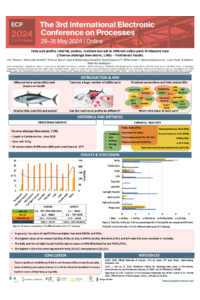
Studying tuna's nutritional composition and potential health benefits is essential for understanding its impact on health, particularly concerning the fatty acid (FA) and protein content in its edible parts. Tuna has a huge number of edible parts and each of them may differ in nutritional profile. Most studies on Thunnus genus only assess the nutritional value of the muscle in general. This study assessed the specific proximal composition and fatty acid profile of different edible parts of a 13 kg male Thunnus alalunga (Bonnaterre, 1788) caught in June 2023 in the Cantabrian Sea. Samples of 10 different tuna edible parts were taken at the fish market from a certified trader and subsequently frozen at -18°C until analyzed. ANOVA and Boferroni’s test (p<0.05) were performed. The moisture (oven dry, 103±2°C), ash (muffle furnace, 550±50°C), protein (Kjeldahl method) and energy content (UE Regulation No. 1169/2011) were significantly higher in the liver (75.0%), top and low loin (1.8%), top loin (28.2%) and belly (206.7 kcal/100 g), respectively. A total of 28 FAs (GC-FID with a HP5 column) were quantified as a percentage of the total fat extracted with the Soxtec method. In general, the value of total polyunsaturated FAs (PUFAs) was higher than that of total monounsaturated FAs (MUFAs) and total saturated FAs (SFAs). The belly was the tuna edible part with the highest values of fat content (12.5%) and PUFAs, n-3PUFAs EPA+DHA (eicosapentaenoic+docosahexaenoic) and h:H ratio (hypocholesterolaemic/hypercholesterolaemic) FAs. The belly and the tail cut had the highest values of EPA+DHA/total fat and PUFAs/SFAs. The belly and low loin showed the highest n-3/n-6 FA ratio. Compared with other parts, the top loin had the highest thrombogenicity index values. We concluded that there is significant variability in nutritional profiles among the samples, with some exhibiting particularly richness in n-3PUFA EPA+DHA beneficial to human health in terms of their fatty acid profile.
Keywords
Keywords: Scombridae family
proximate composition
PUFA
n-3 fatty acids
EPA and DHA.
Poster
ECP 2024 – Confirmed Poster for Gallery - sciforum-090389.pdf
SELECTED ASPECTS OF THE ANTIBACTERIAL USE OF LACTIC ACID IN FOOD PROCESSING
Novel photocatalytic reduction of CO2 into solar fuel under a continuous flow photoreactor using nano-engineered slag catalyst