Event submissions
Published
This submission belongs to the session A. Environmental and Green Processes of the event The 3rd International Electronic Conference on Processes
Published date
28 May, 2024
Academic Editor
'%3e%3cpath%20d='M12.6657%2010.9104C12.4185%2010.325%2012.0599%209.79327%2011.6097%209.34482C11.1609%208.89508%2010.6293%208.5365%2010.0442%208.28888C10.0389%208.28626%2010.0337%208.28495%2010.0285%208.28233C10.8446%207.69279%2011.3752%206.73249%2011.3752%205.64904C11.3752%203.8542%209.92103%202.39999%208.1262%202.39999C6.33136%202.39999%204.87715%203.8542%204.87715%205.64904C4.87715%206.73249%205.40774%207.69279%206.22393%208.28364C6.21869%208.28626%206.21345%208.28757%206.20821%208.29019C5.62129%208.5378%205.09463%208.89284%204.64265%209.34613C4.1929%209.79493%203.83432%2010.3266%203.58671%2010.9117C3.34345%2011.4845%203.21226%2012.0987%203.20023%2012.7209C3.19988%2012.7349%203.20233%2012.7488%203.20744%2012.7619C3.21255%2012.7749%203.22022%2012.7867%203.22998%2012.7968C3.23975%2012.8068%203.25142%2012.8147%203.26431%2012.8202C3.2772%2012.8256%203.29105%2012.8284%203.30504%2012.8284H4.09109C4.14874%2012.8284%204.19459%2012.7825%204.1959%2012.7262C4.2221%2011.7148%204.62823%2010.7676%205.34617%2010.0497C6.08899%209.30683%207.0755%208.89808%208.1262%208.89808C9.17689%208.89808%2010.1634%209.30683%2010.9062%2010.0497C11.6242%2010.7676%2012.0303%2011.7148%2012.0565%2012.7262C12.0578%2012.7838%2012.1037%2012.8284%2012.1613%2012.8284H12.9474C12.9613%2012.8284%2012.9752%2012.8256%2012.9881%2012.8202C13.001%2012.8147%2013.0126%2012.8068%2013.0224%2012.7968C13.0322%2012.7867%2013.0398%2012.7749%2013.0449%2012.7619C13.0501%2012.7488%2013.0525%2012.7349%2013.0522%2012.7209C13.0391%2012.0947%2012.9094%2011.4855%2012.6657%2010.9104ZM8.1262%207.9024C7.52486%207.9024%206.9589%207.6679%206.53312%207.24211C6.10733%206.81633%205.87283%206.25037%205.87283%205.64904C5.87283%205.0477%206.10733%204.48174%206.53312%204.05596C6.9589%203.63018%207.52486%203.39567%208.1262%203.39567C8.72753%203.39567%209.29349%203.63018%209.71927%204.05596C10.1451%204.48174%2010.3796%205.0477%2010.3796%205.64904C10.3796%206.25037%2010.1451%206.81633%209.71927%207.24211C9.29349%207.6679%208.72753%207.9024%208.1262%207.9024Z'%20fill='%235D1EE1'/%3e%3c/g%3e%3c/svg%3e) Isabel Pestana Paixão Cansado
Isabel Pestana Paixão CansadoCitation
Zekarias Andebrhan Asfha, Yulia Kocharovskaya, Nataliya E. Suzina, Tatiana N. Abashina, Valentina N. Polivtseva, Yanina Delegan, Inna Petrovna Solyanikova, Characterization of potential chalky soil bacteria isolated from rhizosphere of Acacia spp. growing in Abardae, Maekel Region of Eritrea, in Proceedings of The 3rd International Electronic Conference on Processes, 29 May–31 May 2024, MDPI: Basel, Switzerland
Share
Email
Facebook
Twitter
LinkedIn
Characterization of potential chalky soil bacteria isolated from rhizosphere of Acacia spp. growing in Abardae, Maekel Region of Eritrea
'%3e%3cpath%20d='M12.6647%2010.9104C12.4176%2010.325%2012.0589%209.7933%2011.6088%209.34485C11.16%208.89511%2010.6283%208.53653%2010.0432%208.28891C10.038%208.28629%2010.0327%208.28498%2010.0275%208.28236C10.8437%207.69282%2011.3743%206.73252%2011.3743%205.64907C11.3743%203.85423%209.92005%202.40002%208.12522%202.40002C6.33038%202.40002%204.87618%203.85423%204.87618%205.64907C4.87618%206.73252%205.40677%207.69282%206.22296%208.28367C6.21772%208.28629%206.21248%208.2876%206.20724%208.29022C5.62031%208.53783%205.09365%208.89287%204.64167%209.34616C4.19192%209.79496%203.83334%2010.3266%203.58573%2010.9117C3.34247%2011.4846%203.21128%2012.0987%203.19925%2012.721C3.1989%2012.735%203.20135%2012.7489%203.20646%2012.7619C3.21157%2012.7749%203.21924%2012.7868%203.22901%2012.7968C3.23877%2012.8068%203.25045%2012.8148%203.26334%2012.8202C3.27623%2012.8256%203.29007%2012.8284%203.30406%2012.8284H4.09012C4.14776%2012.8284%204.19362%2012.7825%204.19493%2012.7262C4.22113%2011.7148%204.62726%2010.7676%205.34519%2010.0497C6.08802%209.30686%207.07452%208.89811%208.12522%208.89811C9.17592%208.89811%2010.1624%209.30686%2010.9052%2010.0497C11.6232%2010.7676%2012.0293%2011.7148%2012.0555%2012.7262C12.0568%2012.7839%2012.1027%2012.8284%2012.1603%2012.8284H12.9464C12.9604%2012.8284%2012.9742%2012.8256%2012.9871%2012.8202C13%2012.8148%2013.0117%2012.8068%2013.0214%2012.7968C13.0312%2012.7868%2013.0389%2012.7749%2013.044%2012.7619C13.0491%2012.7489%2013.0515%2012.735%2013.0512%2012.721C13.0381%2012.0947%2012.9084%2011.4856%2012.6647%2010.9104ZM8.12522%207.90243C7.52388%207.90243%206.95792%207.66793%206.53214%207.24215C6.10636%206.81636%205.87185%206.2504%205.87185%205.64907C5.87185%205.04773%206.10636%204.48177%206.53214%204.05599C6.95792%203.63021%207.52388%203.3957%208.12522%203.3957C8.72655%203.3957%209.29252%203.63021%209.7183%204.05599C10.1441%204.48177%2010.3786%205.04773%2010.3786%205.64907C10.3786%206.2504%2010.1441%206.81636%209.7183%207.24215C9.29252%207.66793%208.72655%207.90243%208.12522%207.90243Z'%20fill='%235D1EE1'/%3e%3c/g%3e%3c/svg%3e)
Zekarias Andebrhan Asfha 1,2
Yulia Kocharovskaya 3
Nataliya E. Suzina 3
Tatiana N. Abashina 3
Valentina N. Polivtseva 3
Yanina Delegan 3

Inna Petrovna Solyanikova 1,3
1. Institute of Pharmacy, Chemistry and Biology, Belgorod State University, Belgorod 308015, Russia
2. Department of Biology, Mai Nefhi college of science, Maekel Region, Eritrea
3. Federal Research Center “Pushchino Scientific Center for Biological Research of the Russian Academy of
Sciences”, Pushchino 142290, Moscow Region, Russia
Abstract
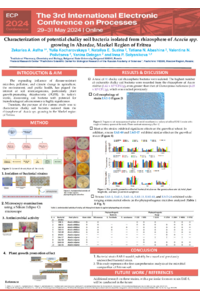
The expanding influence of disease-resistant microbes, pollution, and climate change on agriculture, the environment, and public health has increased the interest in soil microorganisms, particularly plant-growth-promoting rhizobacteria (PGPR). In today's world, discovering soil bacteria with potential for biotechnological advancements is highly significant. Therefore, the purpose of the current study was to characterize chalky soil bacteria that were isolated from the rhizosphere of Acacia spp. growing in the Maekel region of Eritrea. In this study, three chalky soil samples were taken from the rhizosphere of Acacia ethibica, Acacia origena, and non-rhizospheric soil. The number of culturable bacteria in the samples was found to be 1.42 x 10¹⁰, 5.35 x 10⁹, and 5.68 x 10⁷ cfu/g, respectively. In total, 80 bacterial strains were isolated, and 10 of them were chosen for further investigation based on their distinct morphology. The cell morphology of the strains was examined using a Nikon Eclipse Ci microscope. The results demonstrated that the aerial mycelium of strain EAE-1 exhibited a novel and previously undescribed organization of spore-bearing hyphae. The antimicrobial activity against phytopathogenic microbes was evaluated. The results revealed that EAE-1, EAE-3, EAE-14, EAE-15, EAE-40, and EAO-24 exhibited wide-ranging antimicrobial effects. Moreover, plant-growth-promoting activity was assessed using various growth parameters. Most of the strains exhibited significant effects on the growth of wheat. However, the bacterial strains EAE-40 and EAO-17 exhibited significant effects on the growth of maize. In conclusion, the current study probably found novel bacterial strains. Future research will be conducted on these strains, with a particular focus on strain EAE-1. Moreover, this study represents the first comprehensive analysis of the microbial composition of Eritrean soil.
Keywords
Acacia ethibica
Acacia origena
Antimicrobial activity
Phytopathogenic microbes
Growth promotion activity
Chalky soil
Poster
ECP 2024 – Confirmed Poster for Gallery - sciforum-089904.pdf
Comparative Study of Titanium Dioxide and Lysozyme-Added Titanium Dioxide Nanoparticles for Enhanced Photocatalytic Degradation
Water Quality Assessment of Kashkadarya Springs: Implications for Human Health and water resource management