Event submissions
Published
This submission belongs to the session A. Environmental and Green Processes of the event The 3rd International Electronic Conference on Processes
Published date
28 May, 2024
Academic Editor
'%3e%3cpath%20d='M12.6657%2010.9104C12.4185%2010.325%2012.0599%209.79327%2011.6097%209.34482C11.1609%208.89508%2010.6293%208.5365%2010.0442%208.28888C10.0389%208.28626%2010.0337%208.28495%2010.0285%208.28233C10.8446%207.69279%2011.3752%206.73249%2011.3752%205.64904C11.3752%203.8542%209.92103%202.39999%208.1262%202.39999C6.33136%202.39999%204.87715%203.8542%204.87715%205.64904C4.87715%206.73249%205.40774%207.69279%206.22393%208.28364C6.21869%208.28626%206.21345%208.28757%206.20821%208.29019C5.62129%208.5378%205.09463%208.89284%204.64265%209.34613C4.1929%209.79493%203.83432%2010.3266%203.58671%2010.9117C3.34345%2011.4845%203.21226%2012.0987%203.20023%2012.7209C3.19988%2012.7349%203.20233%2012.7488%203.20744%2012.7619C3.21255%2012.7749%203.22022%2012.7867%203.22998%2012.7968C3.23975%2012.8068%203.25142%2012.8147%203.26431%2012.8202C3.2772%2012.8256%203.29105%2012.8284%203.30504%2012.8284H4.09109C4.14874%2012.8284%204.19459%2012.7825%204.1959%2012.7262C4.2221%2011.7148%204.62823%2010.7676%205.34617%2010.0497C6.08899%209.30683%207.0755%208.89808%208.1262%208.89808C9.17689%208.89808%2010.1634%209.30683%2010.9062%2010.0497C11.6242%2010.7676%2012.0303%2011.7148%2012.0565%2012.7262C12.0578%2012.7838%2012.1037%2012.8284%2012.1613%2012.8284H12.9474C12.9613%2012.8284%2012.9752%2012.8256%2012.9881%2012.8202C13.001%2012.8147%2013.0126%2012.8068%2013.0224%2012.7968C13.0322%2012.7867%2013.0398%2012.7749%2013.0449%2012.7619C13.0501%2012.7488%2013.0525%2012.7349%2013.0522%2012.7209C13.0391%2012.0947%2012.9094%2011.4855%2012.6657%2010.9104ZM8.1262%207.9024C7.52486%207.9024%206.9589%207.6679%206.53312%207.24211C6.10733%206.81633%205.87283%206.25037%205.87283%205.64904C5.87283%205.0477%206.10733%204.48174%206.53312%204.05596C6.9589%203.63018%207.52486%203.39567%208.1262%203.39567C8.72753%203.39567%209.29349%203.63018%209.71927%204.05596C10.1451%204.48174%2010.3796%205.0477%2010.3796%205.64904C10.3796%206.25037%2010.1451%206.81633%209.71927%207.24211C9.29349%207.6679%208.72753%207.9024%208.1262%207.9024Z'%20fill='%235D1EE1'/%3e%3c/g%3e%3c/svg%3e) Giancarlo Cravotto
Giancarlo CravottoCitation
Kyle Angelique Epino Bautista, Eugene Josh Dela Cruz Mata, Chris Diane Bawa-an Mercado, Ron Jasper Camposano Placio, Vince Harvey O. Alano, Allan N. Soriano, Rugi Vicente C. Rubi, A Systematic Review of Metal–Organic Framework (MOF)-based Nanocomposites and theirApplication in the Photocatalytic Degradation of Pharmaceutical Compounds, in Proceedings of The 3rd International Electronic Conference on Processes, 29 May–31 May 2024, MDPI: Basel, Switzerland
Share
Email
Facebook
Twitter
LinkedIn
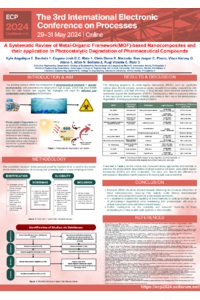
A Systematic Review of Metal–Organic Framework (MOF)-based Nanocomposites and theirApplication in the Photocatalytic Degradation of Pharmaceutical Compounds
'%3e%3cpath%20d='M12.6647%2010.9104C12.4176%2010.325%2012.0589%209.7933%2011.6088%209.34485C11.16%208.89511%2010.6283%208.53653%2010.0432%208.28891C10.038%208.28629%2010.0327%208.28498%2010.0275%208.28236C10.8437%207.69282%2011.3743%206.73252%2011.3743%205.64907C11.3743%203.85423%209.92005%202.40002%208.12522%202.40002C6.33038%202.40002%204.87618%203.85423%204.87618%205.64907C4.87618%206.73252%205.40677%207.69282%206.22296%208.28367C6.21772%208.28629%206.21248%208.2876%206.20724%208.29022C5.62031%208.53783%205.09365%208.89287%204.64167%209.34616C4.19192%209.79496%203.83334%2010.3266%203.58573%2010.9117C3.34247%2011.4846%203.21128%2012.0987%203.19925%2012.721C3.1989%2012.735%203.20135%2012.7489%203.20646%2012.7619C3.21157%2012.7749%203.21924%2012.7868%203.22901%2012.7968C3.23877%2012.8068%203.25045%2012.8148%203.26334%2012.8202C3.27623%2012.8256%203.29007%2012.8284%203.30406%2012.8284H4.09012C4.14776%2012.8284%204.19362%2012.7825%204.19493%2012.7262C4.22113%2011.7148%204.62726%2010.7676%205.34519%2010.0497C6.08802%209.30686%207.07452%208.89811%208.12522%208.89811C9.17592%208.89811%2010.1624%209.30686%2010.9052%2010.0497C11.6232%2010.7676%2012.0293%2011.7148%2012.0555%2012.7262C12.0568%2012.7839%2012.1027%2012.8284%2012.1603%2012.8284H12.9464C12.9604%2012.8284%2012.9742%2012.8256%2012.9871%2012.8202C13%2012.8148%2013.0117%2012.8068%2013.0214%2012.7968C13.0312%2012.7868%2013.0389%2012.7749%2013.044%2012.7619C13.0491%2012.7489%2013.0515%2012.735%2013.0512%2012.721C13.0381%2012.0947%2012.9084%2011.4856%2012.6647%2010.9104ZM8.12522%207.90243C7.52388%207.90243%206.95792%207.66793%206.53214%207.24215C6.10636%206.81636%205.87185%206.2504%205.87185%205.64907C5.87185%205.04773%206.10636%204.48177%206.53214%204.05599C6.95792%203.63021%207.52388%203.3957%208.12522%203.3957C8.72655%203.3957%209.29252%203.63021%209.7183%204.05599C10.1441%204.48177%2010.3786%205.04773%2010.3786%205.64907C10.3786%206.2504%2010.1441%206.81636%209.7183%207.24215C9.29252%207.66793%208.72655%207.90243%208.12522%207.90243Z'%20fill='%235D1EE1'/%3e%3c/g%3e%3c/svg%3e)
Kyle Angelique Epino Bautista 1

Eugene Josh Dela Cruz Mata 1
Chris Diane Bawa-an Mercado 1
Ron Jasper Camposano Placio 1
Vince Harvey O. Alano 1
Allan N. Soriano 2
Rugi Vicente C. Rubi 1,3
1. Chemical Engineering Department, College of Engineering, Pamantasan ng Lungsod ng Maynila, Gen. Luna corner Muralla St., Intramuros Manila, Philippines
2. Chemical Engineering Department, Gokongwei College of Engineering, De La Salle University, 2401 Taft Avenue, Manila 0922, Philippines
3. Chemical Engineering Department, College of Engineering, Adamson University, 900 San Marcelino St., Ermita, Manila, Philippines
Abstract
Photocatalytic degradation has emerged as a promising and sustainable solution to the rising environmental concerns caused by the emergence of pharmaceutical contaminants in aquatic bodies. Given its sustainability, nontoxicity, and energy-efficient attributes, extensive research has been conducted to investigate this approach and explore the synthesis of various photocatalysts. Metal–organic framework (MOF)-based nanocomposites exhibit a broad spectrum of applications across various fields due to their substantial surface area and versatile functionality. In these fields, MOF-based nanocomposites have proven to be excellent photocatalysts in water treatments, particularly in the breakdown of pharmaceutical pollutants in aquatic environments. This systematic review provides an overview of MOF-based nanocomposites and their applications in the photocatalytic degradation of pharmaceutical products. Several studies have explored different synthesis techniques for various MOF-based nanocomposites, and their degradation efficiencies against pollutants, under varying conditions such as catalyst loading, pollutant concentration, light intensity, and exposure time, among others, have also been reported. Moreover, modifications to these synthesis techniques have been made to enhance the degradation capability and stability of MOF-based nanocomposites. Meanwhile, the integration of other metals and biomaterials into MOF-based nanocomposites has been explored to improve the stability and recyclability of these photocatalysts. This paper also highlights the existing gaps in the current research to direct future investigations on photocatalytic degradation using MOF-based nanocomposites.
Keywords
metal organic framework
nanocomposite
photocatalytic degradation
pharmaceuticals
MOF-based nanocomposite
Poster
ECP 2024 – Confirmed Poster for Gallery – sciforum-089568.pdf
Аpproaches to improve the efficient bioleaching of arsenopyrite flotation concentrate
Terbium iodide-filled single-walled carbon nanotubes: microscopy and spectroscopy investigations