Event submissions
Published
This submission belongs to the session A. Environmental and Green Processes of the event The 3rd International Electronic Conference on Processes
Published date
28 May, 2024
Academic Editor
'%3e%3cpath%20d='M12.6657%2010.9104C12.4185%2010.325%2012.0599%209.79327%2011.6097%209.34482C11.1609%208.89508%2010.6293%208.5365%2010.0442%208.28888C10.0389%208.28626%2010.0337%208.28495%2010.0285%208.28233C10.8446%207.69279%2011.3752%206.73249%2011.3752%205.64904C11.3752%203.8542%209.92103%202.39999%208.1262%202.39999C6.33136%202.39999%204.87715%203.8542%204.87715%205.64904C4.87715%206.73249%205.40774%207.69279%206.22393%208.28364C6.21869%208.28626%206.21345%208.28757%206.20821%208.29019C5.62129%208.5378%205.09463%208.89284%204.64265%209.34613C4.1929%209.79493%203.83432%2010.3266%203.58671%2010.9117C3.34345%2011.4845%203.21226%2012.0987%203.20023%2012.7209C3.19988%2012.7349%203.20233%2012.7488%203.20744%2012.7619C3.21255%2012.7749%203.22022%2012.7867%203.22998%2012.7968C3.23975%2012.8068%203.25142%2012.8147%203.26431%2012.8202C3.2772%2012.8256%203.29105%2012.8284%203.30504%2012.8284H4.09109C4.14874%2012.8284%204.19459%2012.7825%204.1959%2012.7262C4.2221%2011.7148%204.62823%2010.7676%205.34617%2010.0497C6.08899%209.30683%207.0755%208.89808%208.1262%208.89808C9.17689%208.89808%2010.1634%209.30683%2010.9062%2010.0497C11.6242%2010.7676%2012.0303%2011.7148%2012.0565%2012.7262C12.0578%2012.7838%2012.1037%2012.8284%2012.1613%2012.8284H12.9474C12.9613%2012.8284%2012.9752%2012.8256%2012.9881%2012.8202C13.001%2012.8147%2013.0126%2012.8068%2013.0224%2012.7968C13.0322%2012.7867%2013.0398%2012.7749%2013.0449%2012.7619C13.0501%2012.7488%2013.0525%2012.7349%2013.0522%2012.7209C13.0391%2012.0947%2012.9094%2011.4855%2012.6657%2010.9104ZM8.1262%207.9024C7.52486%207.9024%206.9589%207.6679%206.53312%207.24211C6.10733%206.81633%205.87283%206.25037%205.87283%205.64904C5.87283%205.0477%206.10733%204.48174%206.53312%204.05596C6.9589%203.63018%207.52486%203.39567%208.1262%203.39567C8.72753%203.39567%209.29349%203.63018%209.71927%204.05596C10.1451%204.48174%2010.3796%205.0477%2010.3796%205.64904C10.3796%206.25037%2010.1451%206.81633%209.71927%207.24211C9.29349%207.6679%208.72753%207.9024%208.1262%207.9024Z'%20fill='%235D1EE1'/%3e%3c/g%3e%3c/svg%3e) Juan Francisco García Martín
Juan Francisco García MartínCitation
Christina Panagiotidou, Elisavet Bouloumpasi, Maria Irakli, Paschalina Chatzopoulou, Optimization of Phenolic Compounds from Oregano by Accelerated Solvent Extraction Using Response Surface Methodology, in Proceedings of The 3rd International Electronic Conference on Processes, 29 May–31 May 2024, MDPI: Basel, Switzerland
Share
Email
Facebook
Twitter
LinkedIn
Optimization of Phenolic Compounds from Oregano by Accelerated Solvent Extraction Using Response Surface Methodology
'%3e%3cpath%20d='M12.6647%2010.9104C12.4176%2010.325%2012.0589%209.7933%2011.6088%209.34485C11.16%208.89511%2010.6283%208.53653%2010.0432%208.28891C10.038%208.28629%2010.0327%208.28498%2010.0275%208.28236C10.8437%207.69282%2011.3743%206.73252%2011.3743%205.64907C11.3743%203.85423%209.92005%202.40002%208.12522%202.40002C6.33038%202.40002%204.87618%203.85423%204.87618%205.64907C4.87618%206.73252%205.40677%207.69282%206.22296%208.28367C6.21772%208.28629%206.21248%208.2876%206.20724%208.29022C5.62031%208.53783%205.09365%208.89287%204.64167%209.34616C4.19192%209.79496%203.83334%2010.3266%203.58573%2010.9117C3.34247%2011.4846%203.21128%2012.0987%203.19925%2012.721C3.1989%2012.735%203.20135%2012.7489%203.20646%2012.7619C3.21157%2012.7749%203.21924%2012.7868%203.22901%2012.7968C3.23877%2012.8068%203.25045%2012.8148%203.26334%2012.8202C3.27623%2012.8256%203.29007%2012.8284%203.30406%2012.8284H4.09012C4.14776%2012.8284%204.19362%2012.7825%204.19493%2012.7262C4.22113%2011.7148%204.62726%2010.7676%205.34519%2010.0497C6.08802%209.30686%207.07452%208.89811%208.12522%208.89811C9.17592%208.89811%2010.1624%209.30686%2010.9052%2010.0497C11.6232%2010.7676%2012.0293%2011.7148%2012.0555%2012.7262C12.0568%2012.7839%2012.1027%2012.8284%2012.1603%2012.8284H12.9464C12.9604%2012.8284%2012.9742%2012.8256%2012.9871%2012.8202C13%2012.8148%2013.0117%2012.8068%2013.0214%2012.7968C13.0312%2012.7868%2013.0389%2012.7749%2013.044%2012.7619C13.0491%2012.7489%2013.0515%2012.735%2013.0512%2012.721C13.0381%2012.0947%2012.9084%2011.4856%2012.6647%2010.9104ZM8.12522%207.90243C7.52388%207.90243%206.95792%207.66793%206.53214%207.24215C6.10636%206.81636%205.87185%206.2504%205.87185%205.64907C5.87185%205.04773%206.10636%204.48177%206.53214%204.05599C6.95792%203.63021%207.52388%203.3957%208.12522%203.3957C8.72655%203.3957%209.29252%203.63021%209.7183%204.05599C10.1441%204.48177%2010.3786%205.04773%2010.3786%205.64907C10.3786%206.2504%2010.1441%206.81636%209.7183%207.24215C9.29252%207.66793%208.72655%207.90243%208.12522%207.90243Z'%20fill='%235D1EE1'/%3e%3c/g%3e%3c/svg%3e)
Christina Panagiotidou 1
Elisavet Bouloumpasi 1
Maria Irakli 1
Paschalina Chatzopoulou 1
1. Hellenic Agricultural Organization–Dimitra, Institute of Plant Breeding and Genetic Resources, 57001, Thermi, Thessaloniki, Greece
Abstract
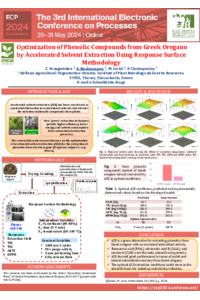
Accelerated solvent extraction (ASE) has been considered as a potential alternative to conventional solvent extraction for the isolation of phenolic compounds from plants. New “green” extraction techniques that provide higher efficiency, lower energy, and solvent consumption than conventional extraction processes have already been utilized in extracting antioxidants from aromatic plants and essential oils’ solid residues in order to improve extraction efficiency and product quality. The current small scale research focuses on the optimization of accelerated solvent extraction (ASE) for the extraction of phenolics from Greek oregano (Origanum vulgare L. subsp. Hirtum). The response surface methodology (RSM) based on Central Composite Design was used to optimize methanol concentration (X1, 40-80 %), extraction time (X2, 3–9 min, 3 cycles), and extraction temperature (X3, 60–140 °C). The responses for the ASE method were estimated as yield (%), total phenolic (TPC) and flavonoid content (TFC), and antioxidant capacity measured by DPPH (2,2-diphenyl-1-picrylhydrazyl), and ABTS (2’-azino-bis-3-ethylbenzthiazoline-6-sulphonic acid), aiming to obtain maximum yields. The optimal extraction conditions for oregano were defined as follows: methanol concentration of 74%, extraction time of 9 min, and extraction temperature of 140 ◦C. Under these conditions, experimental values for extract yield, TPC, DPPH, and ABTS matched those predicted, therefore validating the model adequately. The phenolic profile was analyzed by HPLC/PDA/MS. The oregano extracts were rich in phenolic compounds, with rosmarinic acid, salvianolic acid B, and carvacrol being the most prevalent phenolic components. The results obtained revealed that ASE can be utilized for the extraction of bioactive compounds, and there are advantages to preserving phenolic content if optimization is applied.
Keywords
Origanum vulgare
green extraction methods
Accelerated Solvent Extraction
phenolic extracts
LC-MS analysis
Poster
ECP 2024 – Confirmed Poster for Gallery - sciforum-090340.pdf
Plant-Based Adsorbents for Caffeine Removal: Current Research and Future Outlook
A Systematic Review on Water Hyacinth (Eichhornia crassipes) as a Biosorbent of Cadmium