Event submissions
Published
This submission belongs to the session I. Optical and Photonic Biosensors of the event The 4th International Electronic Conference on Biosensors
Published date
28 May, 2024
Academic Editor
'%3e%3cpath%20d='M12.6657%2010.9104C12.4185%2010.325%2012.0599%209.79327%2011.6097%209.34482C11.1609%208.89508%2010.6293%208.5365%2010.0442%208.28888C10.0389%208.28626%2010.0337%208.28495%2010.0285%208.28233C10.8446%207.69279%2011.3752%206.73249%2011.3752%205.64904C11.3752%203.8542%209.92103%202.39999%208.1262%202.39999C6.33136%202.39999%204.87715%203.8542%204.87715%205.64904C4.87715%206.73249%205.40774%207.69279%206.22393%208.28364C6.21869%208.28626%206.21345%208.28757%206.20821%208.29019C5.62129%208.5378%205.09463%208.89284%204.64265%209.34613C4.1929%209.79493%203.83432%2010.3266%203.58671%2010.9117C3.34345%2011.4845%203.21226%2012.0987%203.20023%2012.7209C3.19988%2012.7349%203.20233%2012.7488%203.20744%2012.7619C3.21255%2012.7749%203.22022%2012.7867%203.22998%2012.7968C3.23975%2012.8068%203.25142%2012.8147%203.26431%2012.8202C3.2772%2012.8256%203.29105%2012.8284%203.30504%2012.8284H4.09109C4.14874%2012.8284%204.19459%2012.7825%204.1959%2012.7262C4.2221%2011.7148%204.62823%2010.7676%205.34617%2010.0497C6.08899%209.30683%207.0755%208.89808%208.1262%208.89808C9.17689%208.89808%2010.1634%209.30683%2010.9062%2010.0497C11.6242%2010.7676%2012.0303%2011.7148%2012.0565%2012.7262C12.0578%2012.7838%2012.1037%2012.8284%2012.1613%2012.8284H12.9474C12.9613%2012.8284%2012.9752%2012.8256%2012.9881%2012.8202C13.001%2012.8147%2013.0126%2012.8068%2013.0224%2012.7968C13.0322%2012.7867%2013.0398%2012.7749%2013.0449%2012.7619C13.0501%2012.7488%2013.0525%2012.7349%2013.0522%2012.7209C13.0391%2012.0947%2012.9094%2011.4855%2012.6657%2010.9104ZM8.1262%207.9024C7.52486%207.9024%206.9589%207.6679%206.53312%207.24211C6.10733%206.81633%205.87283%206.25037%205.87283%205.64904C5.87283%205.0477%206.10733%204.48174%206.53312%204.05596C6.9589%203.63018%207.52486%203.39567%208.1262%203.39567C8.72753%203.39567%209.29349%203.63018%209.71927%204.05596C10.1451%204.48174%2010.3796%205.0477%2010.3796%205.64904C10.3796%206.25037%2010.1451%206.81633%209.71927%207.24211C9.29349%207.6679%208.72753%207.9024%208.1262%207.9024Z'%20fill='%235D1EE1'/%3e%3c/g%3e%3c/svg%3e) Jun-Jie Zhu
Jun-Jie ZhuCitation
Ahmed Akouibaa, Abdelilah Akouibaa, Rachid Masrour, Abdellah Rezzouk, Heryanto Heryanto, Numerical Investigation of a D-Shaped Fiber-Optic Biosensor Utilizing Surface Plasmon Resonance for Early Cancer Cell Detection, in Proceedings of The 4th International Electronic Conference on Biosensors, 20 May–22 May 2024, MDPI: Basel, Switzerland
Share
Email
Facebook
Twitter
LinkedIn
Numerical Investigation of a D-Shaped Fiber-Optic Biosensor Utilizing Surface Plasmon Resonance for Early Cancer Cell Detection
'%3e%3cpath%20d='M12.6647%2010.9104C12.4176%2010.325%2012.0589%209.7933%2011.6088%209.34485C11.16%208.89511%2010.6283%208.53653%2010.0432%208.28891C10.038%208.28629%2010.0327%208.28498%2010.0275%208.28236C10.8437%207.69282%2011.3743%206.73252%2011.3743%205.64907C11.3743%203.85423%209.92005%202.40002%208.12522%202.40002C6.33038%202.40002%204.87618%203.85423%204.87618%205.64907C4.87618%206.73252%205.40677%207.69282%206.22296%208.28367C6.21772%208.28629%206.21248%208.2876%206.20724%208.29022C5.62031%208.53783%205.09365%208.89287%204.64167%209.34616C4.19192%209.79496%203.83334%2010.3266%203.58573%2010.9117C3.34247%2011.4846%203.21128%2012.0987%203.19925%2012.721C3.1989%2012.735%203.20135%2012.7489%203.20646%2012.7619C3.21157%2012.7749%203.21924%2012.7868%203.22901%2012.7968C3.23877%2012.8068%203.25045%2012.8148%203.26334%2012.8202C3.27623%2012.8256%203.29007%2012.8284%203.30406%2012.8284H4.09012C4.14776%2012.8284%204.19362%2012.7825%204.19493%2012.7262C4.22113%2011.7148%204.62726%2010.7676%205.34519%2010.0497C6.08802%209.30686%207.07452%208.89811%208.12522%208.89811C9.17592%208.89811%2010.1624%209.30686%2010.9052%2010.0497C11.6232%2010.7676%2012.0293%2011.7148%2012.0555%2012.7262C12.0568%2012.7839%2012.1027%2012.8284%2012.1603%2012.8284H12.9464C12.9604%2012.8284%2012.9742%2012.8256%2012.9871%2012.8202C13%2012.8148%2013.0117%2012.8068%2013.0214%2012.7968C13.0312%2012.7868%2013.0389%2012.7749%2013.044%2012.7619C13.0491%2012.7489%2013.0515%2012.735%2013.0512%2012.721C13.0381%2012.0947%2012.9084%2011.4856%2012.6647%2010.9104ZM8.12522%207.90243C7.52388%207.90243%206.95792%207.66793%206.53214%207.24215C6.10636%206.81636%205.87185%206.2504%205.87185%205.64907C5.87185%205.04773%206.10636%204.48177%206.53214%204.05599C6.95792%203.63021%207.52388%203.3957%208.12522%203.3957C8.72655%203.3957%209.29252%203.63021%209.7183%204.05599C10.1441%204.48177%2010.3786%205.04773%2010.3786%205.64907C10.3786%206.2504%2010.1441%206.81636%209.7183%207.24215C9.29252%207.66793%208.72655%207.90243%208.12522%207.90243Z'%20fill='%235D1EE1'/%3e%3c/g%3e%3c/svg%3e)
Ahmed Akouibaa 1
Abdelilah Akouibaa 2

Rachid Masrour 1

Abdellah Rezzouk 1
Heryanto Heryanto 3
1. Laboratory of Solid Physics, Faculty of Sciences Dhar El Mahraz, Sidi Mohamed Ben Abdellah University, BP 1796, Fez, Morocco
2. LPPSMM, Physics Department, Faculty of Sciences Ben M’Sik, Hassan II University Casablanca P.O. Box 7955, Casablanca, Morocco
3. Department of Physics, Hasanuddin University, Makassar 90245, Indonesia
Abstract
The field of biosensors has found great use for surface plasmon resonance (SPR), which has attracted attention for its multiple applications. With the goal of early cancer detection at the level of a single living cell, this research numerically investigates a very sensitive D-shaped fiber-optic biosensor based on surface plasmon resonance (SPR). The titanium oxide (TiO2) is coated on gold (Au), which is utilized as a thin-film plasmonic material in the suggested biosensor structure. The guiding of light in the fiber is modeled usingthe finite element technique (FEM) when six different types of healthy human cells and their malignant counterparts are exposed to its sensitive region. Refractive index (RI) differences between cancer cells and healthy cells are found through the analysis of the optical spectra and their amplitudes. This enables us to identify small changes in the optical characteristics of cells that could be a sign of pathogenic alterations. In this work, we concentrated on three forms of cancer: skin cancer (basal cell) and breast cancer (MDA-MB-231 and MCF-7). The results show which parameters are optimal to ensure that the sensor performs well when used to detect the three types of cancer under study. When the suggested sensor's performance is compared to SPR sensors that have previously been published in the literature, it becomes clear that our sensor offers great promise for early cancer detection.
Keywords
Fiber optic sensor
Surface plasmon resonance
biosensor
Sensitivity
FEM
Poster
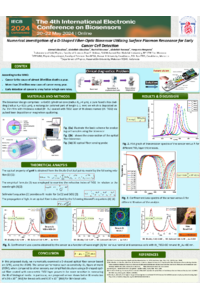
Poster FINAL Breast and Skin cells.pdf
A Spicy Recipe for At-Home Diagnostics: A Smart Salivary Edible Sensor for The Point-of-Care Diagnosis of Jaundice
“Screen-Printed Organic Electrochemical Transistor: A Protein Immobilization Approach to Detect Aromatic Water Pollutants”