Event submissions
Published
This submission belongs to the session I. Optical and Photonic Biosensors of the event The 4th International Electronic Conference on Biosensors
Published date
28 May, 2024
Academic Editor
'%3e%3cpath%20d='M12.6657%2010.9104C12.4185%2010.325%2012.0599%209.79327%2011.6097%209.34482C11.1609%208.89508%2010.6293%208.5365%2010.0442%208.28888C10.0389%208.28626%2010.0337%208.28495%2010.0285%208.28233C10.8446%207.69279%2011.3752%206.73249%2011.3752%205.64904C11.3752%203.8542%209.92103%202.39999%208.1262%202.39999C6.33136%202.39999%204.87715%203.8542%204.87715%205.64904C4.87715%206.73249%205.40774%207.69279%206.22393%208.28364C6.21869%208.28626%206.21345%208.28757%206.20821%208.29019C5.62129%208.5378%205.09463%208.89284%204.64265%209.34613C4.1929%209.79493%203.83432%2010.3266%203.58671%2010.9117C3.34345%2011.4845%203.21226%2012.0987%203.20023%2012.7209C3.19988%2012.7349%203.20233%2012.7488%203.20744%2012.7619C3.21255%2012.7749%203.22022%2012.7867%203.22998%2012.7968C3.23975%2012.8068%203.25142%2012.8147%203.26431%2012.8202C3.2772%2012.8256%203.29105%2012.8284%203.30504%2012.8284H4.09109C4.14874%2012.8284%204.19459%2012.7825%204.1959%2012.7262C4.2221%2011.7148%204.62823%2010.7676%205.34617%2010.0497C6.08899%209.30683%207.0755%208.89808%208.1262%208.89808C9.17689%208.89808%2010.1634%209.30683%2010.9062%2010.0497C11.6242%2010.7676%2012.0303%2011.7148%2012.0565%2012.7262C12.0578%2012.7838%2012.1037%2012.8284%2012.1613%2012.8284H12.9474C12.9613%2012.8284%2012.9752%2012.8256%2012.9881%2012.8202C13.001%2012.8147%2013.0126%2012.8068%2013.0224%2012.7968C13.0322%2012.7867%2013.0398%2012.7749%2013.0449%2012.7619C13.0501%2012.7488%2013.0525%2012.7349%2013.0522%2012.7209C13.0391%2012.0947%2012.9094%2011.4855%2012.6657%2010.9104ZM8.1262%207.9024C7.52486%207.9024%206.9589%207.6679%206.53312%207.24211C6.10733%206.81633%205.87283%206.25037%205.87283%205.64904C5.87283%205.0477%206.10733%204.48174%206.53312%204.05596C6.9589%203.63018%207.52486%203.39567%208.1262%203.39567C8.72753%203.39567%209.29349%203.63018%209.71927%204.05596C10.1451%204.48174%2010.3796%205.0477%2010.3796%205.64904C10.3796%206.25037%2010.1451%206.81633%209.71927%207.24211C9.29349%207.6679%208.72753%207.9024%208.1262%207.9024Z'%20fill='%235D1EE1'/%3e%3c/g%3e%3c/svg%3e) Jun-Jie Zhu
Jun-Jie ZhuCitation
Rahul Runthala, Pankaj Arora, Ultrasensitive surface-plasmon-resonance-based biosensor for efficient detection of SARS-CoV-2 Virus in near-infrared region, in Proceedings of The 4th International Electronic Conference on Biosensors, 20 May–22 May 2024, MDPI: Basel, Switzerland
Share
Email
Facebook
Twitter
LinkedIn
Ultrasensitive surface-plasmon-resonance-based biosensor for efficient detection of SARS-CoV-2 Virus in near-infrared region
'%3e%3cpath%20d='M12.6647%2010.9104C12.4176%2010.325%2012.0589%209.7933%2011.6088%209.34485C11.16%208.89511%2010.6283%208.53653%2010.0432%208.28891C10.038%208.28629%2010.0327%208.28498%2010.0275%208.28236C10.8437%207.69282%2011.3743%206.73252%2011.3743%205.64907C11.3743%203.85423%209.92005%202.40002%208.12522%202.40002C6.33038%202.40002%204.87618%203.85423%204.87618%205.64907C4.87618%206.73252%205.40677%207.69282%206.22296%208.28367C6.21772%208.28629%206.21248%208.2876%206.20724%208.29022C5.62031%208.53783%205.09365%208.89287%204.64167%209.34616C4.19192%209.79496%203.83334%2010.3266%203.58573%2010.9117C3.34247%2011.4846%203.21128%2012.0987%203.19925%2012.721C3.1989%2012.735%203.20135%2012.7489%203.20646%2012.7619C3.21157%2012.7749%203.21924%2012.7868%203.22901%2012.7968C3.23877%2012.8068%203.25045%2012.8148%203.26334%2012.8202C3.27623%2012.8256%203.29007%2012.8284%203.30406%2012.8284H4.09012C4.14776%2012.8284%204.19362%2012.7825%204.19493%2012.7262C4.22113%2011.7148%204.62726%2010.7676%205.34519%2010.0497C6.08802%209.30686%207.07452%208.89811%208.12522%208.89811C9.17592%208.89811%2010.1624%209.30686%2010.9052%2010.0497C11.6232%2010.7676%2012.0293%2011.7148%2012.0555%2012.7262C12.0568%2012.7839%2012.1027%2012.8284%2012.1603%2012.8284H12.9464C12.9604%2012.8284%2012.9742%2012.8256%2012.9871%2012.8202C13%2012.8148%2013.0117%2012.8068%2013.0214%2012.7968C13.0312%2012.7868%2013.0389%2012.7749%2013.044%2012.7619C13.0491%2012.7489%2013.0515%2012.735%2013.0512%2012.721C13.0381%2012.0947%2012.9084%2011.4856%2012.6647%2010.9104ZM8.12522%207.90243C7.52388%207.90243%206.95792%207.66793%206.53214%207.24215C6.10636%206.81636%205.87185%206.2504%205.87185%205.64907C5.87185%205.04773%206.10636%204.48177%206.53214%204.05599C6.95792%203.63021%207.52388%203.3957%208.12522%203.3957C8.72655%203.3957%209.29252%203.63021%209.7183%204.05599C10.1441%204.48177%2010.3786%205.04773%2010.3786%205.64907C10.3786%206.2504%2010.1441%206.81636%209.7183%207.24215C9.29252%207.66793%208.72655%207.90243%208.12522%207.90243Z'%20fill='%235D1EE1'/%3e%3c/g%3e%3c/svg%3e)
Rahul Runthala 1
Pankaj Arora 1
1. Department of Electrical & Electronics Engineering, Birla Institute of Technology & Science, Pilani, Rajasthan (India)
Abstract
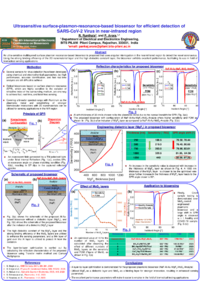
The COVID-19 pandemic has motivated scientists to delve deeper into this area and create cutting-edge biosensors that have the potential to enhance sensing beyond the current state of the art in terms of cost and accuracy. Several sensors for virus detection have been developed using chemical and electrochemical approaches as their foundations. Nevertheless, achieving high performance and accurate identification is not trivial. Surface plasmon resonance (SPR)-based optical biosensors are one method to capture very minute changes accurately via label-free sensing. This work offers a numerical approach for an ultra-sensitive multilayered SPR-based biosensor that uses angular interrogation in the near-infrared (NIR) region to detect the novel coronavirus (SARS-CoV-2). The multi-layered biosensor consists of a plasmonic metal, a dielectric layer (MgF2), and optimized 2D nanomaterial (MoS2) layers. In order to achieve high sensitivity, the figure of merit (FoM), and detection accuracy, the proposed plasmonic sensor was engineered using the transfer matrix method and finite element method after a thorough investigation. This includes the selection of plasmonic metal and optimization for the different layers. Using the strong binding efficiency of the MoS2 layer and the high dielectric constant of the MgF2 layer, the biosensor configuration comprising a glass prism/Al/Au/MgF2/MoS2/sensing sample is observed to exhibit the highest sensitivity of 372°/RIU, FoM of 1690 RIU-1, and detection accuracy of 4.54 degree-1. According to the investigation's findings, the proposed biosensor numerically exhibits excellent performance in the NIR region, making it easier to employ in the field of biomedical sensing applications.
Keywords
Biosensor
Surface Plasmon
SARS-CoV-2
Dielectric layer
2D nanomaterial
near infrared
Poster
IFEB_Arora poster.pdf
SPR studies of the impact of mercury(II) on DNA duplex formation: towards novel applications in nanoparticle-based Hg2+ biosensing
The development and standardization of a U-Bent LSPR Fiber Optic Biosensor to screen for Parvovirus B19 IgM