Event submissions
Published
This submission belongs to the session F. Nanomaterials and Smart Surfaces in Biosensors of the event The 4th International Electronic Conference on Biosensors
Published date
28 May, 2024
Academic Editor
'%3e%3cpath%20d='M12.6657%2010.9104C12.4185%2010.325%2012.0599%209.79327%2011.6097%209.34482C11.1609%208.89508%2010.6293%208.5365%2010.0442%208.28888C10.0389%208.28626%2010.0337%208.28495%2010.0285%208.28233C10.8446%207.69279%2011.3752%206.73249%2011.3752%205.64904C11.3752%203.8542%209.92103%202.39999%208.1262%202.39999C6.33136%202.39999%204.87715%203.8542%204.87715%205.64904C4.87715%206.73249%205.40774%207.69279%206.22393%208.28364C6.21869%208.28626%206.21345%208.28757%206.20821%208.29019C5.62129%208.5378%205.09463%208.89284%204.64265%209.34613C4.1929%209.79493%203.83432%2010.3266%203.58671%2010.9117C3.34345%2011.4845%203.21226%2012.0987%203.20023%2012.7209C3.19988%2012.7349%203.20233%2012.7488%203.20744%2012.7619C3.21255%2012.7749%203.22022%2012.7867%203.22998%2012.7968C3.23975%2012.8068%203.25142%2012.8147%203.26431%2012.8202C3.2772%2012.8256%203.29105%2012.8284%203.30504%2012.8284H4.09109C4.14874%2012.8284%204.19459%2012.7825%204.1959%2012.7262C4.2221%2011.7148%204.62823%2010.7676%205.34617%2010.0497C6.08899%209.30683%207.0755%208.89808%208.1262%208.89808C9.17689%208.89808%2010.1634%209.30683%2010.9062%2010.0497C11.6242%2010.7676%2012.0303%2011.7148%2012.0565%2012.7262C12.0578%2012.7838%2012.1037%2012.8284%2012.1613%2012.8284H12.9474C12.9613%2012.8284%2012.9752%2012.8256%2012.9881%2012.8202C13.001%2012.8147%2013.0126%2012.8068%2013.0224%2012.7968C13.0322%2012.7867%2013.0398%2012.7749%2013.0449%2012.7619C13.0501%2012.7488%2013.0525%2012.7349%2013.0522%2012.7209C13.0391%2012.0947%2012.9094%2011.4855%2012.6657%2010.9104ZM8.1262%207.9024C7.52486%207.9024%206.9589%207.6679%206.53312%207.24211C6.10733%206.81633%205.87283%206.25037%205.87283%205.64904C5.87283%205.0477%206.10733%204.48174%206.53312%204.05596C6.9589%203.63018%207.52486%203.39567%208.1262%203.39567C8.72753%203.39567%209.29349%203.63018%209.71927%204.05596C10.1451%204.48174%2010.3796%205.0477%2010.3796%205.64904C10.3796%206.25037%2010.1451%206.81633%209.71927%207.24211C9.29349%207.6679%208.72753%207.9024%208.1262%207.9024Z'%20fill='%235D1EE1'/%3e%3c/g%3e%3c/svg%3e) Michael Thompson
Michael ThompsonCitation
Martina Tozzetti, Cosimo Bartolini, Piero Procacci, Stefano Menichetti, Gabriella Caminati, Development of a sensor platform for the protein FKBP12, in Proceedings of The 4th International Electronic Conference on Biosensors, 20 May–22 May 2024, MDPI: Basel, Switzerland
Share
Email
Facebook
Twitter
LinkedIn
Development of a sensor platform for the protein FKBP12
'%3e%3cpath%20d='M12.6647%2010.9104C12.4176%2010.325%2012.0589%209.7933%2011.6088%209.34485C11.16%208.89511%2010.6283%208.53653%2010.0432%208.28891C10.038%208.28629%2010.0327%208.28498%2010.0275%208.28236C10.8437%207.69282%2011.3743%206.73252%2011.3743%205.64907C11.3743%203.85423%209.92005%202.40002%208.12522%202.40002C6.33038%202.40002%204.87618%203.85423%204.87618%205.64907C4.87618%206.73252%205.40677%207.69282%206.22296%208.28367C6.21772%208.28629%206.21248%208.2876%206.20724%208.29022C5.62031%208.53783%205.09365%208.89287%204.64167%209.34616C4.19192%209.79496%203.83334%2010.3266%203.58573%2010.9117C3.34247%2011.4846%203.21128%2012.0987%203.19925%2012.721C3.1989%2012.735%203.20135%2012.7489%203.20646%2012.7619C3.21157%2012.7749%203.21924%2012.7868%203.22901%2012.7968C3.23877%2012.8068%203.25045%2012.8148%203.26334%2012.8202C3.27623%2012.8256%203.29007%2012.8284%203.30406%2012.8284H4.09012C4.14776%2012.8284%204.19362%2012.7825%204.19493%2012.7262C4.22113%2011.7148%204.62726%2010.7676%205.34519%2010.0497C6.08802%209.30686%207.07452%208.89811%208.12522%208.89811C9.17592%208.89811%2010.1624%209.30686%2010.9052%2010.0497C11.6232%2010.7676%2012.0293%2011.7148%2012.0555%2012.7262C12.0568%2012.7839%2012.1027%2012.8284%2012.1603%2012.8284H12.9464C12.9604%2012.8284%2012.9742%2012.8256%2012.9871%2012.8202C13%2012.8148%2013.0117%2012.8068%2013.0214%2012.7968C13.0312%2012.7868%2013.0389%2012.7749%2013.044%2012.7619C13.0491%2012.7489%2013.0515%2012.735%2013.0512%2012.721C13.0381%2012.0947%2012.9084%2011.4856%2012.6647%2010.9104ZM8.12522%207.90243C7.52388%207.90243%206.95792%207.66793%206.53214%207.24215C6.10636%206.81636%205.87185%206.2504%205.87185%205.64907C5.87185%205.04773%206.10636%204.48177%206.53214%204.05599C6.95792%203.63021%207.52388%203.3957%208.12522%203.3957C8.72655%203.3957%209.29252%203.63021%209.7183%204.05599C10.1441%204.48177%2010.3786%205.04773%2010.3786%205.64907C10.3786%206.2504%2010.1441%206.81636%209.7183%207.24215C9.29252%207.66793%208.72655%207.90243%208.12522%207.90243Z'%20fill='%235D1EE1'/%3e%3c/g%3e%3c/svg%3e)
Martina Tozzetti 1,2
Cosimo Bartolini 1
Piero Procacci 1

Stefano Menichetti 1
Gabriella Caminati 1,2
1. University of Florence, via della Lastruccia 3-13, 50019, Sesto Fiorentino, (FI), Italy.
2. CSGI, via della Lastruccia 3-13, 50019, Sesto Fiorentino, (FI), Italy.
Abstract
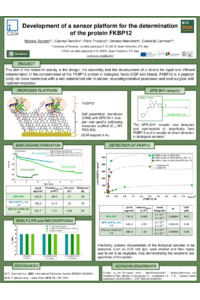
The aim of this research activity is the design, assembly and development of a device for the rapid and efficient detection of the FKBP12 protein in biological fluids, i.e., CSF and blood. FKBP12 is a peptidyl-prolyl cis-trans isomerase with a well-established role in neurodegenerative processes and the post-surgical anti-rejection response. The proposed nanoplatform consists of a gold- or silver-coated support for a Quartz Crystal Microbalance (QCM) functionalized with a synthetic receptor, GPS-SH1, designed and synthesized specifically to bind FKBP12. The nanostructures containing the receptor were obtained via chemical adsorption of the thiolate GPS-SH1, both alone and mixed with anti-fouling spacers, to form a Self-Assembled Monolayer (SAM). In particular, we examined linear chain alkylthiols, e.g., 1-Dodecanethiol (C12-SH), and a thiol-polyethylene glycol (PEG-SH), a polymer with known anti-fouling properties. The kinetics and thermodynamics of SAM formation, as well as the nanolayer structure, were obtained by means of QCM-d measurements for all harmonic frequencies. The same technique was used to monitor the adsorption of the protein on the nanosensor as a function of the FKBP12 concentration. In all cases, we observed immobilization of the protein on the SAM, but the best results in terms of the LOD and linearity range were obtained for SAMs of the GPS-SH1/C12-SH 1:6 mixture. We also tested BSA and IgG, commonly present in biological fluids of interest, to demonstrate the receptor selectivity for the protein. In collaboration with clinical laboratories, the proposed platform has been tested with blood samples from real patients. The addition of ethanol after the absorption of the proteins allows the sensor to be reconditioned for further analysis. Furthermore, frequency values measured on sensors with newly prepared SAMs or on sensors aged up to six months remained unchanged, indicating a long shelf-life.
Keywords
Nanosensor platform
FKBP12
Self-Assembled Monolayer
Quartz-Crystal-Microbalance
Poster
Poster_Tozzetti Martina.pdf
Glucose Detection Using mmWave Biosensor
Hybrid paper–fabric sandwich structure-based micro-analytical device for detection of iodine