Event submissions
Published
This submission belongs to the session F. Nanomaterials and Smart Surfaces in Biosensors of the event The 4th International Electronic Conference on Biosensors
Published date
28 May, 2024
Academic Editor
'%3e%3cpath%20d='M12.6657%2010.9104C12.4185%2010.325%2012.0599%209.79327%2011.6097%209.34482C11.1609%208.89508%2010.6293%208.5365%2010.0442%208.28888C10.0389%208.28626%2010.0337%208.28495%2010.0285%208.28233C10.8446%207.69279%2011.3752%206.73249%2011.3752%205.64904C11.3752%203.8542%209.92103%202.39999%208.1262%202.39999C6.33136%202.39999%204.87715%203.8542%204.87715%205.64904C4.87715%206.73249%205.40774%207.69279%206.22393%208.28364C6.21869%208.28626%206.21345%208.28757%206.20821%208.29019C5.62129%208.5378%205.09463%208.89284%204.64265%209.34613C4.1929%209.79493%203.83432%2010.3266%203.58671%2010.9117C3.34345%2011.4845%203.21226%2012.0987%203.20023%2012.7209C3.19988%2012.7349%203.20233%2012.7488%203.20744%2012.7619C3.21255%2012.7749%203.22022%2012.7867%203.22998%2012.7968C3.23975%2012.8068%203.25142%2012.8147%203.26431%2012.8202C3.2772%2012.8256%203.29105%2012.8284%203.30504%2012.8284H4.09109C4.14874%2012.8284%204.19459%2012.7825%204.1959%2012.7262C4.2221%2011.7148%204.62823%2010.7676%205.34617%2010.0497C6.08899%209.30683%207.0755%208.89808%208.1262%208.89808C9.17689%208.89808%2010.1634%209.30683%2010.9062%2010.0497C11.6242%2010.7676%2012.0303%2011.7148%2012.0565%2012.7262C12.0578%2012.7838%2012.1037%2012.8284%2012.1613%2012.8284H12.9474C12.9613%2012.8284%2012.9752%2012.8256%2012.9881%2012.8202C13.001%2012.8147%2013.0126%2012.8068%2013.0224%2012.7968C13.0322%2012.7867%2013.0398%2012.7749%2013.0449%2012.7619C13.0501%2012.7488%2013.0525%2012.7349%2013.0522%2012.7209C13.0391%2012.0947%2012.9094%2011.4855%2012.6657%2010.9104ZM8.1262%207.9024C7.52486%207.9024%206.9589%207.6679%206.53312%207.24211C6.10733%206.81633%205.87283%206.25037%205.87283%205.64904C5.87283%205.0477%206.10733%204.48174%206.53312%204.05596C6.9589%203.63018%207.52486%203.39567%208.1262%203.39567C8.72753%203.39567%209.29349%203.63018%209.71927%204.05596C10.1451%204.48174%2010.3796%205.0477%2010.3796%205.64904C10.3796%206.25037%2010.1451%206.81633%209.71927%207.24211C9.29349%207.6679%208.72753%207.9024%208.1262%207.9024Z'%20fill='%235D1EE1'/%3e%3c/g%3e%3c/svg%3e) Michael Thompson
Michael ThompsonCitation
María Jesús Ortiz - Aguayo, Carme Martínez - Domingo, Marta Mas - Torrent, Electrolyte-Gated Organic Field-Effect Transistors For Point-Of-Care Tests, in Proceedings of The 4th International Electronic Conference on Biosensors, 20 May–22 May 2024, MDPI: Basel, Switzerland
Share
Email
Facebook
Twitter
LinkedIn
Electrolyte-Gated Organic Field-Effect Transistors For Point-Of-Care Tests
'%3e%3cpath%20d='M12.6647%2010.9104C12.4176%2010.325%2012.0589%209.7933%2011.6088%209.34485C11.16%208.89511%2010.6283%208.53653%2010.0432%208.28891C10.038%208.28629%2010.0327%208.28498%2010.0275%208.28236C10.8437%207.69282%2011.3743%206.73252%2011.3743%205.64907C11.3743%203.85423%209.92005%202.40002%208.12522%202.40002C6.33038%202.40002%204.87618%203.85423%204.87618%205.64907C4.87618%206.73252%205.40677%207.69282%206.22296%208.28367C6.21772%208.28629%206.21248%208.2876%206.20724%208.29022C5.62031%208.53783%205.09365%208.89287%204.64167%209.34616C4.19192%209.79496%203.83334%2010.3266%203.58573%2010.9117C3.34247%2011.4846%203.21128%2012.0987%203.19925%2012.721C3.1989%2012.735%203.20135%2012.7489%203.20646%2012.7619C3.21157%2012.7749%203.21924%2012.7868%203.22901%2012.7968C3.23877%2012.8068%203.25045%2012.8148%203.26334%2012.8202C3.27623%2012.8256%203.29007%2012.8284%203.30406%2012.8284H4.09012C4.14776%2012.8284%204.19362%2012.7825%204.19493%2012.7262C4.22113%2011.7148%204.62726%2010.7676%205.34519%2010.0497C6.08802%209.30686%207.07452%208.89811%208.12522%208.89811C9.17592%208.89811%2010.1624%209.30686%2010.9052%2010.0497C11.6232%2010.7676%2012.0293%2011.7148%2012.0555%2012.7262C12.0568%2012.7839%2012.1027%2012.8284%2012.1603%2012.8284H12.9464C12.9604%2012.8284%2012.9742%2012.8256%2012.9871%2012.8202C13%2012.8148%2013.0117%2012.8068%2013.0214%2012.7968C13.0312%2012.7868%2013.0389%2012.7749%2013.044%2012.7619C13.0491%2012.7489%2013.0515%2012.735%2013.0512%2012.721C13.0381%2012.0947%2012.9084%2011.4856%2012.6647%2010.9104ZM8.12522%207.90243C7.52388%207.90243%206.95792%207.66793%206.53214%207.24215C6.10636%206.81636%205.87185%206.2504%205.87185%205.64907C5.87185%205.04773%206.10636%204.48177%206.53214%204.05599C6.95792%203.63021%207.52388%203.3957%208.12522%203.3957C8.72655%203.3957%209.29252%203.63021%209.7183%204.05599C10.1441%204.48177%2010.3786%205.04773%2010.3786%205.64907C10.3786%206.2504%2010.1441%206.81636%209.7183%207.24215C9.29252%207.66793%208.72655%207.90243%208.12522%207.90243Z'%20fill='%235D1EE1'/%3e%3c/g%3e%3c/svg%3e)
María Jesús Ortiz - Aguayo 1
Carme Martínez - Domingo 1

Marta Mas - Torrent 1
1. ICMAB - CSIC. Campus de la Universitat Autònoma de Barcelona. Carrer dels Til·lers, s/n, 08193 Bellaterra, Barcelona.
Abstract
Over the last few years, flexible electronics have been resonating in a wide variety of novel (bio)applications. As a key component, electrolyte-gated organic field-effect transistors (EGOFETs) are attracting considerable interest for their inherent advantages in miniaturization, low cost fabrication using solution processing methods, low power consumption, and label- free transduction, among others. Bearing this in mind, the idea in this study is to manufacture a novel EGOFET replacing the liquid electrolyte, which acts as dielectric, for new electrolyte platforms (i.e. hydrogels). This could overcome the limitations that aqueous media present. This material employed as an electrolyte provides OFETs with good mechanical properties and excellent biocompatibility, offering a suitable environment for the immobilization of biomolecules. The experimental approach involves the fabrication and characterization of an EGOFET using an organic semiconductor (OSC) as the active material and different dielectric media. For this reason, our proposal is to fabricate EGOFETs using a processing technique compatible with roll-to-roll processing (i.e. bar-assisted meniscus shearing (BAMS)), which allows the deposition of a layer of OSC blended with polystyrene (PS). Subsequently, the devices were characterized electrically by means of Transfer and Output Characteristics in order to demonstrate that the electrical parameters between both devices are comparable in terms of sensitivity. This work demonstrates that these devices based on hydrogels exhibit comparable electrical performance and long-term stability to those employing liquid electrolytes, and therefore they could be employed in several applications such as sensors of (bio)analytes of interest and point-of-care (POC) devices,. In conclusion, this research underscores the promising prospects of EGOFETs in transforming point-of-care testing. The integration of organic semiconductors and electrolyte gating not only enhances device sensitivity but also offers cost-effective and portable solutions for diagnostic applications. Future research may further refine and expand the applications of EGOFETs, paving the way for widespread adoption in routine diagnostic practices.
Keywords
EGOFET biosensor
Organic Electronics
POC devices
Poster
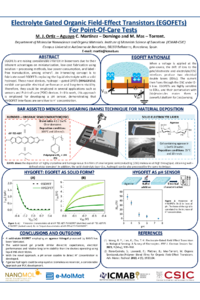
PosterIECB_2024_MJOrtiz-Aguayo.pdf
Bio-detection dogs sniff COVID-19 in Thailand
Ultrasensitive Lateral-Flow Immunoassay Based on Magnetically Modulated Fluorescent Nanodiamonds and Machine Learning Enhancement