Event submissions
Published
This submission belongs to the session A. Environmental and Green Processes of the event The 3rd International Electronic Conference on Processes
Published date
28 May, 2024
Academic Editor
'%3e%3cpath%20d='M12.6657%2010.9104C12.4185%2010.325%2012.0599%209.79327%2011.6097%209.34482C11.1609%208.89508%2010.6293%208.5365%2010.0442%208.28888C10.0389%208.28626%2010.0337%208.28495%2010.0285%208.28233C10.8446%207.69279%2011.3752%206.73249%2011.3752%205.64904C11.3752%203.8542%209.92103%202.39999%208.1262%202.39999C6.33136%202.39999%204.87715%203.8542%204.87715%205.64904C4.87715%206.73249%205.40774%207.69279%206.22393%208.28364C6.21869%208.28626%206.21345%208.28757%206.20821%208.29019C5.62129%208.5378%205.09463%208.89284%204.64265%209.34613C4.1929%209.79493%203.83432%2010.3266%203.58671%2010.9117C3.34345%2011.4845%203.21226%2012.0987%203.20023%2012.7209C3.19988%2012.7349%203.20233%2012.7488%203.20744%2012.7619C3.21255%2012.7749%203.22022%2012.7867%203.22998%2012.7968C3.23975%2012.8068%203.25142%2012.8147%203.26431%2012.8202C3.2772%2012.8256%203.29105%2012.8284%203.30504%2012.8284H4.09109C4.14874%2012.8284%204.19459%2012.7825%204.1959%2012.7262C4.2221%2011.7148%204.62823%2010.7676%205.34617%2010.0497C6.08899%209.30683%207.0755%208.89808%208.1262%208.89808C9.17689%208.89808%2010.1634%209.30683%2010.9062%2010.0497C11.6242%2010.7676%2012.0303%2011.7148%2012.0565%2012.7262C12.0578%2012.7838%2012.1037%2012.8284%2012.1613%2012.8284H12.9474C12.9613%2012.8284%2012.9752%2012.8256%2012.9881%2012.8202C13.001%2012.8147%2013.0126%2012.8068%2013.0224%2012.7968C13.0322%2012.7867%2013.0398%2012.7749%2013.0449%2012.7619C13.0501%2012.7488%2013.0525%2012.7349%2013.0522%2012.7209C13.0391%2012.0947%2012.9094%2011.4855%2012.6657%2010.9104ZM8.1262%207.9024C7.52486%207.9024%206.9589%207.6679%206.53312%207.24211C6.10733%206.81633%205.87283%206.25037%205.87283%205.64904C5.87283%205.0477%206.10733%204.48174%206.53312%204.05596C6.9589%203.63018%207.52486%203.39567%208.1262%203.39567C8.72753%203.39567%209.29349%203.63018%209.71927%204.05596C10.1451%204.48174%2010.3796%205.0477%2010.3796%205.64904C10.3796%206.25037%2010.1451%206.81633%209.71927%207.24211C9.29349%207.6679%208.72753%207.9024%208.1262%207.9024Z'%20fill='%235D1EE1'/%3e%3c/g%3e%3c/svg%3e) Juan Francisco García Martín
Juan Francisco García MartínCitation
CHKALA Hassan, Said IGHIR, Mohammed CHIGR, Nour-Eddine EL MANSOURI, Exploring Leaf Date Palm Fibers as a Reinforcement for Geopolymer Composites made from Mining Waste, in Proceedings of The 3rd International Electronic Conference on Processes, 29 May–31 May 2024, MDPI: Basel, Switzerland
Share
Email
Facebook
Twitter
LinkedIn
Exploring Leaf Date Palm Fibers as a Reinforcement for Geopolymer Composites made from Mining Waste
'%3e%3cpath%20d='M12.6647%2010.9104C12.4176%2010.325%2012.0589%209.7933%2011.6088%209.34485C11.16%208.89511%2010.6283%208.53653%2010.0432%208.28891C10.038%208.28629%2010.0327%208.28498%2010.0275%208.28236C10.8437%207.69282%2011.3743%206.73252%2011.3743%205.64907C11.3743%203.85423%209.92005%202.40002%208.12522%202.40002C6.33038%202.40002%204.87618%203.85423%204.87618%205.64907C4.87618%206.73252%205.40677%207.69282%206.22296%208.28367C6.21772%208.28629%206.21248%208.2876%206.20724%208.29022C5.62031%208.53783%205.09365%208.89287%204.64167%209.34616C4.19192%209.79496%203.83334%2010.3266%203.58573%2010.9117C3.34247%2011.4846%203.21128%2012.0987%203.19925%2012.721C3.1989%2012.735%203.20135%2012.7489%203.20646%2012.7619C3.21157%2012.7749%203.21924%2012.7868%203.22901%2012.7968C3.23877%2012.8068%203.25045%2012.8148%203.26334%2012.8202C3.27623%2012.8256%203.29007%2012.8284%203.30406%2012.8284H4.09012C4.14776%2012.8284%204.19362%2012.7825%204.19493%2012.7262C4.22113%2011.7148%204.62726%2010.7676%205.34519%2010.0497C6.08802%209.30686%207.07452%208.89811%208.12522%208.89811C9.17592%208.89811%2010.1624%209.30686%2010.9052%2010.0497C11.6232%2010.7676%2012.0293%2011.7148%2012.0555%2012.7262C12.0568%2012.7839%2012.1027%2012.8284%2012.1603%2012.8284H12.9464C12.9604%2012.8284%2012.9742%2012.8256%2012.9871%2012.8202C13%2012.8148%2013.0117%2012.8068%2013.0214%2012.7968C13.0312%2012.7868%2013.0389%2012.7749%2013.044%2012.7619C13.0491%2012.7489%2013.0515%2012.735%2013.0512%2012.721C13.0381%2012.0947%2012.9084%2011.4856%2012.6647%2010.9104ZM8.12522%207.90243C7.52388%207.90243%206.95792%207.66793%206.53214%207.24215C6.10636%206.81636%205.87185%206.2504%205.87185%205.64907C5.87185%205.04773%206.10636%204.48177%206.53214%204.05599C6.95792%203.63021%207.52388%203.3957%208.12522%203.3957C8.72655%203.3957%209.29252%203.63021%209.7183%204.05599C10.1441%204.48177%2010.3786%205.04773%2010.3786%205.64907C10.3786%206.2504%2010.1441%206.81636%209.7183%207.24215C9.29252%207.66793%208.72655%207.90243%208.12522%207.90243Z'%20fill='%235D1EE1'/%3e%3c/g%3e%3c/svg%3e)
CHKALA Hassan 1
Said IGHIR 1
Mohammed CHIGR 1
Nour-Eddine EL MANSOURI 1
1. Laboratory of Molecular Chemistry, Materials and Catalysis, Faculty of Science and Technology, Sultan Moulay Slimane University, Beni-Mellal, Morocco.
Abstract
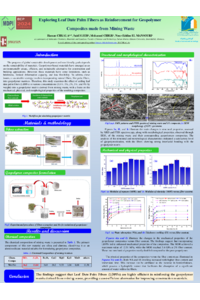
Ensuring the sustainability of geopolymer composites is essential for promoting global sustainable development and eco-friendly objectives. To achieve this, incorporating natural fibers such as palm fibers into geopolymer matrices offers a potential sustainable solution for geopolymer composite applications by reducing the environmental impacts. This study investigates the impact of incorporating leaf date palm fibers (LDPFs) at varying concentrations (0.5%, 1%, 2%, 3%, and 4% by weight) into a geopolymer matrix derived from mining waste on the resulting composites’ mechanical, physical, and morphological properties. The geopolymer matrix was synthetized by activating mining waste with a highly concentrated sodium hydroxide solution. Subsequently, the fibers were blended in until homogenous geopolymer composite pastes were achieved. After a curing period of 28 days, the geopolymer composites underwent a comprehensive analysis to assess their mechanical and physical properties in terms of the modulus of rupture (MOR), modulus of elasticity (MOE), thickness swelling (TS), and water absorption (WA), and their morphological properties (XRD, FTIR, and SEM-EDX spectroscopies).
The study’s findings demonstrate that the incorporation of LDPFs led to improvements in both the studied mechanical and physical properties of the formulated composites. Specifically, the MOR reached a peak of 12.51 MPa, while the MOE attained 3.4 GPa at a fiber content of approximately 2%. These two mechanical properties nearly doubled in value compared to the pure geopolymer. The achieved physical properties did not align with those reported for other composite materials discussed in the literature. Structural and morphological analyses of the geopolymer composites revealed a satisfactory degree of geopolymerization, and the fibers exhibited strong interfacial bonding with the geopolymer matrix.
The findings suggest that LDPFs are highly efficient in reinforcing the geopolymer matrix derived from mining waste, providing a cost-efficient alternative for improving construction materials.
Keywords
Geopolymer
Leaf date palm fibers
sustainability
mechanical
physical properties
structural
morphological.
Poster
65) ECP 2024 – Confirmed Poster for Gallery - sciforum-090282.pdf
INHIBITION EFFECT OF BENZIMIDAZOLIUM SALTS ON SWARING MOTILITY ON PSEUDOMONAS AERUGINOSA PAO1
The Prospects of Acetogenic Pretreatment for Energy Conservation in Textile Processing Wastewater in Resource-Constrained Economies