Event submissions
Published
This submission belongs to the session A. Environmental and Green Processes of the event The 3rd International Electronic Conference on Processes
Published date
28 May, 2024
Academic Editor
'%3e%3cpath%20d='M12.6657%2010.9104C12.4185%2010.325%2012.0599%209.79327%2011.6097%209.34482C11.1609%208.89508%2010.6293%208.5365%2010.0442%208.28888C10.0389%208.28626%2010.0337%208.28495%2010.0285%208.28233C10.8446%207.69279%2011.3752%206.73249%2011.3752%205.64904C11.3752%203.8542%209.92103%202.39999%208.1262%202.39999C6.33136%202.39999%204.87715%203.8542%204.87715%205.64904C4.87715%206.73249%205.40774%207.69279%206.22393%208.28364C6.21869%208.28626%206.21345%208.28757%206.20821%208.29019C5.62129%208.5378%205.09463%208.89284%204.64265%209.34613C4.1929%209.79493%203.83432%2010.3266%203.58671%2010.9117C3.34345%2011.4845%203.21226%2012.0987%203.20023%2012.7209C3.19988%2012.7349%203.20233%2012.7488%203.20744%2012.7619C3.21255%2012.7749%203.22022%2012.7867%203.22998%2012.7968C3.23975%2012.8068%203.25142%2012.8147%203.26431%2012.8202C3.2772%2012.8256%203.29105%2012.8284%203.30504%2012.8284H4.09109C4.14874%2012.8284%204.19459%2012.7825%204.1959%2012.7262C4.2221%2011.7148%204.62823%2010.7676%205.34617%2010.0497C6.08899%209.30683%207.0755%208.89808%208.1262%208.89808C9.17689%208.89808%2010.1634%209.30683%2010.9062%2010.0497C11.6242%2010.7676%2012.0303%2011.7148%2012.0565%2012.7262C12.0578%2012.7838%2012.1037%2012.8284%2012.1613%2012.8284H12.9474C12.9613%2012.8284%2012.9752%2012.8256%2012.9881%2012.8202C13.001%2012.8147%2013.0126%2012.8068%2013.0224%2012.7968C13.0322%2012.7867%2013.0398%2012.7749%2013.0449%2012.7619C13.0501%2012.7488%2013.0525%2012.7349%2013.0522%2012.7209C13.0391%2012.0947%2012.9094%2011.4855%2012.6657%2010.9104ZM8.1262%207.9024C7.52486%207.9024%206.9589%207.6679%206.53312%207.24211C6.10733%206.81633%205.87283%206.25037%205.87283%205.64904C5.87283%205.0477%206.10733%204.48174%206.53312%204.05596C6.9589%203.63018%207.52486%203.39567%208.1262%203.39567C8.72753%203.39567%209.29349%203.63018%209.71927%204.05596C10.1451%204.48174%2010.3796%205.0477%2010.3796%205.64904C10.3796%206.25037%2010.1451%206.81633%209.71927%207.24211C9.29349%207.6679%208.72753%207.9024%208.1262%207.9024Z'%20fill='%235D1EE1'/%3e%3c/g%3e%3c/svg%3e) Juan Francisco García Martín
Juan Francisco García MartínCitation
Zaid Mohammad Ahmad Al-Zrigat, Integrated BIM Framework for Minimizing Embodied Energy in Heritage Buildings: A Study in Old Downtown Amman with Darat al Funun Building, in Proceedings of The 3rd International Electronic Conference on Processes, 29 May–31 May 2024, MDPI: Basel, Switzerland
Share
Email
Facebook
Twitter
LinkedIn
Integrated BIM Framework for Minimizing Embodied Energy in Heritage Buildings: A Study in Old Downtown Amman with Darat al Funun Building

Zaid Mohammad Ahmad Al-Zrigat 1
1. Faculty of Technical Education, Al al-Bayt University, Al Mafraq, Jordan.
Abstract
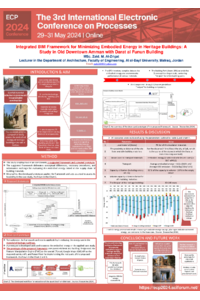
This study proposes an integrated Building Information Modeling (BIM) framework to minimize embodied energy (EE) in heritage buildings, focusing on Darat al Funun in Old Downtown Amman. Recognizing EE's significant role in heritage structures, this research addresses the need for comprehensive lifecycle energy evaluation of building materials. The framework merges BIM with Life Cycle Assessment (LCA), utilizing Extraction, Transformation, and Loading (ETL) technologies for enhanced data interoperability. The methodology involves developing a prototype in Autodesk Revit, incorporating spatial ETL via the Feature Manipulation Engine (FME), and using the Google Maps API for mapping services. Power Pivot facilitates advanced data analysis.
Applying the prototype to Darat al Funun assesses EE parameters, including material type (local stone), transportation means, and site proximity. Results show that using local materials reduces EE, with a 34 km transport distance from Salt, the stone source, demonstrating lower energy consumption and CO2 emissions. The study highlights the importance of transportation impacts, capacity utilization, and material lifespan in EE assessment. The framework effectively integrates BIM for energy evaluations, promotes eco-efficient materials, and influences green supply chain practices. The findings demonstrate its potential as a decision-support tool for sustainable heritage building practices. Future research should validate the framework in various projects, refine the prototype for industrial applications, and address on-site construction impacts and procurement costs. This study contributes to the literature by bridging the gap in embodied energy assessment within BIM processes for heritage environments.
Keywords
Building Information Modeling (BIM)-Embodied Energy (EE)- Heritage Buildings-Life Cycle Assessment (LCA).
Poster
Final Poster in MDPI.pdf
Impact of Plastic Cells and Fly Ash on the Compressive Strength of Concrete: An Empirical Investigation
Managing Dynamic Product Recovery of Electronic Goods in Wake of Reverse Logistics