Event submissions
Published
This submission belongs to the session A. Environmental and Green Processes of the event The 3rd International Electronic Conference on Processes
Published date
28 May, 2024
Academic Editor
'%3e%3cpath%20d='M12.6657%2010.9104C12.4185%2010.325%2012.0599%209.79327%2011.6097%209.34482C11.1609%208.89508%2010.6293%208.5365%2010.0442%208.28888C10.0389%208.28626%2010.0337%208.28495%2010.0285%208.28233C10.8446%207.69279%2011.3752%206.73249%2011.3752%205.64904C11.3752%203.8542%209.92103%202.39999%208.1262%202.39999C6.33136%202.39999%204.87715%203.8542%204.87715%205.64904C4.87715%206.73249%205.40774%207.69279%206.22393%208.28364C6.21869%208.28626%206.21345%208.28757%206.20821%208.29019C5.62129%208.5378%205.09463%208.89284%204.64265%209.34613C4.1929%209.79493%203.83432%2010.3266%203.58671%2010.9117C3.34345%2011.4845%203.21226%2012.0987%203.20023%2012.7209C3.19988%2012.7349%203.20233%2012.7488%203.20744%2012.7619C3.21255%2012.7749%203.22022%2012.7867%203.22998%2012.7968C3.23975%2012.8068%203.25142%2012.8147%203.26431%2012.8202C3.2772%2012.8256%203.29105%2012.8284%203.30504%2012.8284H4.09109C4.14874%2012.8284%204.19459%2012.7825%204.1959%2012.7262C4.2221%2011.7148%204.62823%2010.7676%205.34617%2010.0497C6.08899%209.30683%207.0755%208.89808%208.1262%208.89808C9.17689%208.89808%2010.1634%209.30683%2010.9062%2010.0497C11.6242%2010.7676%2012.0303%2011.7148%2012.0565%2012.7262C12.0578%2012.7838%2012.1037%2012.8284%2012.1613%2012.8284H12.9474C12.9613%2012.8284%2012.9752%2012.8256%2012.9881%2012.8202C13.001%2012.8147%2013.0126%2012.8068%2013.0224%2012.7968C13.0322%2012.7867%2013.0398%2012.7749%2013.0449%2012.7619C13.0501%2012.7488%2013.0525%2012.7349%2013.0522%2012.7209C13.0391%2012.0947%2012.9094%2011.4855%2012.6657%2010.9104ZM8.1262%207.9024C7.52486%207.9024%206.9589%207.6679%206.53312%207.24211C6.10733%206.81633%205.87283%206.25037%205.87283%205.64904C5.87283%205.0477%206.10733%204.48174%206.53312%204.05596C6.9589%203.63018%207.52486%203.39567%208.1262%203.39567C8.72753%203.39567%209.29349%203.63018%209.71927%204.05596C10.1451%204.48174%2010.3796%205.0477%2010.3796%205.64904C10.3796%206.25037%2010.1451%206.81633%209.71927%207.24211C9.29349%207.6679%208.72753%207.9024%208.1262%207.9024Z'%20fill='%235D1EE1'/%3e%3c/g%3e%3c/svg%3e) Giancarlo Cravotto
Giancarlo CravottoCitation
Asma Nouira, imene bekri abbes, Isabel Pestana Paixão Cansado, Paulo Mira Mourão, José Eduardo Castanheiro, Using activated carbon adsorbents obtained from plastic wastes from the Tunisian beverage industry, in Proceedings of The 3rd International Electronic Conference on Processes, 29 May–31 May 2024, MDPI: Basel, Switzerland
Share
Email
Facebook
Twitter
LinkedIn
Using activated carbon adsorbents obtained from plastic wastes from the Tunisian beverage industry
'%3e%3cpath%20d='M12.6647%2010.9104C12.4176%2010.325%2012.0589%209.7933%2011.6088%209.34485C11.16%208.89511%2010.6283%208.53653%2010.0432%208.28891C10.038%208.28629%2010.0327%208.28498%2010.0275%208.28236C10.8437%207.69282%2011.3743%206.73252%2011.3743%205.64907C11.3743%203.85423%209.92005%202.40002%208.12522%202.40002C6.33038%202.40002%204.87618%203.85423%204.87618%205.64907C4.87618%206.73252%205.40677%207.69282%206.22296%208.28367C6.21772%208.28629%206.21248%208.2876%206.20724%208.29022C5.62031%208.53783%205.09365%208.89287%204.64167%209.34616C4.19192%209.79496%203.83334%2010.3266%203.58573%2010.9117C3.34247%2011.4846%203.21128%2012.0987%203.19925%2012.721C3.1989%2012.735%203.20135%2012.7489%203.20646%2012.7619C3.21157%2012.7749%203.21924%2012.7868%203.22901%2012.7968C3.23877%2012.8068%203.25045%2012.8148%203.26334%2012.8202C3.27623%2012.8256%203.29007%2012.8284%203.30406%2012.8284H4.09012C4.14776%2012.8284%204.19362%2012.7825%204.19493%2012.7262C4.22113%2011.7148%204.62726%2010.7676%205.34519%2010.0497C6.08802%209.30686%207.07452%208.89811%208.12522%208.89811C9.17592%208.89811%2010.1624%209.30686%2010.9052%2010.0497C11.6232%2010.7676%2012.0293%2011.7148%2012.0555%2012.7262C12.0568%2012.7839%2012.1027%2012.8284%2012.1603%2012.8284H12.9464C12.9604%2012.8284%2012.9742%2012.8256%2012.9871%2012.8202C13%2012.8148%2013.0117%2012.8068%2013.0214%2012.7968C13.0312%2012.7868%2013.0389%2012.7749%2013.044%2012.7619C13.0491%2012.7489%2013.0515%2012.735%2013.0512%2012.721C13.0381%2012.0947%2012.9084%2011.4856%2012.6647%2010.9104ZM8.12522%207.90243C7.52388%207.90243%206.95792%207.66793%206.53214%207.24215C6.10636%206.81636%205.87185%206.2504%205.87185%205.64907C5.87185%205.04773%206.10636%204.48177%206.53214%204.05599C6.95792%203.63021%207.52388%203.3957%208.12522%203.3957C8.72655%203.3957%209.29252%203.63021%209.7183%204.05599C10.1441%204.48177%2010.3786%205.04773%2010.3786%205.64907C10.3786%206.2504%2010.1441%206.81636%209.7183%207.24215C9.29252%207.66793%208.72655%207.90243%208.12522%207.90243Z'%20fill='%235D1EE1'/%3e%3c/g%3e%3c/svg%3e)
Asma Nouira 1,2,3
imene bekri abbes 2

Isabel Pestana Paixão Cansado 4

Paulo Mira Mourão 4

José Eduardo Castanheiro 4
1. University of Tunis El Manar, Faculty of Mathematical, Physical and Natural Sciences of Tunis, Campus Universitaire 2092 - El Manar-Tunis, Tunisia
2. National Center for Research in Materials Science, Borj Cedria, Technopole of Borj Cedria, Slimane 8027, Tunisia
3. Polo da Mitra da Universidade de Évora, 7000-083 Nossa Senhora da Tourega, Portugal
4. 3Mediterranean Institute for Agriculture, Environment and Development & Change – Global Change and Sustainability Institute, Departamento de Química e Bioquímica, Escola de Ciências e Tecnologia, Universidade de Évora, Rua Romão Ramalho nº 59, 7000-671 Év
Abstract
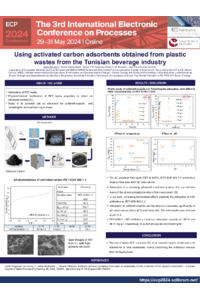
In this study, we investigated the preparation of char and activated carbon (AC) materials derived from water bottles and bottle waste collected at a waste collection point in Tunisia. The materials were synthesized using a rotary horizontal tubular furnace on a lab/pilot scale and through chemical activation. Characterization of the carbon materials was performed using nitrogen adsorption isotherms at 77K and SEM-EDX analysis.
Furthermore, we examined the effectiveness of the ACs in removing the antibiotics 4-amino-N-(5-methyl-1,2-oxazol-3-yl)benzenesulfonamide (sulfamethoxazole - C10H11N3O3S) and 5-(3,4,5-trimethoxybenzyl)pyrimidine-2,4-diamine (trimethoprim) from aqueous solutions. The results revealed a maximum adsorption capacity of 108.17 mg g-1 (85.34%) for sulfamethoxazole and 98.11 mg g-1 (89.73%) for trimethoprim on the PET-KOH-1:1-800°C sample.
Additionally, we analyzed the adsorption kinetics, fitting the data to pseudo-first and -second-order models, and studied the equilibrium isotherms using the Langmuir and Freundlich equation models. These findings suggest significant potential for the application of ACs derived from plastic bottle waste in the treatment of wastewater containing antibiotics.
Overall, our study highlights the feasibility of utilizing waste materials for the synthesis of valuable carbon-based adsorbents with promising adsorption capabilities. This research contributes to the ongoing efforts towards sustainable waste management and environmental remediation.
Keywords
activated
carbon
bottle
waste
sulfamethoxazole
trimethoprim
adsorption
Poster
ECP 2024 – Confirmed Poster for Gallery - sciforum-090452.pdf
Physiology and cell viability of new strains of destructors of organic pollutants
Improvement of structural, morphological and mechanical properties by reinforcing sisal fibers in a reinforced concrete slab