Event submissions
Published
This submission belongs to the session A. Environmental and Green Processes of the event The 3rd International Electronic Conference on Processes
Published date
28 May, 2024
Academic Editor
'%3e%3cpath%20d='M12.6657%2010.9104C12.4185%2010.325%2012.0599%209.79327%2011.6097%209.34482C11.1609%208.89508%2010.6293%208.5365%2010.0442%208.28888C10.0389%208.28626%2010.0337%208.28495%2010.0285%208.28233C10.8446%207.69279%2011.3752%206.73249%2011.3752%205.64904C11.3752%203.8542%209.92103%202.39999%208.1262%202.39999C6.33136%202.39999%204.87715%203.8542%204.87715%205.64904C4.87715%206.73249%205.40774%207.69279%206.22393%208.28364C6.21869%208.28626%206.21345%208.28757%206.20821%208.29019C5.62129%208.5378%205.09463%208.89284%204.64265%209.34613C4.1929%209.79493%203.83432%2010.3266%203.58671%2010.9117C3.34345%2011.4845%203.21226%2012.0987%203.20023%2012.7209C3.19988%2012.7349%203.20233%2012.7488%203.20744%2012.7619C3.21255%2012.7749%203.22022%2012.7867%203.22998%2012.7968C3.23975%2012.8068%203.25142%2012.8147%203.26431%2012.8202C3.2772%2012.8256%203.29105%2012.8284%203.30504%2012.8284H4.09109C4.14874%2012.8284%204.19459%2012.7825%204.1959%2012.7262C4.2221%2011.7148%204.62823%2010.7676%205.34617%2010.0497C6.08899%209.30683%207.0755%208.89808%208.1262%208.89808C9.17689%208.89808%2010.1634%209.30683%2010.9062%2010.0497C11.6242%2010.7676%2012.0303%2011.7148%2012.0565%2012.7262C12.0578%2012.7838%2012.1037%2012.8284%2012.1613%2012.8284H12.9474C12.9613%2012.8284%2012.9752%2012.8256%2012.9881%2012.8202C13.001%2012.8147%2013.0126%2012.8068%2013.0224%2012.7968C13.0322%2012.7867%2013.0398%2012.7749%2013.0449%2012.7619C13.0501%2012.7488%2013.0525%2012.7349%2013.0522%2012.7209C13.0391%2012.0947%2012.9094%2011.4855%2012.6657%2010.9104ZM8.1262%207.9024C7.52486%207.9024%206.9589%207.6679%206.53312%207.24211C6.10733%206.81633%205.87283%206.25037%205.87283%205.64904C5.87283%205.0477%206.10733%204.48174%206.53312%204.05596C6.9589%203.63018%207.52486%203.39567%208.1262%203.39567C8.72753%203.39567%209.29349%203.63018%209.71927%204.05596C10.1451%204.48174%2010.3796%205.0477%2010.3796%205.64904C10.3796%206.25037%2010.1451%206.81633%209.71927%207.24211C9.29349%207.6679%208.72753%207.9024%208.1262%207.9024Z'%20fill='%235D1EE1'/%3e%3c/g%3e%3c/svg%3e) Juan Francisco García Martín
Juan Francisco García MartínCitation
Robert Someo Makomere, Lawrence Koech, Hilary Limo Rutto, Alfayo Alugongo, Exploring the Dynamics of Natural Sodium Bicarbonate, Sodium Carbonate, and Black Ash in Spray-Dry SO₂ Capture, in Proceedings of The 3rd International Electronic Conference on Processes, 29 May–31 May 2024, MDPI: Basel, Switzerland
Share
Email
Facebook
Twitter
LinkedIn
Exploring the Dynamics of Natural Sodium Bicarbonate, Sodium Carbonate, and Black Ash in Spray-Dry SO2 Capture
'%3e%3cpath%20d='M12.6647%2010.9104C12.4176%2010.325%2012.0589%209.7933%2011.6088%209.34485C11.16%208.89511%2010.6283%208.53653%2010.0432%208.28891C10.038%208.28629%2010.0327%208.28498%2010.0275%208.28236C10.8437%207.69282%2011.3743%206.73252%2011.3743%205.64907C11.3743%203.85423%209.92005%202.40002%208.12522%202.40002C6.33038%202.40002%204.87618%203.85423%204.87618%205.64907C4.87618%206.73252%205.40677%207.69282%206.22296%208.28367C6.21772%208.28629%206.21248%208.2876%206.20724%208.29022C5.62031%208.53783%205.09365%208.89287%204.64167%209.34616C4.19192%209.79496%203.83334%2010.3266%203.58573%2010.9117C3.34247%2011.4846%203.21128%2012.0987%203.19925%2012.721C3.1989%2012.735%203.20135%2012.7489%203.20646%2012.7619C3.21157%2012.7749%203.21924%2012.7868%203.22901%2012.7968C3.23877%2012.8068%203.25045%2012.8148%203.26334%2012.8202C3.27623%2012.8256%203.29007%2012.8284%203.30406%2012.8284H4.09012C4.14776%2012.8284%204.19362%2012.7825%204.19493%2012.7262C4.22113%2011.7148%204.62726%2010.7676%205.34519%2010.0497C6.08802%209.30686%207.07452%208.89811%208.12522%208.89811C9.17592%208.89811%2010.1624%209.30686%2010.9052%2010.0497C11.6232%2010.7676%2012.0293%2011.7148%2012.0555%2012.7262C12.0568%2012.7839%2012.1027%2012.8284%2012.1603%2012.8284H12.9464C12.9604%2012.8284%2012.9742%2012.8256%2012.9871%2012.8202C13%2012.8148%2013.0117%2012.8068%2013.0214%2012.7968C13.0312%2012.7868%2013.0389%2012.7749%2013.044%2012.7619C13.0491%2012.7489%2013.0515%2012.735%2013.0512%2012.721C13.0381%2012.0947%2012.9084%2011.4856%2012.6647%2010.9104ZM8.12522%207.90243C7.52388%207.90243%206.95792%207.66793%206.53214%207.24215C6.10636%206.81636%205.87185%206.2504%205.87185%205.64907C5.87185%205.04773%206.10636%204.48177%206.53214%204.05599C6.95792%203.63021%207.52388%203.3957%208.12522%203.3957C8.72655%203.3957%209.29252%203.63021%209.7183%204.05599C10.1441%204.48177%2010.3786%205.04773%2010.3786%205.64907C10.3786%206.2504%2010.1441%206.81636%209.7183%207.24215C9.29252%207.66793%208.72655%207.90243%208.12522%207.90243Z'%20fill='%235D1EE1'/%3e%3c/g%3e%3c/svg%3e)
Robert Someo Makomere 1
Lawrence Koech 2
Hilary Limo Rutto 2
Alfayo Alugongo 3
1. Department of Chemical and Metallurgical Engineering, Vaal University of Technology, Private Bag X021, Vanderbijlpark 1900, Gauteng, South Africa.
2. Clean Technology and Applied Materials Research Group, Department of Chemical and Metallurgical Engineering, Vaal University of Technology, Private Bag X021, Vanderbijlpark 1900, Gauteng, South Africa.
3. Department of Industrial Engineering, Operation Management, and Mechanical Engineering, Vaal University of Technology, Andries Potgieter Blvd, Private Bag X021, Vanderbijlpark 1911, South Africa
Abstract
The viability of spray-dry desulphurisation relative to wet flue gas desulphurisation (FGD) systems is determined by selecting a highly reactive scrubbing reagent. This research evaluated sodium-based reagents from natural and waste by-product sources for treating sulphur dioxide (SO2). Sodium carbonate (Na2CO3) and sodium bicarbonate (NaHCO3) were obtained from mineral sources, whereas the black ash (BA) (Na2CO3.NaHCO3) was sourced from the pulp and paper industry. The sorbents introduced in slurry form were subject to SO2 absorption conditions in a lab-scale spray dryer, including an inlet gas phase temperature of 120 to 180 °C, a flue gas flow rate of 21 to 34 m3/h, and a sodium-to-sulphur stoichiometric ratio (SR) (Na:S) of 0.5 to 2. The performance comparison was assessed based on %SO2 removal efficiency (% DeSOx) and revealed that NaHCO3 exhibited the highest overall effectiveness of 62% at saturation. BA was the second-best-performing reagent, achieving a removal efficiency of 56%, and Na2CO3 demonstrated the lowest efficiency of 53%. The maximum SO2 reduction of NaHCO3 at individual operating conditions was seen at an SR of 1.75 (69%), a reaction temperature of 120 °C (73%), and a gas inlet flow rate of 34 m3/h (80%). In summary, the sodium reagents produced a notable SO2 neutralisation of over 50% in their unprocessed state, which is within permissible bounds in small- to medium-sized coal-fired power plants considering retrofitting pollution mitigation systems.
Keywords
Black Ash
Desulphurisation
Emission control
Sodium Carbonate
Sodium Bicarbonate
Spray-dry
Poster
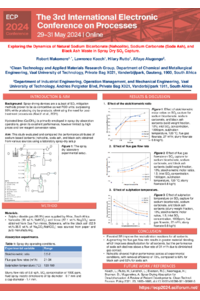
ECP 2024 – Confirmed Poster for Gallery - sciforum-084520.pdf
REMOVAL OF CADMIUM (II) FROM ACID MINE DRAINAGE USING BIODEGRADABLE ADSORBENT USING RESPONSE SURFACE METHODOLOGY
Removal of micropollutant by using hydrocavitation/ozone