Event submissions
Published
This submission belongs to the session B. Energy Systems of the event The 3rd International Electronic Conference on Processes
Published date
28 May, 2024
Academic Editor
'%3e%3cpath%20d='M12.6657%2010.9104C12.4185%2010.325%2012.0599%209.79327%2011.6097%209.34482C11.1609%208.89508%2010.6293%208.5365%2010.0442%208.28888C10.0389%208.28626%2010.0337%208.28495%2010.0285%208.28233C10.8446%207.69279%2011.3752%206.73249%2011.3752%205.64904C11.3752%203.8542%209.92103%202.39999%208.1262%202.39999C6.33136%202.39999%204.87715%203.8542%204.87715%205.64904C4.87715%206.73249%205.40774%207.69279%206.22393%208.28364C6.21869%208.28626%206.21345%208.28757%206.20821%208.29019C5.62129%208.5378%205.09463%208.89284%204.64265%209.34613C4.1929%209.79493%203.83432%2010.3266%203.58671%2010.9117C3.34345%2011.4845%203.21226%2012.0987%203.20023%2012.7209C3.19988%2012.7349%203.20233%2012.7488%203.20744%2012.7619C3.21255%2012.7749%203.22022%2012.7867%203.22998%2012.7968C3.23975%2012.8068%203.25142%2012.8147%203.26431%2012.8202C3.2772%2012.8256%203.29105%2012.8284%203.30504%2012.8284H4.09109C4.14874%2012.8284%204.19459%2012.7825%204.1959%2012.7262C4.2221%2011.7148%204.62823%2010.7676%205.34617%2010.0497C6.08899%209.30683%207.0755%208.89808%208.1262%208.89808C9.17689%208.89808%2010.1634%209.30683%2010.9062%2010.0497C11.6242%2010.7676%2012.0303%2011.7148%2012.0565%2012.7262C12.0578%2012.7838%2012.1037%2012.8284%2012.1613%2012.8284H12.9474C12.9613%2012.8284%2012.9752%2012.8256%2012.9881%2012.8202C13.001%2012.8147%2013.0126%2012.8068%2013.0224%2012.7968C13.0322%2012.7867%2013.0398%2012.7749%2013.0449%2012.7619C13.0501%2012.7488%2013.0525%2012.7349%2013.0522%2012.7209C13.0391%2012.0947%2012.9094%2011.4855%2012.6657%2010.9104ZM8.1262%207.9024C7.52486%207.9024%206.9589%207.6679%206.53312%207.24211C6.10733%206.81633%205.87283%206.25037%205.87283%205.64904C5.87283%205.0477%206.10733%204.48174%206.53312%204.05596C6.9589%203.63018%207.52486%203.39567%208.1262%203.39567C8.72753%203.39567%209.29349%203.63018%209.71927%204.05596C10.1451%204.48174%2010.3796%205.0477%2010.3796%205.64904C10.3796%206.25037%2010.1451%206.81633%209.71927%207.24211C9.29349%207.6679%208.72753%207.9024%208.1262%207.9024Z'%20fill='%235D1EE1'/%3e%3c/g%3e%3c/svg%3e) Michael C. Georgiadis
Michael C. GeorgiadisCitation
Paolo Blecich, Igor Wolf, Tomislav Senčić, Igor Bonefačić, IMPACT OF CLIMATE CHANGE ON THE THERMOECONOMIC PERFORMANCE OF BINARY-CYCLE GEOTHERMAL POWER PLANTS, in Proceedings of The 3rd International Electronic Conference on Processes, 29 May–31 May 2024, MDPI: Basel, Switzerland
Share
Email
Facebook
Twitter
LinkedIn
IMPACT OF CLIMATE CHANGE ON THE THERMOECONOMIC PERFORMANCE OF BINARY-CYCLE GEOTHERMAL POWER PLANTS

Paolo Blecich 1
'%3e%3cpath%20d='M12.6647%2010.9104C12.4176%2010.325%2012.0589%209.7933%2011.6088%209.34485C11.16%208.89511%2010.6283%208.53653%2010.0432%208.28891C10.038%208.28629%2010.0327%208.28498%2010.0275%208.28236C10.8437%207.69282%2011.3743%206.73252%2011.3743%205.64907C11.3743%203.85423%209.92005%202.40002%208.12522%202.40002C6.33038%202.40002%204.87618%203.85423%204.87618%205.64907C4.87618%206.73252%205.40677%207.69282%206.22296%208.28367C6.21772%208.28629%206.21248%208.2876%206.20724%208.29022C5.62031%208.53783%205.09365%208.89287%204.64167%209.34616C4.19192%209.79496%203.83334%2010.3266%203.58573%2010.9117C3.34247%2011.4846%203.21128%2012.0987%203.19925%2012.721C3.1989%2012.735%203.20135%2012.7489%203.20646%2012.7619C3.21157%2012.7749%203.21924%2012.7868%203.22901%2012.7968C3.23877%2012.8068%203.25045%2012.8148%203.26334%2012.8202C3.27623%2012.8256%203.29007%2012.8284%203.30406%2012.8284H4.09012C4.14776%2012.8284%204.19362%2012.7825%204.19493%2012.7262C4.22113%2011.7148%204.62726%2010.7676%205.34519%2010.0497C6.08802%209.30686%207.07452%208.89811%208.12522%208.89811C9.17592%208.89811%2010.1624%209.30686%2010.9052%2010.0497C11.6232%2010.7676%2012.0293%2011.7148%2012.0555%2012.7262C12.0568%2012.7839%2012.1027%2012.8284%2012.1603%2012.8284H12.9464C12.9604%2012.8284%2012.9742%2012.8256%2012.9871%2012.8202C13%2012.8148%2013.0117%2012.8068%2013.0214%2012.7968C13.0312%2012.7868%2013.0389%2012.7749%2013.044%2012.7619C13.0491%2012.7489%2013.0515%2012.735%2013.0512%2012.721C13.0381%2012.0947%2012.9084%2011.4856%2012.6647%2010.9104ZM8.12522%207.90243C7.52388%207.90243%206.95792%207.66793%206.53214%207.24215C6.10636%206.81636%205.87185%206.2504%205.87185%205.64907C5.87185%205.04773%206.10636%204.48177%206.53214%204.05599C6.95792%203.63021%207.52388%203.3957%208.12522%203.3957C8.72655%203.3957%209.29252%203.63021%209.7183%204.05599C10.1441%204.48177%2010.3786%205.04773%2010.3786%205.64907C10.3786%206.2504%2010.1441%206.81636%209.7183%207.24215C9.29252%207.66793%208.72655%207.90243%208.12522%207.90243Z'%20fill='%235D1EE1'/%3e%3c/g%3e%3c/svg%3e)
Igor Wolf 1

Tomislav Senčić 1
Igor Bonefačić 1
1. Department of Thermodynamics and Energy Engineering, Faculty of Engineering, University of Rijeka, Croatia
Abstract
The thermoeconomic performance of binary-cycle geothermal power plants is influenced by a variety of site-specific factors, major economic variables and the type of the involved technology. Besides those, ambient conditions also play a role in the geothermal power generation by acting on the cooling towers. This study focuses on the performance analysis of subcritical and supercritical isobutane cycles for power generation from geothermal source temperatures between 150 and 200 °C, additionally accounting for the impact of short- and long-term variations in the ambient conditions. Short-term variations are represented by hourly, daily and seasonal variations in the ambient conditions while long-term variations are described by climate projections under two representative concentration pathways (RCPs): the intermediate RCP4.5 scenario and the extreme RCP8.5 scenario, over the period from 2021 to 2100. The global climate models from the most recent Climate Model Intercomparison Project (CMIP6) are compared against observed temperature data from the reference period 1991-2020. The predictive power of the CMIP6 climate models is evaluated using the root mean square error (RMSE) and the Kullback–Leibler (KL) criteria. The thermoeconomic performance of the geothermal power plant is expressed in terms of net power output, annual electricity generation and levelized cost of electricity (LCOE). The results revealed that a reference geothermal power plant with 10 MW net power output and an LCOE of 74 US$/MWh at the standard ambient state (t = 20 °C, rh = 50%, p = 101325 Pa) is subject to daily, monthly and seasonal variations by as much as 25% in net power output and up to 15% in the LCOE. Over the period from 2021 to 2100, the annual electricity generation of the reference geothermal power plant is reduced by 5% and 3% in the extreme (RCP8.5) and intermediate (RCP4.5) climate change scenarios, respectively.
Keywords
thermoeconomic analysis
geothermal power plant
climate change
binary cycle technology
isobutane
Poster
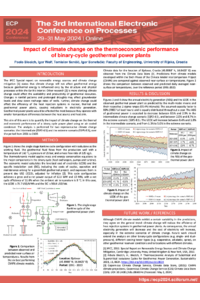
ECP 2024 – Confirmed Poster for Gallery - sciforum-087480.pdf
An energy-efficient routing technique based on concentric and progressive clusters for wireless sensor networks
A Review of Smart Grid Technologies: Past, Present, and Future Outlook