Event submissions
Published
This submission belongs to the session B. Energy Systems of the event The 3rd International Electronic Conference on Processes
Published date
28 May, 2024
Academic Editor
'%3e%3cpath%20d='M12.6657%2010.9104C12.4185%2010.325%2012.0599%209.79327%2011.6097%209.34482C11.1609%208.89508%2010.6293%208.5365%2010.0442%208.28888C10.0389%208.28626%2010.0337%208.28495%2010.0285%208.28233C10.8446%207.69279%2011.3752%206.73249%2011.3752%205.64904C11.3752%203.8542%209.92103%202.39999%208.1262%202.39999C6.33136%202.39999%204.87715%203.8542%204.87715%205.64904C4.87715%206.73249%205.40774%207.69279%206.22393%208.28364C6.21869%208.28626%206.21345%208.28757%206.20821%208.29019C5.62129%208.5378%205.09463%208.89284%204.64265%209.34613C4.1929%209.79493%203.83432%2010.3266%203.58671%2010.9117C3.34345%2011.4845%203.21226%2012.0987%203.20023%2012.7209C3.19988%2012.7349%203.20233%2012.7488%203.20744%2012.7619C3.21255%2012.7749%203.22022%2012.7867%203.22998%2012.7968C3.23975%2012.8068%203.25142%2012.8147%203.26431%2012.8202C3.2772%2012.8256%203.29105%2012.8284%203.30504%2012.8284H4.09109C4.14874%2012.8284%204.19459%2012.7825%204.1959%2012.7262C4.2221%2011.7148%204.62823%2010.7676%205.34617%2010.0497C6.08899%209.30683%207.0755%208.89808%208.1262%208.89808C9.17689%208.89808%2010.1634%209.30683%2010.9062%2010.0497C11.6242%2010.7676%2012.0303%2011.7148%2012.0565%2012.7262C12.0578%2012.7838%2012.1037%2012.8284%2012.1613%2012.8284H12.9474C12.9613%2012.8284%2012.9752%2012.8256%2012.9881%2012.8202C13.001%2012.8147%2013.0126%2012.8068%2013.0224%2012.7968C13.0322%2012.7867%2013.0398%2012.7749%2013.0449%2012.7619C13.0501%2012.7488%2013.0525%2012.7349%2013.0522%2012.7209C13.0391%2012.0947%2012.9094%2011.4855%2012.6657%2010.9104ZM8.1262%207.9024C7.52486%207.9024%206.9589%207.6679%206.53312%207.24211C6.10733%206.81633%205.87283%206.25037%205.87283%205.64904C5.87283%205.0477%206.10733%204.48174%206.53312%204.05596C6.9589%203.63018%207.52486%203.39567%208.1262%203.39567C8.72753%203.39567%209.29349%203.63018%209.71927%204.05596C10.1451%204.48174%2010.3796%205.0477%2010.3796%205.64904C10.3796%206.25037%2010.1451%206.81633%209.71927%207.24211C9.29349%207.6679%208.72753%207.9024%208.1262%207.9024Z'%20fill='%235D1EE1'/%3e%3c/g%3e%3c/svg%3e) Michael C. Georgiadis
Michael C. GeorgiadisCitation
Mehdi BOUDOUH, Brahim El Khalil HACHI, Mohamed HABOUSSI, Sadam Houcine Habib, Application of the finite element method (FEM) to analyze the mechanical behavior on peizoelectric materials when an electric field is applied to a piezoelectric structure (Inverse Piezoelectricity), in Proceedings of The 3rd International Electronic Conference on Processes, 29 May–31 May 2024, MDPI: Basel, Switzerland
Share
Email
Facebook
Twitter
LinkedIn
Application of the finite element method (FEM) to analyze the mechanical behavior on peizoelectric materials when an electric field is applied to a piezoelectric structure (Inverse Piezoelectricity)
'%3e%3cpath%20d='M12.6647%2010.9104C12.4176%2010.325%2012.0589%209.7933%2011.6088%209.34485C11.16%208.89511%2010.6283%208.53653%2010.0432%208.28891C10.038%208.28629%2010.0327%208.28498%2010.0275%208.28236C10.8437%207.69282%2011.3743%206.73252%2011.3743%205.64907C11.3743%203.85423%209.92005%202.40002%208.12522%202.40002C6.33038%202.40002%204.87618%203.85423%204.87618%205.64907C4.87618%206.73252%205.40677%207.69282%206.22296%208.28367C6.21772%208.28629%206.21248%208.2876%206.20724%208.29022C5.62031%208.53783%205.09365%208.89287%204.64167%209.34616C4.19192%209.79496%203.83334%2010.3266%203.58573%2010.9117C3.34247%2011.4846%203.21128%2012.0987%203.19925%2012.721C3.1989%2012.735%203.20135%2012.7489%203.20646%2012.7619C3.21157%2012.7749%203.21924%2012.7868%203.22901%2012.7968C3.23877%2012.8068%203.25045%2012.8148%203.26334%2012.8202C3.27623%2012.8256%203.29007%2012.8284%203.30406%2012.8284H4.09012C4.14776%2012.8284%204.19362%2012.7825%204.19493%2012.7262C4.22113%2011.7148%204.62726%2010.7676%205.34519%2010.0497C6.08802%209.30686%207.07452%208.89811%208.12522%208.89811C9.17592%208.89811%2010.1624%209.30686%2010.9052%2010.0497C11.6232%2010.7676%2012.0293%2011.7148%2012.0555%2012.7262C12.0568%2012.7839%2012.1027%2012.8284%2012.1603%2012.8284H12.9464C12.9604%2012.8284%2012.9742%2012.8256%2012.9871%2012.8202C13%2012.8148%2013.0117%2012.8068%2013.0214%2012.7968C13.0312%2012.7868%2013.0389%2012.7749%2013.044%2012.7619C13.0491%2012.7489%2013.0515%2012.735%2013.0512%2012.721C13.0381%2012.0947%2012.9084%2011.4856%2012.6647%2010.9104ZM8.12522%207.90243C7.52388%207.90243%206.95792%207.66793%206.53214%207.24215C6.10636%206.81636%205.87185%206.2504%205.87185%205.64907C5.87185%205.04773%206.10636%204.48177%206.53214%204.05599C6.95792%203.63021%207.52388%203.3957%208.12522%203.3957C8.72655%203.3957%209.29252%203.63021%209.7183%204.05599C10.1441%204.48177%2010.3786%205.04773%2010.3786%205.64907C10.3786%206.2504%2010.1441%206.81636%209.7183%207.24215C9.29252%207.66793%208.72655%207.90243%208.12522%207.90243Z'%20fill='%235D1EE1'/%3e%3c/g%3e%3c/svg%3e)
Mehdi BOUDOUH 1
Brahim El Khalil HACHI 1
Mohamed HABOUSSI 2
Sadam Houcine Habib 1
1. laboratory of development in mechanical and materials (LDMM) , Ziane Achour University , Djelfa , Algeria
2. Laboratory of Process and Materials Sciences (LSPM), Sorbonne Paris Nord University, UPR 3407 CNRS, F-93430, Villetaneuse, France
Abstract
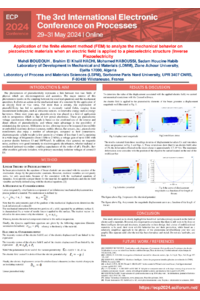
Modeling the inverse effect of piezoelectricity on the mechanical behavior of smart (piezoelectric) materials utilizing the finite element method (FEM) involves a comprehensive framework that encompasses various components and intricacies. By employing the FEM, researchers aim to analyze and understand the intricate interplay between the mechanical behavior and piezoelectric properties of smart materials. This modeling process involves the utilization of numerical techniques which help to examine the inverse effects of piezoelectricity on mechanical behavior in a precise and accurate manner. The FEM provides a robust and efficient approach to simulate the intricate behavior and response of smart materials under different loading conditions, considering the complex interactions between the mechanical and electrical fields. Through this modeling approach, researchers are able to gain valuable insights into the underlying mechanisms and phenomena governing the inverse effect of piezoelectricity, thereby paving the way for the development of advanced smart materials with enhanced performance and functionality. Therefore, modeling the inverse effects of piezoelectricity on the mechanical behavior of smart materials using the finite element method is a fundamental and crucial aspect of material science research, contributing to advancements in various fields such as robotics, energy harvesting, and structural health monitoring.
The main objective of this work is to model the effect of inverse piezoelectricity on the mechanical behavior of piezoelectric materials; we applied the principles of continuum mechanics to mechanical and electrical considerations to calculate the mechanical field when an electric field is applied to the piezoelectric structure.
Keywords
piezoelectric materials
direct effect
inverse effect
mechanical fields
electric fields
Poster
ECP 2024 – Confirmed Poster for Gallery - sciforum-087389.pdf
agro-industrial residues from sugar cane for energy use and application in energy storage devices.
Study of structure and electrochemical properties of LaFeO3 and La2FeO4 as electrode materials for super-capacitor application