Event submissions
Published
This submission belongs to the session C. Food Processes of the event The 3rd International Electronic Conference on Processes
Published date
28 May, 2024
Academic Editor
'%3e%3cpath%20d='M12.6657%2010.9104C12.4185%2010.325%2012.0599%209.79327%2011.6097%209.34482C11.1609%208.89508%2010.6293%208.5365%2010.0442%208.28888C10.0389%208.28626%2010.0337%208.28495%2010.0285%208.28233C10.8446%207.69279%2011.3752%206.73249%2011.3752%205.64904C11.3752%203.8542%209.92103%202.39999%208.1262%202.39999C6.33136%202.39999%204.87715%203.8542%204.87715%205.64904C4.87715%206.73249%205.40774%207.69279%206.22393%208.28364C6.21869%208.28626%206.21345%208.28757%206.20821%208.29019C5.62129%208.5378%205.09463%208.89284%204.64265%209.34613C4.1929%209.79493%203.83432%2010.3266%203.58671%2010.9117C3.34345%2011.4845%203.21226%2012.0987%203.20023%2012.7209C3.19988%2012.7349%203.20233%2012.7488%203.20744%2012.7619C3.21255%2012.7749%203.22022%2012.7867%203.22998%2012.7968C3.23975%2012.8068%203.25142%2012.8147%203.26431%2012.8202C3.2772%2012.8256%203.29105%2012.8284%203.30504%2012.8284H4.09109C4.14874%2012.8284%204.19459%2012.7825%204.1959%2012.7262C4.2221%2011.7148%204.62823%2010.7676%205.34617%2010.0497C6.08899%209.30683%207.0755%208.89808%208.1262%208.89808C9.17689%208.89808%2010.1634%209.30683%2010.9062%2010.0497C11.6242%2010.7676%2012.0303%2011.7148%2012.0565%2012.7262C12.0578%2012.7838%2012.1037%2012.8284%2012.1613%2012.8284H12.9474C12.9613%2012.8284%2012.9752%2012.8256%2012.9881%2012.8202C13.001%2012.8147%2013.0126%2012.8068%2013.0224%2012.7968C13.0322%2012.7867%2013.0398%2012.7749%2013.0449%2012.7619C13.0501%2012.7488%2013.0525%2012.7349%2013.0522%2012.7209C13.0391%2012.0947%2012.9094%2011.4855%2012.6657%2010.9104ZM8.1262%207.9024C7.52486%207.9024%206.9589%207.6679%206.53312%207.24211C6.10733%206.81633%205.87283%206.25037%205.87283%205.64904C5.87283%205.0477%206.10733%204.48174%206.53312%204.05596C6.9589%203.63018%207.52486%203.39567%208.1262%203.39567C8.72753%203.39567%209.29349%203.63018%209.71927%204.05596C10.1451%204.48174%2010.3796%205.0477%2010.3796%205.64904C10.3796%206.25037%2010.1451%206.81633%209.71927%207.24211C9.29349%207.6679%208.72753%207.9024%208.1262%207.9024Z'%20fill='%235D1EE1'/%3e%3c/g%3e%3c/svg%3e) Dariusz Dziki
Dariusz DzikiCitation
Grażyna Neunert, Wiktoria Kamińska, Determination of qualitative changes in edible oils during the oxidation process using the FTIR method., in Proceedings of The 3rd International Electronic Conference on Processes, 29 May–31 May 2024, MDPI: Basel, Switzerland
Share
Email
Facebook
Twitter
LinkedIn
Determination of qualitative changes in edible oils during the oxidation process using the FTIR method.
'%3e%3cpath%20d='M12.6647%2010.9104C12.4176%2010.325%2012.0589%209.7933%2011.6088%209.34485C11.16%208.89511%2010.6283%208.53653%2010.0432%208.28891C10.038%208.28629%2010.0327%208.28498%2010.0275%208.28236C10.8437%207.69282%2011.3743%206.73252%2011.3743%205.64907C11.3743%203.85423%209.92005%202.40002%208.12522%202.40002C6.33038%202.40002%204.87618%203.85423%204.87618%205.64907C4.87618%206.73252%205.40677%207.69282%206.22296%208.28367C6.21772%208.28629%206.21248%208.2876%206.20724%208.29022C5.62031%208.53783%205.09365%208.89287%204.64167%209.34616C4.19192%209.79496%203.83334%2010.3266%203.58573%2010.9117C3.34247%2011.4846%203.21128%2012.0987%203.19925%2012.721C3.1989%2012.735%203.20135%2012.7489%203.20646%2012.7619C3.21157%2012.7749%203.21924%2012.7868%203.22901%2012.7968C3.23877%2012.8068%203.25045%2012.8148%203.26334%2012.8202C3.27623%2012.8256%203.29007%2012.8284%203.30406%2012.8284H4.09012C4.14776%2012.8284%204.19362%2012.7825%204.19493%2012.7262C4.22113%2011.7148%204.62726%2010.7676%205.34519%2010.0497C6.08802%209.30686%207.07452%208.89811%208.12522%208.89811C9.17592%208.89811%2010.1624%209.30686%2010.9052%2010.0497C11.6232%2010.7676%2012.0293%2011.7148%2012.0555%2012.7262C12.0568%2012.7839%2012.1027%2012.8284%2012.1603%2012.8284H12.9464C12.9604%2012.8284%2012.9742%2012.8256%2012.9871%2012.8202C13%2012.8148%2013.0117%2012.8068%2013.0214%2012.7968C13.0312%2012.7868%2013.0389%2012.7749%2013.044%2012.7619C13.0491%2012.7489%2013.0515%2012.735%2013.0512%2012.721C13.0381%2012.0947%2012.9084%2011.4856%2012.6647%2010.9104ZM8.12522%207.90243C7.52388%207.90243%206.95792%207.66793%206.53214%207.24215C6.10636%206.81636%205.87185%206.2504%205.87185%205.64907C5.87185%205.04773%206.10636%204.48177%206.53214%204.05599C6.95792%203.63021%207.52388%203.3957%208.12522%203.3957C8.72655%203.3957%209.29252%203.63021%209.7183%204.05599C10.1441%204.48177%2010.3786%205.04773%2010.3786%205.64907C10.3786%206.2504%2010.1441%206.81636%209.7183%207.24215C9.29252%207.66793%208.72655%207.90243%208.12522%207.90243Z'%20fill='%235D1EE1'/%3e%3c/g%3e%3c/svg%3e)
Grażyna Neunert 1
Wiktoria Kamińska 1
1. Department of Physics and Biophysics, Faculty of Food and Nutrition Sciences, Poznan University of Life Sciences, Wojska Polskiego 38/42, 60-637 Poznan, Poland
Abstract
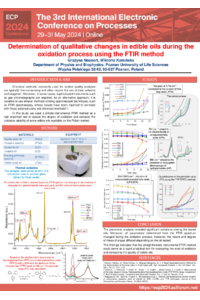
In the food industry, including the fat and oil sector, chemical methods are commonly used for routine quality analyses. These analyses are typically time-consuming and often require the use of toxic solvents and reagents. Moreover, in some cases, sophisticated instruments such as gas chromatographs are used, which are expensive and a form of advanced instrumentation. As an alternative approach, it is possible to use simpler methods utilizing spectroscopic techniques, like FTIR spectroscopy, the results of which have been reported to correlate with those obtained using wet chemical methods. In this study, we used the FTIR technique to assess the oxidative stability of some edible oils available on the Polish market. The oils studied were nigella seed, pumpkin seed, flax seed, linseed, evening primrose seed, and thistle seed oils. FTIR/ATR spectra of the undiluted oils were recorded in the range of 500–4000 cm^−1 with a resolution of 2 cm^−1. To monitor the oxidation process, the peak at 721 cm^−1, related to cis double bonds of unsaturated fatty acids (UFAs), and the peak intensity at 986 cm^−1, associated with the presence of conjugated diene groups of hydroperoxides (HPs), were analyzed. The content of free fatty acids (FFAs) and the ratio of unsaturated/saturated fatty acids (UFAs/SFAs) were qualitatively expressed by the intensity band at 1712 cm^−1 and the peak ratio of 3011/2925 cm^−1, respectively. Additionally, using the Triphenylphosphine/Triphenylphosphine Oxide (TPP/TPPO) assay, the peroxide value (PV) was calculated. The parameter analysis revealed significant variations among the tested oils. Moreover, all determined parameters from the FTIR spectrum changed during the oxidation process. However, the nature and degree of these changes differed depending on the oil tested. The findings indicated that the straightforward instrumental FTIR method could serve as a rapid analytical tool for evaluating the level of oxidation or comparing the quality of edible oils.
Keywords
FTIR spectroscopy
edible oils
oxidation process
peroxide value (PV)
Poster
ECP 2024 – Confirmed Poster for Gallery - sciforum-089987.pdf
Effects of LED Light Irradiation on Ripening and Nutritional Quality of 'Puwalu' Banana (Musa sp.) during Postharvest Storage
Exploring FTIR Absorption Spectra of Agriculturally Applicable Biodegradable Films with Structural Reinforcement.