Event submissions
Published
This submission belongs to the session C. Food Processes of the event The 3rd International Electronic Conference on Processes
Published date
28 May, 2024
Academic Editor
'%3e%3cpath%20d='M12.6657%2010.9104C12.4185%2010.325%2012.0599%209.79327%2011.6097%209.34482C11.1609%208.89508%2010.6293%208.5365%2010.0442%208.28888C10.0389%208.28626%2010.0337%208.28495%2010.0285%208.28233C10.8446%207.69279%2011.3752%206.73249%2011.3752%205.64904C11.3752%203.8542%209.92103%202.39999%208.1262%202.39999C6.33136%202.39999%204.87715%203.8542%204.87715%205.64904C4.87715%206.73249%205.40774%207.69279%206.22393%208.28364C6.21869%208.28626%206.21345%208.28757%206.20821%208.29019C5.62129%208.5378%205.09463%208.89284%204.64265%209.34613C4.1929%209.79493%203.83432%2010.3266%203.58671%2010.9117C3.34345%2011.4845%203.21226%2012.0987%203.20023%2012.7209C3.19988%2012.7349%203.20233%2012.7488%203.20744%2012.7619C3.21255%2012.7749%203.22022%2012.7867%203.22998%2012.7968C3.23975%2012.8068%203.25142%2012.8147%203.26431%2012.8202C3.2772%2012.8256%203.29105%2012.8284%203.30504%2012.8284H4.09109C4.14874%2012.8284%204.19459%2012.7825%204.1959%2012.7262C4.2221%2011.7148%204.62823%2010.7676%205.34617%2010.0497C6.08899%209.30683%207.0755%208.89808%208.1262%208.89808C9.17689%208.89808%2010.1634%209.30683%2010.9062%2010.0497C11.6242%2010.7676%2012.0303%2011.7148%2012.0565%2012.7262C12.0578%2012.7838%2012.1037%2012.8284%2012.1613%2012.8284H12.9474C12.9613%2012.8284%2012.9752%2012.8256%2012.9881%2012.8202C13.001%2012.8147%2013.0126%2012.8068%2013.0224%2012.7968C13.0322%2012.7867%2013.0398%2012.7749%2013.0449%2012.7619C13.0501%2012.7488%2013.0525%2012.7349%2013.0522%2012.7209C13.0391%2012.0947%2012.9094%2011.4855%2012.6657%2010.9104ZM8.1262%207.9024C7.52486%207.9024%206.9589%207.6679%206.53312%207.24211C6.10733%206.81633%205.87283%206.25037%205.87283%205.64904C5.87283%205.0477%206.10733%204.48174%206.53312%204.05596C6.9589%203.63018%207.52486%203.39567%208.1262%203.39567C8.72753%203.39567%209.29349%203.63018%209.71927%204.05596C10.1451%204.48174%2010.3796%205.0477%2010.3796%205.64904C10.3796%206.25037%2010.1451%206.81633%209.71927%207.24211C9.29349%207.6679%208.72753%207.9024%208.1262%207.9024Z'%20fill='%235D1EE1'/%3e%3c/g%3e%3c/svg%3e) Dariusz Dziki
Dariusz DzikiCitation
Maria Inês Machado, Pâmela Karini Barros Ângelo, Angela Gonçalves, Renan Matos Monção, Rômulo Ribeiro Magalhães de Souza, Adriana Rodrigues Machado, Exploring FTIR Absorption Spectra of Agriculturally Applicable Biodegradable Films with Structural Reinforcement., in Proceedings of The 3rd International Electronic Conference on Processes, 29 May–31 May 2024, MDPI: Basel, Switzerland
Share
Email
Facebook
Twitter
LinkedIn
Exploring FTIR Absorption Spectra of Agriculturally Applicable Biodegradable Films with Structural Reinforcement.
'%3e%3cpath%20d='M12.6647%2010.9104C12.4176%2010.325%2012.0589%209.7933%2011.6088%209.34485C11.16%208.89511%2010.6283%208.53653%2010.0432%208.28891C10.038%208.28629%2010.0327%208.28498%2010.0275%208.28236C10.8437%207.69282%2011.3743%206.73252%2011.3743%205.64907C11.3743%203.85423%209.92005%202.40002%208.12522%202.40002C6.33038%202.40002%204.87618%203.85423%204.87618%205.64907C4.87618%206.73252%205.40677%207.69282%206.22296%208.28367C6.21772%208.28629%206.21248%208.2876%206.20724%208.29022C5.62031%208.53783%205.09365%208.89287%204.64167%209.34616C4.19192%209.79496%203.83334%2010.3266%203.58573%2010.9117C3.34247%2011.4846%203.21128%2012.0987%203.19925%2012.721C3.1989%2012.735%203.20135%2012.7489%203.20646%2012.7619C3.21157%2012.7749%203.21924%2012.7868%203.22901%2012.7968C3.23877%2012.8068%203.25045%2012.8148%203.26334%2012.8202C3.27623%2012.8256%203.29007%2012.8284%203.30406%2012.8284H4.09012C4.14776%2012.8284%204.19362%2012.7825%204.19493%2012.7262C4.22113%2011.7148%204.62726%2010.7676%205.34519%2010.0497C6.08802%209.30686%207.07452%208.89811%208.12522%208.89811C9.17592%208.89811%2010.1624%209.30686%2010.9052%2010.0497C11.6232%2010.7676%2012.0293%2011.7148%2012.0555%2012.7262C12.0568%2012.7839%2012.1027%2012.8284%2012.1603%2012.8284H12.9464C12.9604%2012.8284%2012.9742%2012.8256%2012.9871%2012.8202C13%2012.8148%2013.0117%2012.8068%2013.0214%2012.7968C13.0312%2012.7868%2013.0389%2012.7749%2013.044%2012.7619C13.0491%2012.7489%2013.0515%2012.735%2013.0512%2012.721C13.0381%2012.0947%2012.9084%2011.4856%2012.6647%2010.9104ZM8.12522%207.90243C7.52388%207.90243%206.95792%207.66793%206.53214%207.24215C6.10636%206.81636%205.87185%206.2504%205.87185%205.64907C5.87185%205.04773%206.10636%204.48177%206.53214%204.05599C6.95792%203.63021%207.52388%203.3957%208.12522%203.3957C8.72655%203.3957%209.29252%203.63021%209.7183%204.05599C10.1441%204.48177%2010.3786%205.04773%2010.3786%205.64907C10.3786%206.2504%2010.1441%206.81636%209.7183%207.24215C9.29252%207.66793%208.72655%207.90243%208.12522%207.90243Z'%20fill='%235D1EE1'/%3e%3c/g%3e%3c/svg%3e)
Maria Inês Machado 1,2
Pâmela Karini Barros Ângelo 2,3
Angela Gonçalves 2,4
Renan Matos Monção 5,6
Rômulo Ribeiro Magalhães de Souza 5,6
Adriana Rodrigues Machado 1,2
1. Universidade Federal do Cariri
2. Centro de Ciências Agrárias e da Biodiversidade
3. Universidade Federal do Cariri
Centro de Ciências Agrárias e da Biodiversidade
4. Universidade Federeal do Cariri
5. Universidade Federal do Piauí
6. Programa de Pós-Graduação em Engenharia e Ciências dos Materiais
Abstract
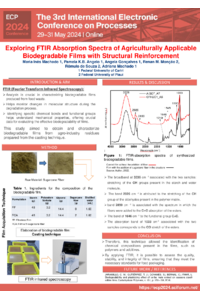
FTIR (Fourier Transform Infrared Spectroscopy) analysis is a crucial process in characterizing biodegradable films produced from food waste. The FTIR technique helps monitor changes in molecular structure during the degradation process. Identifying specific chemical bonds and functional groups helps in understanding mechanical properties, offering crucial data for evaluating the effective biodegradability of films. The objective of this study was to obtain and characterize biodegradable films from agro-industry residues prepared from the casting technique. Sugarcane fiber was used as a strengthening agent of the structure, with the addition of antimicrobial, potassium sorbate and glycerol plasticizer to reduce environmental impacts. FTIR analysis was performed on the biodegradable films. The results of the analysis showed that the formulations of the films presented spectra in characteristic bands. The broadband at 3336 cm-1 associated with the two samples corresponds to the stretching of the O-H groups present in the starch and water molecule. The 2926 cm-1 band is attributed to the stretching of the C-H group of the aldehydes present in the polymer matrix, while the 2850 cm-1 band is associated with the spectrum in which the fibers were added to the C=O absorption of esters. The 1646 cm-1 band corresponds to the functional group C=C. The 1033 cm-1 absorption band associated with the two samples corresponds to the C-O stretch of esters. Thus, in this study, it was noted that there were modifications in the chemical bonds of the water-treated film. Displacement or intensities of different bands were also observed, which indicate greater or lesser interaction between the additional components. Therefore, this technique allowed the identification of chemical compositions present in the films, such as polymers and additives. By applying FTIR, it is possible to assess the quality, stability, and integrity of films, ensuring that they meet the necessary standards for food packaging.
Keywords
band
functional group
molecular structure
food waste.
Poster
Poste for galleri-Sciforum-EOP 2024_sciforum-090475.pdf
Determination of qualitative changes in edible oils during the oxidation process using the FTIR method.
Encapsulation and Characterisation of the Aqueous Extract of Hancornia speciosa-Mangaba from the Cerrado of Goiás