Event submissions
Published
This submission belongs to the session C. Food Processes of the event The 3rd International Electronic Conference on Processes
Published date
28 May, 2024
Academic Editor
'%3e%3cpath%20d='M12.6657%2010.9104C12.4185%2010.325%2012.0599%209.79327%2011.6097%209.34482C11.1609%208.89508%2010.6293%208.5365%2010.0442%208.28888C10.0389%208.28626%2010.0337%208.28495%2010.0285%208.28233C10.8446%207.69279%2011.3752%206.73249%2011.3752%205.64904C11.3752%203.8542%209.92103%202.39999%208.1262%202.39999C6.33136%202.39999%204.87715%203.8542%204.87715%205.64904C4.87715%206.73249%205.40774%207.69279%206.22393%208.28364C6.21869%208.28626%206.21345%208.28757%206.20821%208.29019C5.62129%208.5378%205.09463%208.89284%204.64265%209.34613C4.1929%209.79493%203.83432%2010.3266%203.58671%2010.9117C3.34345%2011.4845%203.21226%2012.0987%203.20023%2012.7209C3.19988%2012.7349%203.20233%2012.7488%203.20744%2012.7619C3.21255%2012.7749%203.22022%2012.7867%203.22998%2012.7968C3.23975%2012.8068%203.25142%2012.8147%203.26431%2012.8202C3.2772%2012.8256%203.29105%2012.8284%203.30504%2012.8284H4.09109C4.14874%2012.8284%204.19459%2012.7825%204.1959%2012.7262C4.2221%2011.7148%204.62823%2010.7676%205.34617%2010.0497C6.08899%209.30683%207.0755%208.89808%208.1262%208.89808C9.17689%208.89808%2010.1634%209.30683%2010.9062%2010.0497C11.6242%2010.7676%2012.0303%2011.7148%2012.0565%2012.7262C12.0578%2012.7838%2012.1037%2012.8284%2012.1613%2012.8284H12.9474C12.9613%2012.8284%2012.9752%2012.8256%2012.9881%2012.8202C13.001%2012.8147%2013.0126%2012.8068%2013.0224%2012.7968C13.0322%2012.7867%2013.0398%2012.7749%2013.0449%2012.7619C13.0501%2012.7488%2013.0525%2012.7349%2013.0522%2012.7209C13.0391%2012.0947%2012.9094%2011.4855%2012.6657%2010.9104ZM8.1262%207.9024C7.52486%207.9024%206.9589%207.6679%206.53312%207.24211C6.10733%206.81633%205.87283%206.25037%205.87283%205.64904C5.87283%205.0477%206.10733%204.48174%206.53312%204.05596C6.9589%203.63018%207.52486%203.39567%208.1262%203.39567C8.72753%203.39567%209.29349%203.63018%209.71927%204.05596C10.1451%204.48174%2010.3796%205.0477%2010.3796%205.64904C10.3796%206.25037%2010.1451%206.81633%209.71927%207.24211C9.29349%207.6679%208.72753%207.9024%208.1262%207.9024Z'%20fill='%235D1EE1'/%3e%3c/g%3e%3c/svg%3e) Dariusz Dziki
Dariusz DzikiCitation
Oksana Vladimirovna Stepanova, Daniil Lyalin, Oksana Sergeevna Stepanova, Georgii Konoplev, Artur Kuznetsov, Liubov Abramova, Andrey Kozin, Aleksandr Frorip, Rapid assessment of canned fish quality via fast protein and metabolite liquid chromatography, in Proceedings of The 3rd International Electronic Conference on Processes, 29 May–31 May 2024, MDPI: Basel, Switzerland
Share
Email
Facebook
Twitter
LinkedIn
Rapid assessment of canned fish quality via fast protein and metabolite liquid chromatography
'%3e%3cpath%20d='M12.6647%2010.9104C12.4176%2010.325%2012.0589%209.7933%2011.6088%209.34485C11.16%208.89511%2010.6283%208.53653%2010.0432%208.28891C10.038%208.28629%2010.0327%208.28498%2010.0275%208.28236C10.8437%207.69282%2011.3743%206.73252%2011.3743%205.64907C11.3743%203.85423%209.92005%202.40002%208.12522%202.40002C6.33038%202.40002%204.87618%203.85423%204.87618%205.64907C4.87618%206.73252%205.40677%207.69282%206.22296%208.28367C6.21772%208.28629%206.21248%208.2876%206.20724%208.29022C5.62031%208.53783%205.09365%208.89287%204.64167%209.34616C4.19192%209.79496%203.83334%2010.3266%203.58573%2010.9117C3.34247%2011.4846%203.21128%2012.0987%203.19925%2012.721C3.1989%2012.735%203.20135%2012.7489%203.20646%2012.7619C3.21157%2012.7749%203.21924%2012.7868%203.22901%2012.7968C3.23877%2012.8068%203.25045%2012.8148%203.26334%2012.8202C3.27623%2012.8256%203.29007%2012.8284%203.30406%2012.8284H4.09012C4.14776%2012.8284%204.19362%2012.7825%204.19493%2012.7262C4.22113%2011.7148%204.62726%2010.7676%205.34519%2010.0497C6.08802%209.30686%207.07452%208.89811%208.12522%208.89811C9.17592%208.89811%2010.1624%209.30686%2010.9052%2010.0497C11.6232%2010.7676%2012.0293%2011.7148%2012.0555%2012.7262C12.0568%2012.7839%2012.1027%2012.8284%2012.1603%2012.8284H12.9464C12.9604%2012.8284%2012.9742%2012.8256%2012.9871%2012.8202C13%2012.8148%2013.0117%2012.8068%2013.0214%2012.7968C13.0312%2012.7868%2013.0389%2012.7749%2013.044%2012.7619C13.0491%2012.7489%2013.0515%2012.735%2013.0512%2012.721C13.0381%2012.0947%2012.9084%2011.4856%2012.6647%2010.9104ZM8.12522%207.90243C7.52388%207.90243%206.95792%207.66793%206.53214%207.24215C6.10636%206.81636%205.87185%206.2504%205.87185%205.64907C5.87185%205.04773%206.10636%204.48177%206.53214%204.05599C6.95792%203.63021%207.52388%203.3957%208.12522%203.3957C8.72655%203.3957%209.29252%203.63021%209.7183%204.05599C10.1441%204.48177%2010.3786%205.04773%2010.3786%205.64907C10.3786%206.2504%2010.1441%206.81636%209.7183%207.24215C9.29252%207.66793%208.72655%207.90243%208.12522%207.90243Z'%20fill='%235D1EE1'/%3e%3c/g%3e%3c/svg%3e)
Oksana Vladimirovna Stepanova 1
Daniil Lyalin 1
Oksana Sergeevna Stepanova 1
Georgii Konoplev 1
Artur Kuznetsov 2
Liubov Abramova 3
Andrey Kozin 3
Aleksandr Frorip 2
1. Department of Photonics, Saint Petersburg Electrotechnical University “LETI”, 197022 Saint Petersburg, Russia
2. AS Ldiamon, 50411 Tartu, Estonia
3. Research Institute of Fisheries and Oceanography, 105187 Moscow, Russia
Abstract
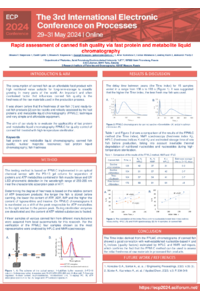
The consumption of canned fish as an affordable food source for consumers, and as a suitable option forlong-term-storage food with high nutritional value, is steadily growing in many parts of the world. An important and often overlooked factor that influences canned fish quality is the freshness of raw fish used in the production process. It was shown before that the freshness of fish can be assessed using fast proteins and metabolite liquid chromatography (FPMLC). The aim of our study is to evaluate the applicability of FPMLC to analyze the quality of canned fish. Fifteen samples of various canned fish from different manufacturers were acquired from local supermarkets. FPMLC chromatograms of the samples were processed with the compact optoelectronic chromatographic sensor using PD-10 mini-columns and photometric detection at 255-265 nm with a deep UV LED. All chromatograms showed two peaks: the first one was related to proteins and the second one one was formed by adenosine triphosphate (ATP) metabolites. The delay time between peaks (the Time index) varied in a range from 138 s to 195 s. It was suggested that the higher the time index, the less fresh raw fish was used. In several chromatograms, a characteristic "hump" related to hypoxanthine emerged clearly, indicating that the raw fish was in the early stages of bacterial spoilage. For the additional verification of the FPMLC technique, four samples chosen as the most representative were analyzed via HPLC and two of them via NMR spectroscopy. The time index of the FPLMC chromatograms was in a good correlation with well-established nucleotide-based K and K1 indices (quality factors) estimated from HPLC chromatograms and NMR spectra, which confirms the fact that the FPMLC method can be used to assess the freshness of raw materials in processed fish products.
Keywords
fast protein and metabolite liquid chromatography
canned fish quality
nuclear magnetic resonance
fast protein liquid chromatography
fish freshness
Poster
ECP 2024 – Confirmed Poster for Gallery - sciforum-090034.pdf
Impact of sonication on apricot juice quality characteristics
Revalorization of cinnamon leaves via a phenolic compound extraction process: an optimization using Box–Behnken design.