Event submissions
Published
This submission belongs to the session D. Chemical Processes and Systems of the event The 3rd International Electronic Conference on Processes
Published date
28 May, 2024
Academic Editor
'%3e%3cpath%20d='M12.6657%2010.9104C12.4185%2010.325%2012.0599%209.79327%2011.6097%209.34482C11.1609%208.89508%2010.6293%208.5365%2010.0442%208.28888C10.0389%208.28626%2010.0337%208.28495%2010.0285%208.28233C10.8446%207.69279%2011.3752%206.73249%2011.3752%205.64904C11.3752%203.8542%209.92103%202.39999%208.1262%202.39999C6.33136%202.39999%204.87715%203.8542%204.87715%205.64904C4.87715%206.73249%205.40774%207.69279%206.22393%208.28364C6.21869%208.28626%206.21345%208.28757%206.20821%208.29019C5.62129%208.5378%205.09463%208.89284%204.64265%209.34613C4.1929%209.79493%203.83432%2010.3266%203.58671%2010.9117C3.34345%2011.4845%203.21226%2012.0987%203.20023%2012.7209C3.19988%2012.7349%203.20233%2012.7488%203.20744%2012.7619C3.21255%2012.7749%203.22022%2012.7867%203.22998%2012.7968C3.23975%2012.8068%203.25142%2012.8147%203.26431%2012.8202C3.2772%2012.8256%203.29105%2012.8284%203.30504%2012.8284H4.09109C4.14874%2012.8284%204.19459%2012.7825%204.1959%2012.7262C4.2221%2011.7148%204.62823%2010.7676%205.34617%2010.0497C6.08899%209.30683%207.0755%208.89808%208.1262%208.89808C9.17689%208.89808%2010.1634%209.30683%2010.9062%2010.0497C11.6242%2010.7676%2012.0303%2011.7148%2012.0565%2012.7262C12.0578%2012.7838%2012.1037%2012.8284%2012.1613%2012.8284H12.9474C12.9613%2012.8284%2012.9752%2012.8256%2012.9881%2012.8202C13.001%2012.8147%2013.0126%2012.8068%2013.0224%2012.7968C13.0322%2012.7867%2013.0398%2012.7749%2013.0449%2012.7619C13.0501%2012.7488%2013.0525%2012.7349%2013.0522%2012.7209C13.0391%2012.0947%2012.9094%2011.4855%2012.6657%2010.9104ZM8.1262%207.9024C7.52486%207.9024%206.9589%207.6679%206.53312%207.24211C6.10733%206.81633%205.87283%206.25037%205.87283%205.64904C5.87283%205.0477%206.10733%204.48174%206.53312%204.05596C6.9589%203.63018%207.52486%203.39567%208.1262%203.39567C8.72753%203.39567%209.29349%203.63018%209.71927%204.05596C10.1451%204.48174%2010.3796%205.0477%2010.3796%205.64904C10.3796%206.25037%2010.1451%206.81633%209.71927%207.24211C9.29349%207.6679%208.72753%207.9024%208.1262%207.9024Z'%20fill='%235D1EE1'/%3e%3c/g%3e%3c/svg%3e) Blaž Likozar
Blaž LikozarCitation
Marianna V. Kharlamova, The effect of metal halides and metal chalcogenides, such as iron chloride, cobalt chloride, and bismuth telluride, on the morphology and electronic properties of single-walled carbon nanotubes, in Proceedings of The 3rd International Electronic Conference on Processes, 29 May–31 May 2024, MDPI: Basel, Switzerland
Share
Email
Facebook
Twitter
LinkedIn
The effect of metal halides and metal chalcogenides, such as iron chloride, cobalt chloride, and bismuth telluride, on the morphology and electronic properties of single-walled carbon nanotubes

Marianna V. Kharlamova 1
1. Centre for Advanced Materials Application (CEMEA), Slovak Academy of Sciences, Dúbravská cesta 5807/9, 845 11 Bratislava, Slovakia
Abstract
The loading of single-walled carbon nanotubes (SWCNTs) is very important for applications. Loading methods include loading from the gas phase, as well as the liquid phase— melted compounds and solutions. It was demonstrated that the incorporated substances form new, interesting properties and phases inside SWCNTs. Spectroscopic techniques, such as Raman spectroscopy, X-ray photoelectron spectroscopy (XPS), optical absorption spectroscopy (OAS), and near-edge X-ray absorption fine structure spectroscopy (NEXAFS), were utilized. It was shown that the incorporated substances may cause the p- and n-doping of the SWCNTs. I have encapsulated new compounds, such as iron chloride (FeCl2), cobalt chloride (CoCl2), and bismuth telluride (Bi2Te3), inside SWCNTs. The loading was investigated by high-resolution transmission electron microscopy (HRTEM), and it was proven that the interior space within the SWCNT walls was loaded. The incorporated substances formed crystalline phases inside the SWCNTs. The spectroscopic investigations showed that iron chloride and cobalt chloride led to p-doping of the SWCNTs. This was observed as the changes in the shapes of the Raman modes, shifts in the C 1s XPS on the lower-binding-energy side, the appearance of additional peaks in the C 1s NEXAFS, and the disappearance of peaks in the OAS spectra.
Keywords
carbon nanotube
filling
doping
electronic properties
iron chloride
cobalt chloride
bismuth telluride
Poster
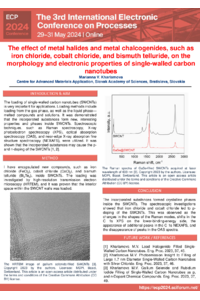
ECP 2024 – Confirmed Poster for Gallery - sciforum-080574.pdf
Application for Validation of Compound Identification in GC×GC Based on Retention Index
QUANTITATIVE ANALYSIS OF VITAMINS AND AMINO ACIDS FOR ALHAGI MAURORUM PLANT EXTRACT