Event submissions
Published
This submission belongs to the session D. Chemical Processes and Systems of the event The 3rd International Electronic Conference on Processes
Published date
28 May, 2024
Academic Editor
'%3e%3cpath%20d='M12.6657%2010.9104C12.4185%2010.325%2012.0599%209.79327%2011.6097%209.34482C11.1609%208.89508%2010.6293%208.5365%2010.0442%208.28888C10.0389%208.28626%2010.0337%208.28495%2010.0285%208.28233C10.8446%207.69279%2011.3752%206.73249%2011.3752%205.64904C11.3752%203.8542%209.92103%202.39999%208.1262%202.39999C6.33136%202.39999%204.87715%203.8542%204.87715%205.64904C4.87715%206.73249%205.40774%207.69279%206.22393%208.28364C6.21869%208.28626%206.21345%208.28757%206.20821%208.29019C5.62129%208.5378%205.09463%208.89284%204.64265%209.34613C4.1929%209.79493%203.83432%2010.3266%203.58671%2010.9117C3.34345%2011.4845%203.21226%2012.0987%203.20023%2012.7209C3.19988%2012.7349%203.20233%2012.7488%203.20744%2012.7619C3.21255%2012.7749%203.22022%2012.7867%203.22998%2012.7968C3.23975%2012.8068%203.25142%2012.8147%203.26431%2012.8202C3.2772%2012.8256%203.29105%2012.8284%203.30504%2012.8284H4.09109C4.14874%2012.8284%204.19459%2012.7825%204.1959%2012.7262C4.2221%2011.7148%204.62823%2010.7676%205.34617%2010.0497C6.08899%209.30683%207.0755%208.89808%208.1262%208.89808C9.17689%208.89808%2010.1634%209.30683%2010.9062%2010.0497C11.6242%2010.7676%2012.0303%2011.7148%2012.0565%2012.7262C12.0578%2012.7838%2012.1037%2012.8284%2012.1613%2012.8284H12.9474C12.9613%2012.8284%2012.9752%2012.8256%2012.9881%2012.8202C13.001%2012.8147%2013.0126%2012.8068%2013.0224%2012.7968C13.0322%2012.7867%2013.0398%2012.7749%2013.0449%2012.7619C13.0501%2012.7488%2013.0525%2012.7349%2013.0522%2012.7209C13.0391%2012.0947%2012.9094%2011.4855%2012.6657%2010.9104ZM8.1262%207.9024C7.52486%207.9024%206.9589%207.6679%206.53312%207.24211C6.10733%206.81633%205.87283%206.25037%205.87283%205.64904C5.87283%205.0477%206.10733%204.48174%206.53312%204.05596C6.9589%203.63018%207.52486%203.39567%208.1262%203.39567C8.72753%203.39567%209.29349%203.63018%209.71927%204.05596C10.1451%204.48174%2010.3796%205.0477%2010.3796%205.64904C10.3796%206.25037%2010.1451%206.81633%209.71927%207.24211C9.29349%207.6679%208.72753%207.9024%208.1262%207.9024Z'%20fill='%235D1EE1'/%3e%3c/g%3e%3c/svg%3e) Blaž Likozar
Blaž LikozarCitation
Danatbek Murzalinov, Rashid Zhapakov, The evolution of defect formation during the deposition of thin layers of ZnO on the surface of hierarchical porous silicon and subsequent multi-stage annealing, in Proceedings of The 3rd International Electronic Conference on Processes, 29 May–31 May 2024, MDPI: Basel, Switzerland
Share
Email
Facebook
Twitter
LinkedIn
The evolution of defect formation during the deposition of thin layers of ZnO on the surface of hierarchical porous silicon and subsequent multi-stage annealing
'%3e%3cpath%20d='M12.6647%2010.9104C12.4176%2010.325%2012.0589%209.7933%2011.6088%209.34485C11.16%208.89511%2010.6283%208.53653%2010.0432%208.28891C10.038%208.28629%2010.0327%208.28498%2010.0275%208.28236C10.8437%207.69282%2011.3743%206.73252%2011.3743%205.64907C11.3743%203.85423%209.92005%202.40002%208.12522%202.40002C6.33038%202.40002%204.87618%203.85423%204.87618%205.64907C4.87618%206.73252%205.40677%207.69282%206.22296%208.28367C6.21772%208.28629%206.21248%208.2876%206.20724%208.29022C5.62031%208.53783%205.09365%208.89287%204.64167%209.34616C4.19192%209.79496%203.83334%2010.3266%203.58573%2010.9117C3.34247%2011.4846%203.21128%2012.0987%203.19925%2012.721C3.1989%2012.735%203.20135%2012.7489%203.20646%2012.7619C3.21157%2012.7749%203.21924%2012.7868%203.22901%2012.7968C3.23877%2012.8068%203.25045%2012.8148%203.26334%2012.8202C3.27623%2012.8256%203.29007%2012.8284%203.30406%2012.8284H4.09012C4.14776%2012.8284%204.19362%2012.7825%204.19493%2012.7262C4.22113%2011.7148%204.62726%2010.7676%205.34519%2010.0497C6.08802%209.30686%207.07452%208.89811%208.12522%208.89811C9.17592%208.89811%2010.1624%209.30686%2010.9052%2010.0497C11.6232%2010.7676%2012.0293%2011.7148%2012.0555%2012.7262C12.0568%2012.7839%2012.1027%2012.8284%2012.1603%2012.8284H12.9464C12.9604%2012.8284%2012.9742%2012.8256%2012.9871%2012.8202C13%2012.8148%2013.0117%2012.8068%2013.0214%2012.7968C13.0312%2012.7868%2013.0389%2012.7749%2013.044%2012.7619C13.0491%2012.7489%2013.0515%2012.735%2013.0512%2012.721C13.0381%2012.0947%2012.9084%2011.4856%2012.6647%2010.9104ZM8.12522%207.90243C7.52388%207.90243%206.95792%207.66793%206.53214%207.24215C6.10636%206.81636%205.87185%206.2504%205.87185%205.64907C5.87185%205.04773%206.10636%204.48177%206.53214%204.05599C6.95792%203.63021%207.52388%203.3957%208.12522%203.3957C8.72655%203.3957%209.29252%203.63021%209.7183%204.05599C10.1441%204.48177%2010.3786%205.04773%2010.3786%205.64907C10.3786%206.2504%2010.1441%206.81636%209.7183%207.24215C9.29252%207.66793%208.72655%207.90243%208.12522%207.90243Z'%20fill='%235D1EE1'/%3e%3c/g%3e%3c/svg%3e)
Danatbek Murzalinov 1
Rashid Zhapakov 2
1. Institute of Physics and Technology, Satbayev University
2. Satbayev university
Abstract
Research on the formation of substances at different hierarchy levels of structure is a promising scientific direction. The multilevel surface of the sample was obtained via the electrochemical etching of silicon and the subsequent deposition of thin layers of zinc oxide via spray pyrolysis. Studies using the "Box counting" method revealed fractal properties at macro-, micro-, and nano-levels of the investigated surfaces.
It is known that the sensor responses depend on the level of ordering regarding particles of matter. If the structure is regular and the degree of fractality is high, the exciting signal moves along a short trajectory at a given speed. If there is a local deviation in the wave, the path length and the duration of the response increase.
The growth of structures in a certain direction with predetermined properties is due to the nature of the interaction between paramagnetic centers. EPR studies on samples showed the presence of a hyperfine spectrum structure, where the splitting of levels is the result of the influence of two different nuclei on the paramagnetic center. The sequential annealing of samples at a gradually increasing temperature led to the manifestation of the complex character of the signal from the trapped charges. Based on the variety of EPR signal saturation mechanisms, ZnO synthesis occurred at the boundaries of porous hierarchy structures with different sizes.
Paramagnetic centers are involved in the movement of charges through a jumping mechanism. At the same time, the highest concentration of particles with dangling bonds is located at the boundaries of structures (pores and clusters). Consequently, with an increase in the number of surface structures, the velocity of charge movement increases. This mechanism significantly enhances the sensitivity of sensors, the surface of which includes several levels of hierarchy.
Keywords
levels of the hierarchy
fractal properties
sensor response
hyperfine structure of EPR spectrum
EPR signal saturation
Poster
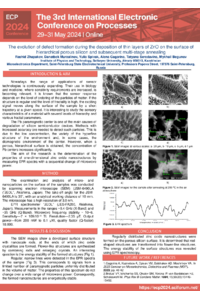
ECP 2024 – Confirmed Poster for Gallery - sciforum-081100.pdf
Optimization of House Price Prediction Machine Learning Techniques
Conduction characteristics of some polymer/carbon nanotubes composites: the effect of polymer matrix features