Event submissions
Published
This submission belongs to the session D. Chemical Processes and Systems of the event The 3rd International Electronic Conference on Processes
Published date
28 May, 2024
Academic Editor
'%3e%3cpath%20d='M12.6657%2010.9104C12.4185%2010.325%2012.0599%209.79327%2011.6097%209.34482C11.1609%208.89508%2010.6293%208.5365%2010.0442%208.28888C10.0389%208.28626%2010.0337%208.28495%2010.0285%208.28233C10.8446%207.69279%2011.3752%206.73249%2011.3752%205.64904C11.3752%203.8542%209.92103%202.39999%208.1262%202.39999C6.33136%202.39999%204.87715%203.8542%204.87715%205.64904C4.87715%206.73249%205.40774%207.69279%206.22393%208.28364C6.21869%208.28626%206.21345%208.28757%206.20821%208.29019C5.62129%208.5378%205.09463%208.89284%204.64265%209.34613C4.1929%209.79493%203.83432%2010.3266%203.58671%2010.9117C3.34345%2011.4845%203.21226%2012.0987%203.20023%2012.7209C3.19988%2012.7349%203.20233%2012.7488%203.20744%2012.7619C3.21255%2012.7749%203.22022%2012.7867%203.22998%2012.7968C3.23975%2012.8068%203.25142%2012.8147%203.26431%2012.8202C3.2772%2012.8256%203.29105%2012.8284%203.30504%2012.8284H4.09109C4.14874%2012.8284%204.19459%2012.7825%204.1959%2012.7262C4.2221%2011.7148%204.62823%2010.7676%205.34617%2010.0497C6.08899%209.30683%207.0755%208.89808%208.1262%208.89808C9.17689%208.89808%2010.1634%209.30683%2010.9062%2010.0497C11.6242%2010.7676%2012.0303%2011.7148%2012.0565%2012.7262C12.0578%2012.7838%2012.1037%2012.8284%2012.1613%2012.8284H12.9474C12.9613%2012.8284%2012.9752%2012.8256%2012.9881%2012.8202C13.001%2012.8147%2013.0126%2012.8068%2013.0224%2012.7968C13.0322%2012.7867%2013.0398%2012.7749%2013.0449%2012.7619C13.0501%2012.7488%2013.0525%2012.7349%2013.0522%2012.7209C13.0391%2012.0947%2012.9094%2011.4855%2012.6657%2010.9104ZM8.1262%207.9024C7.52486%207.9024%206.9589%207.6679%206.53312%207.24211C6.10733%206.81633%205.87283%206.25037%205.87283%205.64904C5.87283%205.0477%206.10733%204.48174%206.53312%204.05596C6.9589%203.63018%207.52486%203.39567%208.1262%203.39567C8.72753%203.39567%209.29349%203.63018%209.71927%204.05596C10.1451%204.48174%2010.3796%205.0477%2010.3796%205.64904C10.3796%206.25037%2010.1451%206.81633%209.71927%207.24211C9.29349%207.6679%208.72753%207.9024%208.1262%207.9024Z'%20fill='%235D1EE1'/%3e%3c/g%3e%3c/svg%3e) Blaž Likozar
Blaž LikozarCitation
MASSIMO BARBIERI, Hydrogen peroxide industrial production: a patent prior art analysis, in Proceedings of The 3rd International Electronic Conference on Processes, 29 May–31 May 2024, MDPI: Basel, Switzerland
Share
Email
Facebook
Twitter
LinkedIn
Hydrogen peroxide industrial production: a patent prior art analysis

MASSIMO BARBIERI 1
1. Politecnico di Milano (Technology Transfer Office), Piazza Leonardo da Vinci 32 – 20133 Milan (Italy)
Abstract
The aim of this study is to present an overview of industrial hydrogen peroxide production processes. Searches were conducted on two databases, namely Espacenet (https://worldwide.espacenet.com) and Orbit (https://www.orbit.com), using mainly IPC and CPC classification symbols, sometimes combined with keywords.
Espacenet and the new EPO tool for categorizing CPC text (available at https://epn.epo.org/cpc-text-categoriser) were used to retrieve specific classification codes on patented information related to the production of hydrogen peroxide.
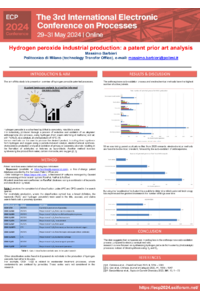
An analysis of the data from the Orbit database reveals that the anthraquinone auto-oxidation process and electrochemical methods have the highest number of active patents.
When examining patent applications filed from 2020 onwards, electrochemical methods are found to be the most prevalent, followed by the auto-oxidation of anthraquinone.
These are typically patent applications filed in China by academic institutions or companies.
By using the 'acceleration' indicator, which is defined as the ratio between the number of applications filed from a specific time (in this case, from 2020) and the total number of published and currently active applications, it is possible to determine which patented technology has experienced the greatest increase in the number of filings over time. In this case, the synthesis from water, carbon monoxide, and oxygen followed by electrochemical methods has shown the highest increase in filings.
The data suggest that companies are investing less in the anthraquinone auto-oxidation process compared to electrochemical methods. Research is now focused on synthesizing hydrogen peroxide from water, carbon monoxide and oxygen instead of direct synthesis using H2 and O2.
Keywords
Hydrogen peroxide
industrial production
patents
patent landscape
patent searching
Poster
Poster_ECP2024_H2O2.pdf
Optimization of Methylene Blue Photodegradation Using Copper (II) Oxide Photocatalyst under Visible Light: A Response Surface Methodology Approach
Synthesis of N-flurbiprofen-substituted 1,2,3,4-tetrahydroisoquinolines