Event submissions
Published
This submission belongs to the session D. Chemical Processes and Systems of the event The 3rd International Electronic Conference on Processes
Published date
28 May, 2024
Academic Editor
'%3e%3cpath%20d='M12.6657%2010.9104C12.4185%2010.325%2012.0599%209.79327%2011.6097%209.34482C11.1609%208.89508%2010.6293%208.5365%2010.0442%208.28888C10.0389%208.28626%2010.0337%208.28495%2010.0285%208.28233C10.8446%207.69279%2011.3752%206.73249%2011.3752%205.64904C11.3752%203.8542%209.92103%202.39999%208.1262%202.39999C6.33136%202.39999%204.87715%203.8542%204.87715%205.64904C4.87715%206.73249%205.40774%207.69279%206.22393%208.28364C6.21869%208.28626%206.21345%208.28757%206.20821%208.29019C5.62129%208.5378%205.09463%208.89284%204.64265%209.34613C4.1929%209.79493%203.83432%2010.3266%203.58671%2010.9117C3.34345%2011.4845%203.21226%2012.0987%203.20023%2012.7209C3.19988%2012.7349%203.20233%2012.7488%203.20744%2012.7619C3.21255%2012.7749%203.22022%2012.7867%203.22998%2012.7968C3.23975%2012.8068%203.25142%2012.8147%203.26431%2012.8202C3.2772%2012.8256%203.29105%2012.8284%203.30504%2012.8284H4.09109C4.14874%2012.8284%204.19459%2012.7825%204.1959%2012.7262C4.2221%2011.7148%204.62823%2010.7676%205.34617%2010.0497C6.08899%209.30683%207.0755%208.89808%208.1262%208.89808C9.17689%208.89808%2010.1634%209.30683%2010.9062%2010.0497C11.6242%2010.7676%2012.0303%2011.7148%2012.0565%2012.7262C12.0578%2012.7838%2012.1037%2012.8284%2012.1613%2012.8284H12.9474C12.9613%2012.8284%2012.9752%2012.8256%2012.9881%2012.8202C13.001%2012.8147%2013.0126%2012.8068%2013.0224%2012.7968C13.0322%2012.7867%2013.0398%2012.7749%2013.0449%2012.7619C13.0501%2012.7488%2013.0525%2012.7349%2013.0522%2012.7209C13.0391%2012.0947%2012.9094%2011.4855%2012.6657%2010.9104ZM8.1262%207.9024C7.52486%207.9024%206.9589%207.6679%206.53312%207.24211C6.10733%206.81633%205.87283%206.25037%205.87283%205.64904C5.87283%205.0477%206.10733%204.48174%206.53312%204.05596C6.9589%203.63018%207.52486%203.39567%208.1262%203.39567C8.72753%203.39567%209.29349%203.63018%209.71927%204.05596C10.1451%204.48174%2010.3796%205.0477%2010.3796%205.64904C10.3796%206.25037%2010.1451%206.81633%209.71927%207.24211C9.29349%207.6679%208.72753%207.9024%208.1262%207.9024Z'%20fill='%235D1EE1'/%3e%3c/g%3e%3c/svg%3e) Blaž Likozar
Blaž LikozarCitation
Paloma L. Barros, Farhad Ein-Mozaffari, Ali Lohi, Investigation of Scale-Up Strategies for an Aerated Bioreactor Comprised of a Coaxial Mixer with Yield-Pseudoplastic Fluid, in Proceedings of The 3rd International Electronic Conference on Processes, 29 May–31 May 2024, MDPI: Basel, Switzerland
Share
Email
Facebook
Twitter
LinkedIn
Investigation of Scale-Up Strategies for an Aerated Bioreactor Comprised of a Coaxial Mixer with Yield-Pseudoplastic Fluid
'%3e%3cpath%20d='M12.6647%2010.9104C12.4176%2010.325%2012.0589%209.7933%2011.6088%209.34485C11.16%208.89511%2010.6283%208.53653%2010.0432%208.28891C10.038%208.28629%2010.0327%208.28498%2010.0275%208.28236C10.8437%207.69282%2011.3743%206.73252%2011.3743%205.64907C11.3743%203.85423%209.92005%202.40002%208.12522%202.40002C6.33038%202.40002%204.87618%203.85423%204.87618%205.64907C4.87618%206.73252%205.40677%207.69282%206.22296%208.28367C6.21772%208.28629%206.21248%208.2876%206.20724%208.29022C5.62031%208.53783%205.09365%208.89287%204.64167%209.34616C4.19192%209.79496%203.83334%2010.3266%203.58573%2010.9117C3.34247%2011.4846%203.21128%2012.0987%203.19925%2012.721C3.1989%2012.735%203.20135%2012.7489%203.20646%2012.7619C3.21157%2012.7749%203.21924%2012.7868%203.22901%2012.7968C3.23877%2012.8068%203.25045%2012.8148%203.26334%2012.8202C3.27623%2012.8256%203.29007%2012.8284%203.30406%2012.8284H4.09012C4.14776%2012.8284%204.19362%2012.7825%204.19493%2012.7262C4.22113%2011.7148%204.62726%2010.7676%205.34519%2010.0497C6.08802%209.30686%207.07452%208.89811%208.12522%208.89811C9.17592%208.89811%2010.1624%209.30686%2010.9052%2010.0497C11.6232%2010.7676%2012.0293%2011.7148%2012.0555%2012.7262C12.0568%2012.7839%2012.1027%2012.8284%2012.1603%2012.8284H12.9464C12.9604%2012.8284%2012.9742%2012.8256%2012.9871%2012.8202C13%2012.8148%2013.0117%2012.8068%2013.0214%2012.7968C13.0312%2012.7868%2013.0389%2012.7749%2013.044%2012.7619C13.0491%2012.7489%2013.0515%2012.735%2013.0512%2012.721C13.0381%2012.0947%2012.9084%2011.4856%2012.6647%2010.9104ZM8.12522%207.90243C7.52388%207.90243%206.95792%207.66793%206.53214%207.24215C6.10636%206.81636%205.87185%206.2504%205.87185%205.64907C5.87185%205.04773%206.10636%204.48177%206.53214%204.05599C6.95792%203.63021%207.52388%203.3957%208.12522%203.3957C8.72655%203.3957%209.29252%203.63021%209.7183%204.05599C10.1441%204.48177%2010.3786%205.04773%2010.3786%205.64907C10.3786%206.2504%2010.1441%206.81636%209.7183%207.24215C9.29252%207.66793%208.72655%207.90243%208.12522%207.90243Z'%20fill='%235D1EE1'/%3e%3c/g%3e%3c/svg%3e)
Paloma L. Barros 1

Farhad Ein-Mozaffari 1
Ali Lohi 1
1. Toronto Metropolitan University
Abstract
Defining bioreactor scale-up strategies is a complex task aimed at establishing a framework for achieving equal mixing and mass transfer quality at large scales when compared to smaller scales. A primary concern in developing these strategies is ensuring the applicability of empirical correlations derived from small-scale equipment to its large-scale counterpart. This applicability primarily depends on potential changes in flow regimes upon scale-up. In view of that, the present study aims to propose and evaluate scale-up frameworks based on empirical estimations of volumetric mass transfer coefficients obtained from a small-scale vessel. Experimental investigations were conducted on a coaxial mixer furnished with an anchor-PBT impeller in two scales with a yield-pseudoplastic xanthan gum solution. The process efficiency was assessed in terms of the volumetric mass transfer coefficient and specific power consumption at various agitation speeds and air flow rates. The experimental data were employed to validate a computational fluid dynamics (CFD) numerical approach, which was further utilized for evaluating the local mixing and mass transfer parameters. Among the five scale-up criteria investigated, the results demonstrated that the most accurate and energy-efficient scale-up approach consisted of maintaining an equal specific power consumption, speed ratio, and volume of air per volume of liquid per minute (vvm) across different scales. Additionally, the CFD simulations precisely characterized the mass transfer performance and gas distribution behavior, which enabled us to identify the flow regime on both scales. The numerical analysis also allowed us to investigate the local distribution of gas holdup and volumetric mass transfer coefficients for larger scales, which are particularly crucial for industrial applications. In fact, the combination of experimental analysis and CFD simulations proved valuable for validating scale-up strategies’ applicability prior to actual operation.
Keywords
Gas-liquid mixing
Bioreactor
Scale-up
Non-Newtonian Fluids
Empirical correlation
Computational fluid dynamics.
Poster
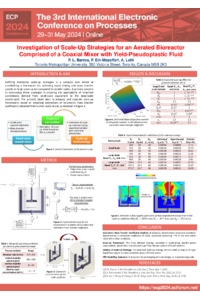
Poster-Paloma Lins Barros.pdf
Advanced Investigation of Indazole Derivatives as Corrosion Inhibitors for Brass in Acidic Environments: Electrochemical, Theoretical, and Surface Analysis
Тhe effect of a hardener on the characteristics of a polyester-based coating