Event submissions
Published
This submission belongs to the session D. Chemical Processes and Systems of the event The 3rd International Electronic Conference on Processes
Published date
28 May, 2024
Academic Editor
'%3e%3cpath%20d='M12.6657%2010.9104C12.4185%2010.325%2012.0599%209.79327%2011.6097%209.34482C11.1609%208.89508%2010.6293%208.5365%2010.0442%208.28888C10.0389%208.28626%2010.0337%208.28495%2010.0285%208.28233C10.8446%207.69279%2011.3752%206.73249%2011.3752%205.64904C11.3752%203.8542%209.92103%202.39999%208.1262%202.39999C6.33136%202.39999%204.87715%203.8542%204.87715%205.64904C4.87715%206.73249%205.40774%207.69279%206.22393%208.28364C6.21869%208.28626%206.21345%208.28757%206.20821%208.29019C5.62129%208.5378%205.09463%208.89284%204.64265%209.34613C4.1929%209.79493%203.83432%2010.3266%203.58671%2010.9117C3.34345%2011.4845%203.21226%2012.0987%203.20023%2012.7209C3.19988%2012.7349%203.20233%2012.7488%203.20744%2012.7619C3.21255%2012.7749%203.22022%2012.7867%203.22998%2012.7968C3.23975%2012.8068%203.25142%2012.8147%203.26431%2012.8202C3.2772%2012.8256%203.29105%2012.8284%203.30504%2012.8284H4.09109C4.14874%2012.8284%204.19459%2012.7825%204.1959%2012.7262C4.2221%2011.7148%204.62823%2010.7676%205.34617%2010.0497C6.08899%209.30683%207.0755%208.89808%208.1262%208.89808C9.17689%208.89808%2010.1634%209.30683%2010.9062%2010.0497C11.6242%2010.7676%2012.0303%2011.7148%2012.0565%2012.7262C12.0578%2012.7838%2012.1037%2012.8284%2012.1613%2012.8284H12.9474C12.9613%2012.8284%2012.9752%2012.8256%2012.9881%2012.8202C13.001%2012.8147%2013.0126%2012.8068%2013.0224%2012.7968C13.0322%2012.7867%2013.0398%2012.7749%2013.0449%2012.7619C13.0501%2012.7488%2013.0525%2012.7349%2013.0522%2012.7209C13.0391%2012.0947%2012.9094%2011.4855%2012.6657%2010.9104ZM8.1262%207.9024C7.52486%207.9024%206.9589%207.6679%206.53312%207.24211C6.10733%206.81633%205.87283%206.25037%205.87283%205.64904C5.87283%205.0477%206.10733%204.48174%206.53312%204.05596C6.9589%203.63018%207.52486%203.39567%208.1262%203.39567C8.72753%203.39567%209.29349%203.63018%209.71927%204.05596C10.1451%204.48174%2010.3796%205.0477%2010.3796%205.64904C10.3796%206.25037%2010.1451%206.81633%209.71927%207.24211C9.29349%207.6679%208.72753%207.9024%208.1262%207.9024Z'%20fill='%235D1EE1'/%3e%3c/g%3e%3c/svg%3e) Blaž Likozar
Blaž LikozarCitation
KULSUM HASHMI, Satya Satya, Sakshi Gupta, Priya Mishra, Tahmeena Khan, Seema Joshi, Synthesis of transition metal complexes containing thiosemicarbazone ligand and their biological activity, in Proceedings of The 3rd International Electronic Conference on Processes, 29 May–31 May 2024, MDPI: Basel, Switzerland
Share
Email
Facebook
Twitter
LinkedIn
Synthesis of transition metal complexes containing thiosemicarbazone ligand and their biological activity
'%3e%3cpath%20d='M12.6647%2010.9104C12.4176%2010.325%2012.0589%209.7933%2011.6088%209.34485C11.16%208.89511%2010.6283%208.53653%2010.0432%208.28891C10.038%208.28629%2010.0327%208.28498%2010.0275%208.28236C10.8437%207.69282%2011.3743%206.73252%2011.3743%205.64907C11.3743%203.85423%209.92005%202.40002%208.12522%202.40002C6.33038%202.40002%204.87618%203.85423%204.87618%205.64907C4.87618%206.73252%205.40677%207.69282%206.22296%208.28367C6.21772%208.28629%206.21248%208.2876%206.20724%208.29022C5.62031%208.53783%205.09365%208.89287%204.64167%209.34616C4.19192%209.79496%203.83334%2010.3266%203.58573%2010.9117C3.34247%2011.4846%203.21128%2012.0987%203.19925%2012.721C3.1989%2012.735%203.20135%2012.7489%203.20646%2012.7619C3.21157%2012.7749%203.21924%2012.7868%203.22901%2012.7968C3.23877%2012.8068%203.25045%2012.8148%203.26334%2012.8202C3.27623%2012.8256%203.29007%2012.8284%203.30406%2012.8284H4.09012C4.14776%2012.8284%204.19362%2012.7825%204.19493%2012.7262C4.22113%2011.7148%204.62726%2010.7676%205.34519%2010.0497C6.08802%209.30686%207.07452%208.89811%208.12522%208.89811C9.17592%208.89811%2010.1624%209.30686%2010.9052%2010.0497C11.6232%2010.7676%2012.0293%2011.7148%2012.0555%2012.7262C12.0568%2012.7839%2012.1027%2012.8284%2012.1603%2012.8284H12.9464C12.9604%2012.8284%2012.9742%2012.8256%2012.9871%2012.8202C13%2012.8148%2013.0117%2012.8068%2013.0214%2012.7968C13.0312%2012.7868%2013.0389%2012.7749%2013.044%2012.7619C13.0491%2012.7489%2013.0515%2012.735%2013.0512%2012.721C13.0381%2012.0947%2012.9084%2011.4856%2012.6647%2010.9104ZM8.12522%207.90243C7.52388%207.90243%206.95792%207.66793%206.53214%207.24215C6.10636%206.81636%205.87185%206.2504%205.87185%205.64907C5.87185%205.04773%206.10636%204.48177%206.53214%204.05599C6.95792%203.63021%207.52388%203.3957%208.12522%203.3957C8.72655%203.3957%209.29252%203.63021%209.7183%204.05599C10.1441%204.48177%2010.3786%205.04773%2010.3786%205.64907C10.3786%206.2504%2010.1441%206.81636%209.7183%207.24215C9.29252%207.66793%208.72655%207.90243%208.12522%207.90243Z'%20fill='%235D1EE1'/%3e%3c/g%3e%3c/svg%3e)
KULSUM HASHMI 1

Satya Satya 1
Sakshi Gupta 1
Priya Mishra 1
Tahmeena Khan 2
Seema Joshi 1
1. Department of Chemistry, Isabella Thoburn College, Lucknow, UP 226007, India
2. Department of Chemistry, Integral University, Lucknow, UP 226026, India
Abstract
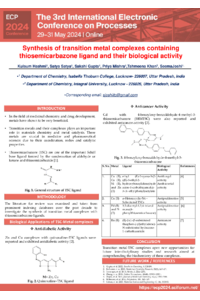
In the fields of medicinal chemistry and drug development, metals have been shown to be very beneficial. Currently, the main goal of bioinorganic chemistry is the design and synthesis of novel metal-based complexes and metal ion binding substances for the treatment of human diseases. The present paper summarizes the synthesis of transition metal complexes containing thiosemicarbazone ligand and their biological activity. Transition metals and their complexes play an important role in materials chemistry and metal catalysis. These metals are crucial in medicine and pharmaceutical sciences due to their coordination, redox and catalytic properties. Transition metal/TSC complexes have pertinent biological significance. TSCs are one of the important Schiff base ligands formed by the condensation of an aldehyde or ketone and thiosemicarbazide. When combined with metals, they have been shown to be effective antibacterial, antioxidant and anticancer agents. The synthesis of Zn, Co, Fe, Cu, Mn and Cr complexes with Benzaldehyde-N (4)–phenyl SCs have been reported and these complexes are known to exhibit antibacterial activity. Zn and Cu complexes with quinoxaline–TSC ligands were also reported and exhibited antidiabetic activity. Ni and Cu complexes with Cinnamaldehyde and cuminaldehyde thiosemicarbazne are known to exhibit antileukemic activity. The synthesis of Pt and Pd complexes containing 3,5-diacetyl-1,2,4- triazol mono(4-phenylthiosemicarbazone) ligand has been reported, and these complexes are known to exhibit anticancer activity. Cd with 4-benzyloxy-benzaldehyde-4-methyl-3-thiosemicarbazone (BBMTSC) has also been reported to exhibit anticancer activity. Over the past decade, the literature was examined and taken from prominent indexing databases to investigate the synthesis of transition metal complexes using thiosemicarbazone ligands. Transition metal/TSC complexes open new opportunities for future interdisciplinary studies and research aimed at comprehending the biochemistry of these complexes.
Keywords
Transition metal
Schiff base
Thiosemicarbazone
Metal based complexes
Anticancer and antibacterial activity
Poster
ECP 2024 - Confirmed Poster for Gallery - sciforum-090386.pdf
Enhancing Carbon Capture Efficiency in Chemical Looping Combustion Using Fe2O3 and Mn2O3 Oxygen Carriers: Insights from ASPEN Plus Modeling
Surface Area Enhancement through Electrochemical Oxidation of Ferricyanide At A Carbon Paste Electrode Modified with Zr-Based MOF