Event submissions
Published
This submission belongs to the session A. Environmental and Green Processes of the event The 3rd International Electronic Conference on Processes
Published date
28 May, 2024
Academic Editor
'%3e%3cpath%20d='M12.6657%2010.9104C12.4185%2010.325%2012.0599%209.79327%2011.6097%209.34482C11.1609%208.89508%2010.6293%208.5365%2010.0442%208.28888C10.0389%208.28626%2010.0337%208.28495%2010.0285%208.28233C10.8446%207.69279%2011.3752%206.73249%2011.3752%205.64904C11.3752%203.8542%209.92103%202.39999%208.1262%202.39999C6.33136%202.39999%204.87715%203.8542%204.87715%205.64904C4.87715%206.73249%205.40774%207.69279%206.22393%208.28364C6.21869%208.28626%206.21345%208.28757%206.20821%208.29019C5.62129%208.5378%205.09463%208.89284%204.64265%209.34613C4.1929%209.79493%203.83432%2010.3266%203.58671%2010.9117C3.34345%2011.4845%203.21226%2012.0987%203.20023%2012.7209C3.19988%2012.7349%203.20233%2012.7488%203.20744%2012.7619C3.21255%2012.7749%203.22022%2012.7867%203.22998%2012.7968C3.23975%2012.8068%203.25142%2012.8147%203.26431%2012.8202C3.2772%2012.8256%203.29105%2012.8284%203.30504%2012.8284H4.09109C4.14874%2012.8284%204.19459%2012.7825%204.1959%2012.7262C4.2221%2011.7148%204.62823%2010.7676%205.34617%2010.0497C6.08899%209.30683%207.0755%208.89808%208.1262%208.89808C9.17689%208.89808%2010.1634%209.30683%2010.9062%2010.0497C11.6242%2010.7676%2012.0303%2011.7148%2012.0565%2012.7262C12.0578%2012.7838%2012.1037%2012.8284%2012.1613%2012.8284H12.9474C12.9613%2012.8284%2012.9752%2012.8256%2012.9881%2012.8202C13.001%2012.8147%2013.0126%2012.8068%2013.0224%2012.7968C13.0322%2012.7867%2013.0398%2012.7749%2013.0449%2012.7619C13.0501%2012.7488%2013.0525%2012.7349%2013.0522%2012.7209C13.0391%2012.0947%2012.9094%2011.4855%2012.6657%2010.9104ZM8.1262%207.9024C7.52486%207.9024%206.9589%207.6679%206.53312%207.24211C6.10733%206.81633%205.87283%206.25037%205.87283%205.64904C5.87283%205.0477%206.10733%204.48174%206.53312%204.05596C6.9589%203.63018%207.52486%203.39567%208.1262%203.39567C8.72753%203.39567%209.29349%203.63018%209.71927%204.05596C10.1451%204.48174%2010.3796%205.0477%2010.3796%205.64904C10.3796%206.25037%2010.1451%206.81633%209.71927%207.24211C9.29349%207.6679%208.72753%207.9024%208.1262%207.9024Z'%20fill='%235D1EE1'/%3e%3c/g%3e%3c/svg%3e) Juan Francisco García Martín
Juan Francisco García MartínCitation
Padinchare Veettil Gayathri, Divya Nair, Shijo Joseph, Solar-Enhanced Photocatalytic Decontamination Of Water From Tetracycline Antibiotics And Its Application In Aquaculture, in Proceedings of The 3rd International Electronic Conference on Processes, 29 May–31 May 2024, MDPI: Basel, Switzerland
Share
Email
Facebook
Twitter
LinkedIn
Solar-Enhanced Photocatalytic Decontamination Of Water From Tetracycline Antibiotics And Its Application In Aquaculture
'%3e%3cpath%20d='M12.6647%2010.9104C12.4176%2010.325%2012.0589%209.7933%2011.6088%209.34485C11.16%208.89511%2010.6283%208.53653%2010.0432%208.28891C10.038%208.28629%2010.0327%208.28498%2010.0275%208.28236C10.8437%207.69282%2011.3743%206.73252%2011.3743%205.64907C11.3743%203.85423%209.92005%202.40002%208.12522%202.40002C6.33038%202.40002%204.87618%203.85423%204.87618%205.64907C4.87618%206.73252%205.40677%207.69282%206.22296%208.28367C6.21772%208.28629%206.21248%208.2876%206.20724%208.29022C5.62031%208.53783%205.09365%208.89287%204.64167%209.34616C4.19192%209.79496%203.83334%2010.3266%203.58573%2010.9117C3.34247%2011.4846%203.21128%2012.0987%203.19925%2012.721C3.1989%2012.735%203.20135%2012.7489%203.20646%2012.7619C3.21157%2012.7749%203.21924%2012.7868%203.22901%2012.7968C3.23877%2012.8068%203.25045%2012.8148%203.26334%2012.8202C3.27623%2012.8256%203.29007%2012.8284%203.30406%2012.8284H4.09012C4.14776%2012.8284%204.19362%2012.7825%204.19493%2012.7262C4.22113%2011.7148%204.62726%2010.7676%205.34519%2010.0497C6.08802%209.30686%207.07452%208.89811%208.12522%208.89811C9.17592%208.89811%2010.1624%209.30686%2010.9052%2010.0497C11.6232%2010.7676%2012.0293%2011.7148%2012.0555%2012.7262C12.0568%2012.7839%2012.1027%2012.8284%2012.1603%2012.8284H12.9464C12.9604%2012.8284%2012.9742%2012.8256%2012.9871%2012.8202C13%2012.8148%2013.0117%2012.8068%2013.0214%2012.7968C13.0312%2012.7868%2013.0389%2012.7749%2013.044%2012.7619C13.0491%2012.7489%2013.0515%2012.735%2013.0512%2012.721C13.0381%2012.0947%2012.9084%2011.4856%2012.6647%2010.9104ZM8.12522%207.90243C7.52388%207.90243%206.95792%207.66793%206.53214%207.24215C6.10636%206.81636%205.87185%206.2504%205.87185%205.64907C5.87185%205.04773%206.10636%204.48177%206.53214%204.05599C6.95792%203.63021%207.52388%203.3957%208.12522%203.3957C8.72655%203.3957%209.29252%203.63021%209.7183%204.05599C10.1441%204.48177%2010.3786%205.04773%2010.3786%205.64907C10.3786%206.2504%2010.1441%206.81636%209.7183%207.24215C9.29252%207.66793%208.72655%207.90243%208.12522%207.90243Z'%20fill='%235D1EE1'/%3e%3c/g%3e%3c/svg%3e)
Padinchare Veettil Gayathri 1,2
Divya Nair 3
Shijo Joseph 4
1. Department of Chemistry, St. Alberts College, Ernakulam
2. Department of Climate Variability and Aquatic Ecosystems, Kerala University of Fisheries and Ocean Studies, Pudhuvype
3. Department of Climate Variability and Aquatic Ecosystems, Kerala University of Fisheries and Ocean Studies, Panangad
4. Assistant Professor, Department of Climate Variability and Aquatic Ecosystems, Kerala University of Fisheries and Ocean Studies, Pudhuvype
Abstract
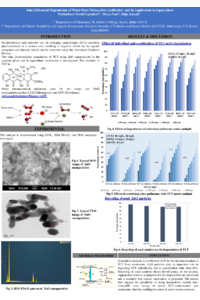
The occurrence of emerging pharmaceutical contaminants, especially antibiotics in water systems, is an alarming issue and is addressed using advanced oxidation processes (AOPs). In this study, the degradation of tetracycline hydrochloride (TCT) is evaluated and compared using UV and solar light as the source of energy in the presence of semiconductor oxide catalyst ZnO. Further, the effective solar photocatalytic degradation of TCT in distilled water and aquaculture wastewater was deeply investigated. TCT showed a 62% degradation efficiency in deionized water at the laboratory scale, while aquaculture effluent exhibited 87% degradation efficiency with the ZnO catalyst after 60 minutes of solar irradiation. The effect of multiple contaminants such as chloroquine (CLQ) and sulphamethoxazole (SMX) on TCT degradation was also investigated. CLQ inhibited the degradation of TCT, whereas SMX did not. The effective operational parameters, such as pH, irradiation time, photocatalyst dosage, the effect of oxidants, the effect of anions, and TCT concentration, were studied consecutively. The pseudo-first-order kinetic model best fit the experimental results (different tetracycline concentrations). Complete COD removal of TCT concentrations was achieved in deionized (up to 90 mg/L) and aquaculture wastewater. The catalyst was characterized using SEM, TEM, and XRD images. LC-QTOF analysis was used to identify the intermediates formed during the degradation using a mechanistic pathway. The results suggest the possibility of using inexpensive natural, non-renewable solar energy to purify TCT-contaminated real wastewater, thereby enabling the reuse of scarce water resources.
Keywords
Photocatalysis
ZnO
Tetracycline
Chloroquine
Sulphamethoxazole
aquaculture
degradation
Poster
Gayathri et al MDPI POSTER.pdf
A novel optimal power management and control strategy for Marine Microgrids Integrated with Renewable Energy Sources and hybrid energy storage devices
Optimizing carbon capture efficiency in coal-fired power plant using pinch assessment techniques for clean and sustainable energy production