Event submissions
Published
This submission belongs to the session E. Process Control and Monitoring of the event The 3rd International Electronic Conference on Processes
Published date
28 May, 2024
Academic Editor
'%3e%3cpath%20d='M12.6657%2010.9104C12.4185%2010.325%2012.0599%209.79327%2011.6097%209.34482C11.1609%208.89508%2010.6293%208.5365%2010.0442%208.28888C10.0389%208.28626%2010.0337%208.28495%2010.0285%208.28233C10.8446%207.69279%2011.3752%206.73249%2011.3752%205.64904C11.3752%203.8542%209.92103%202.39999%208.1262%202.39999C6.33136%202.39999%204.87715%203.8542%204.87715%205.64904C4.87715%206.73249%205.40774%207.69279%206.22393%208.28364C6.21869%208.28626%206.21345%208.28757%206.20821%208.29019C5.62129%208.5378%205.09463%208.89284%204.64265%209.34613C4.1929%209.79493%203.83432%2010.3266%203.58671%2010.9117C3.34345%2011.4845%203.21226%2012.0987%203.20023%2012.7209C3.19988%2012.7349%203.20233%2012.7488%203.20744%2012.7619C3.21255%2012.7749%203.22022%2012.7867%203.22998%2012.7968C3.23975%2012.8068%203.25142%2012.8147%203.26431%2012.8202C3.2772%2012.8256%203.29105%2012.8284%203.30504%2012.8284H4.09109C4.14874%2012.8284%204.19459%2012.7825%204.1959%2012.7262C4.2221%2011.7148%204.62823%2010.7676%205.34617%2010.0497C6.08899%209.30683%207.0755%208.89808%208.1262%208.89808C9.17689%208.89808%2010.1634%209.30683%2010.9062%2010.0497C11.6242%2010.7676%2012.0303%2011.7148%2012.0565%2012.7262C12.0578%2012.7838%2012.1037%2012.8284%2012.1613%2012.8284H12.9474C12.9613%2012.8284%2012.9752%2012.8256%2012.9881%2012.8202C13.001%2012.8147%2013.0126%2012.8068%2013.0224%2012.7968C13.0322%2012.7867%2013.0398%2012.7749%2013.0449%2012.7619C13.0501%2012.7488%2013.0525%2012.7349%2013.0522%2012.7209C13.0391%2012.0947%2012.9094%2011.4855%2012.6657%2010.9104ZM8.1262%207.9024C7.52486%207.9024%206.9589%207.6679%206.53312%207.24211C6.10733%206.81633%205.87283%206.25037%205.87283%205.64904C5.87283%205.0477%206.10733%204.48174%206.53312%204.05596C6.9589%203.63018%207.52486%203.39567%208.1262%203.39567C8.72753%203.39567%209.29349%203.63018%209.71927%204.05596C10.1451%204.48174%2010.3796%205.0477%2010.3796%205.64904C10.3796%206.25037%2010.1451%206.81633%209.71927%207.24211C9.29349%207.6679%208.72753%207.9024%208.1262%207.9024Z'%20fill='%235D1EE1'/%3e%3c/g%3e%3c/svg%3e) Wen-Jer Chang
Wen-Jer ChangCitation
Khomchan Promneewat, Tadsuda Taksavasu, An Affordable IoT System for Weather Monitoring and Emergency Assessment in a Confined Space: A Case Study of Muang-On Cave, northern Thailand, in Proceedings of The 3rd International Electronic Conference on Processes, 29 May–31 May 2024, MDPI: Basel, Switzerland
Share
Email
Facebook
Twitter
LinkedIn
An Affordable IoT System for Weather Monitoring and Emergency Assessment in a Confined Space: A Case Study of Muang-On Cave, northern Thailand
'%3e%3cpath%20d='M12.6647%2010.9104C12.4176%2010.325%2012.0589%209.7933%2011.6088%209.34485C11.16%208.89511%2010.6283%208.53653%2010.0432%208.28891C10.038%208.28629%2010.0327%208.28498%2010.0275%208.28236C10.8437%207.69282%2011.3743%206.73252%2011.3743%205.64907C11.3743%203.85423%209.92005%202.40002%208.12522%202.40002C6.33038%202.40002%204.87618%203.85423%204.87618%205.64907C4.87618%206.73252%205.40677%207.69282%206.22296%208.28367C6.21772%208.28629%206.21248%208.2876%206.20724%208.29022C5.62031%208.53783%205.09365%208.89287%204.64167%209.34616C4.19192%209.79496%203.83334%2010.3266%203.58573%2010.9117C3.34247%2011.4846%203.21128%2012.0987%203.19925%2012.721C3.1989%2012.735%203.20135%2012.7489%203.20646%2012.7619C3.21157%2012.7749%203.21924%2012.7868%203.22901%2012.7968C3.23877%2012.8068%203.25045%2012.8148%203.26334%2012.8202C3.27623%2012.8256%203.29007%2012.8284%203.30406%2012.8284H4.09012C4.14776%2012.8284%204.19362%2012.7825%204.19493%2012.7262C4.22113%2011.7148%204.62726%2010.7676%205.34519%2010.0497C6.08802%209.30686%207.07452%208.89811%208.12522%208.89811C9.17592%208.89811%2010.1624%209.30686%2010.9052%2010.0497C11.6232%2010.7676%2012.0293%2011.7148%2012.0555%2012.7262C12.0568%2012.7839%2012.1027%2012.8284%2012.1603%2012.8284H12.9464C12.9604%2012.8284%2012.9742%2012.8256%2012.9871%2012.8202C13%2012.8148%2013.0117%2012.8068%2013.0214%2012.7968C13.0312%2012.7868%2013.0389%2012.7749%2013.044%2012.7619C13.0491%2012.7489%2013.0515%2012.735%2013.0512%2012.721C13.0381%2012.0947%2012.9084%2011.4856%2012.6647%2010.9104ZM8.12522%207.90243C7.52388%207.90243%206.95792%207.66793%206.53214%207.24215C6.10636%206.81636%205.87185%206.2504%205.87185%205.64907C5.87185%205.04773%206.10636%204.48177%206.53214%204.05599C6.95792%203.63021%207.52388%203.3957%208.12522%203.3957C8.72655%203.3957%209.29252%203.63021%209.7183%204.05599C10.1441%204.48177%2010.3786%205.04773%2010.3786%205.64907C10.3786%206.2504%2010.1441%206.81636%209.7183%207.24215C9.29252%207.66793%208.72655%207.90243%208.12522%207.90243Z'%20fill='%235D1EE1'/%3e%3c/g%3e%3c/svg%3e)
Khomchan Promneewat 1
Tadsuda Taksavasu 2
1. Thoranee Krasib Co., Ltd., Chiang Mai, Thailand
2. Department of Mining and Petroleum Engineering, Faculty of Engineering, Chiang Mai University, Chiang Mai, Thailand
Abstract
Currently, many high-level technologies exist that give humans opportunities to access, explore, or even work wherever they wish. One example of this is confined spaces, such as tourism to undiscovered caves, tunnelling construction, and underground storage on any scale. However, these limited-in-space areas pose challenges, as there are limited numbers of entrances and air circulation. Monitoring systems that can automatically report the weather situation and provide an emergency signal at a particular time are necessary tools, despite their high prices and unfamiliarity.
This study proposes a cost-effective automatic system to detect the weather in a confined space named the Muang-On Cave, located in Chiang Mai, Thailand. The system also provides an emergency alerting signal in this cave. A three-dimensional model of the cave has been produced as a monitoring point reference. We applied and integrated a technology using a low-cost microcontroller called the Internet of Things (IoT). The system consists of four ground wireless stations with 11, 31, and 43 meters of spacing. The distance of the final station from the cave entrance is approximately 85 meters. Each station is responsible for (1) weather monitoring in terms of temperatures (oC), humidity (%), carbon dioxide content (ppm), and total organic volatile content (ppm) and (2) emergency detection, which will only work when required. After 17 days of the system working, the weather data from the monitoring session are uploaded into the cloud system through a chain-like data transferring pattern. The emergency session is set on the cloud system through the registration of cave visitors, as they can hit the virtual emergency button on their mobile device screen. The total cost of this system is below USD 200. Our findings suggest that this system appears to be suitable for environmental hazard monitoring and may need further development.
Keywords
confined space
monitoring
emergency assessment
speleology
low-cost
Poster
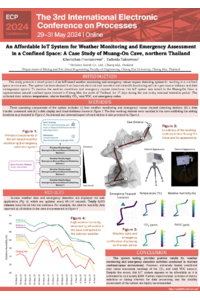
ECP2024-Poster-sciforum-084736.pdf
Therapeutic Potential of Fractions of Globimetula oreophila (Oliv. ex Hook.f.) Leaf Extract Growing on Azadirachta indica Against Plasmodium berghei-infected Mice: an In Vivo Approach
Spectroscopy insight in the nickel catalyst state in carbon nanotube growth inside metallic single-walled carbon nanotubes