Event submissions
Published
This submission belongs to the session F. Biomaterials for Diagnostics, Therapy and Healthcare of the event The 1st International Online Conference on Functional Biomaterials
Published date
08 Jul, 2024
Academic Editor
'%3e%3cpath%20d='M12.6657%2010.9104C12.4185%2010.325%2012.0599%209.79327%2011.6097%209.34482C11.1609%208.89508%2010.6293%208.5365%2010.0442%208.28888C10.0389%208.28626%2010.0337%208.28495%2010.0285%208.28233C10.8446%207.69279%2011.3752%206.73249%2011.3752%205.64904C11.3752%203.8542%209.92103%202.39999%208.1262%202.39999C6.33136%202.39999%204.87715%203.8542%204.87715%205.64904C4.87715%206.73249%205.40774%207.69279%206.22393%208.28364C6.21869%208.28626%206.21345%208.28757%206.20821%208.29019C5.62129%208.5378%205.09463%208.89284%204.64265%209.34613C4.1929%209.79493%203.83432%2010.3266%203.58671%2010.9117C3.34345%2011.4845%203.21226%2012.0987%203.20023%2012.7209C3.19988%2012.7349%203.20233%2012.7488%203.20744%2012.7619C3.21255%2012.7749%203.22022%2012.7867%203.22998%2012.7968C3.23975%2012.8068%203.25142%2012.8147%203.26431%2012.8202C3.2772%2012.8256%203.29105%2012.8284%203.30504%2012.8284H4.09109C4.14874%2012.8284%204.19459%2012.7825%204.1959%2012.7262C4.2221%2011.7148%204.62823%2010.7676%205.34617%2010.0497C6.08899%209.30683%207.0755%208.89808%208.1262%208.89808C9.17689%208.89808%2010.1634%209.30683%2010.9062%2010.0497C11.6242%2010.7676%2012.0303%2011.7148%2012.0565%2012.7262C12.0578%2012.7838%2012.1037%2012.8284%2012.1613%2012.8284H12.9474C12.9613%2012.8284%2012.9752%2012.8256%2012.9881%2012.8202C13.001%2012.8147%2013.0126%2012.8068%2013.0224%2012.7968C13.0322%2012.7867%2013.0398%2012.7749%2013.0449%2012.7619C13.0501%2012.7488%2013.0525%2012.7349%2013.0522%2012.7209C13.0391%2012.0947%2012.9094%2011.4855%2012.6657%2010.9104ZM8.1262%207.9024C7.52486%207.9024%206.9589%207.6679%206.53312%207.24211C6.10733%206.81633%205.87283%206.25037%205.87283%205.64904C5.87283%205.0477%206.10733%204.48174%206.53312%204.05596C6.9589%203.63018%207.52486%203.39567%208.1262%203.39567C8.72753%203.39567%209.29349%203.63018%209.71927%204.05596C10.1451%204.48174%2010.3796%205.0477%2010.3796%205.64904C10.3796%206.25037%2010.1451%206.81633%209.71927%207.24211C9.29349%207.6679%208.72753%207.9024%208.1262%207.9024Z'%20fill='%235D1EE1'/%3e%3c/g%3e%3c/svg%3e) Serena Danti
Serena DantiCitation
Maryam alqayem, Hawra Alkhadad, Noor Jaragh, Zainab Ateya, Roshan Deen, Fryad Henari Henari, uwe Torsten, Reuseable and Efficient Catalytic Alginate Beads Encapsulated with Silver Nanoclusters synthesized using Mangosteen Peel, in Proceedings of The 1st International Online Conference on Functional Biomaterials, 10 July–12 July 2024, MDPI: Basel, Switzerland
Share
Email
Facebook
Twitter
LinkedIn
Reuseable and Efficient Catalytic Alginate Beads Encapsulated with Silver Nanoclusters synthesized using Mangosteen Peel
'%3e%3cpath%20d='M12.6647%2010.9104C12.4176%2010.325%2012.0589%209.7933%2011.6088%209.34485C11.16%208.89511%2010.6283%208.53653%2010.0432%208.28891C10.038%208.28629%2010.0327%208.28498%2010.0275%208.28236C10.8437%207.69282%2011.3743%206.73252%2011.3743%205.64907C11.3743%203.85423%209.92005%202.40002%208.12522%202.40002C6.33038%202.40002%204.87618%203.85423%204.87618%205.64907C4.87618%206.73252%205.40677%207.69282%206.22296%208.28367C6.21772%208.28629%206.21248%208.2876%206.20724%208.29022C5.62031%208.53783%205.09365%208.89287%204.64167%209.34616C4.19192%209.79496%203.83334%2010.3266%203.58573%2010.9117C3.34247%2011.4846%203.21128%2012.0987%203.19925%2012.721C3.1989%2012.735%203.20135%2012.7489%203.20646%2012.7619C3.21157%2012.7749%203.21924%2012.7868%203.22901%2012.7968C3.23877%2012.8068%203.25045%2012.8148%203.26334%2012.8202C3.27623%2012.8256%203.29007%2012.8284%203.30406%2012.8284H4.09012C4.14776%2012.8284%204.19362%2012.7825%204.19493%2012.7262C4.22113%2011.7148%204.62726%2010.7676%205.34519%2010.0497C6.08802%209.30686%207.07452%208.89811%208.12522%208.89811C9.17592%208.89811%2010.1624%209.30686%2010.9052%2010.0497C11.6232%2010.7676%2012.0293%2011.7148%2012.0555%2012.7262C12.0568%2012.7839%2012.1027%2012.8284%2012.1603%2012.8284H12.9464C12.9604%2012.8284%2012.9742%2012.8256%2012.9871%2012.8202C13%2012.8148%2013.0117%2012.8068%2013.0214%2012.7968C13.0312%2012.7868%2013.0389%2012.7749%2013.044%2012.7619C13.0491%2012.7489%2013.0515%2012.735%2013.0512%2012.721C13.0381%2012.0947%2012.9084%2011.4856%2012.6647%2010.9104ZM8.12522%207.90243C7.52388%207.90243%206.95792%207.66793%206.53214%207.24215C6.10636%206.81636%205.87185%206.2504%205.87185%205.64907C5.87185%205.04773%206.10636%204.48177%206.53214%204.05599C6.95792%203.63021%207.52388%203.3957%208.12522%203.3957C8.72655%203.3957%209.29252%203.63021%209.7183%204.05599C10.1441%204.48177%2010.3786%205.04773%2010.3786%205.64907C10.3786%206.2504%2010.1441%206.81636%209.7183%207.24215C9.29252%207.66793%208.72655%207.90243%208.12522%207.90243Z'%20fill='%235D1EE1'/%3e%3c/g%3e%3c/svg%3e)
Maryam alqayem 1
Hawra Alkhadad 1
Noor Jaragh 1
Zainab Ateya 1

Roshan Deen 1

Fryad Henari Henari 1

uwe Torsten 1
1. Royal college of surgeons in Ireland-Medical University of Bahrain, school of Medicine
Abstract
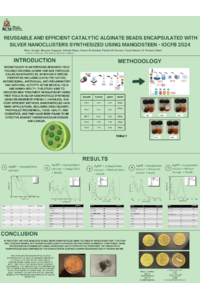
In recent years, phytosynthesis of metallic nanoparticles using aqueous extracts of plants and plant products has become considerably important in biomedical and environmental applications due to its non-toxicity and the fact that it is an environmentally friendly approach.
In this study, we developed stable silver nanoparticles using the peels of mangosteen fruit. This fruit peel contains several phytochemicals including flavonoids and polyphenols (phenolic compounds). These phytochemicals possess anti-aging, antioxidant and cytoprotective properties. The formation of nanoparticles was confirmed by the characteristic surface plasmon resonance peak at around 400 nm.
The synthesized nanoparticles were encapsulated in sodium alginate beads with a single-step method via ionotropic crosslinking using calcium chloride (5 wt%). The resulting beads were compact and porous. The photocatalytic properties of the beads were evaluated using various toxic dyes such as Congo red, methylene blue, Alizarin yellow and methyl orange both in the presence and absence of solar radiation.
The nanoclusters acted as catalytic sites for the degradation process, while alginate provided a stable matrix for the immobilization of the nanoclusters and facilitated the mass transfer of the pollutants to the catalytic sites. The study highlights the effectiveness of silver-nanocluster-loaded alginate beads as a promising and eco-friendly material for the treatment of medical waste and contaminated water in the future.
Keywords
Silver Nanoclusters ,Alginate Beads ,Mangosteen Peel
Poster
sciforum-089268.pdf
Stimuli-responsive materials for drug delivery, neuromodulation, tissue engineering and regenerative medicine.
Towards Sustainability and Waste-to-Wealth Approach: The Development of Metallic Nanoparticles for Biomedical Applications using Local Palm Tree Waste