Event submissions
Published
This submission belongs to the session C. Antibacterial Biomaterials of the event The 1st International Online Conference on Functional Biomaterials
Published date
08 Jul, 2024
Academic Editor
'%3e%3cpath%20d='M12.6657%2010.9104C12.4185%2010.325%2012.0599%209.79327%2011.6097%209.34482C11.1609%208.89508%2010.6293%208.5365%2010.0442%208.28888C10.0389%208.28626%2010.0337%208.28495%2010.0285%208.28233C10.8446%207.69279%2011.3752%206.73249%2011.3752%205.64904C11.3752%203.8542%209.92103%202.39999%208.1262%202.39999C6.33136%202.39999%204.87715%203.8542%204.87715%205.64904C4.87715%206.73249%205.40774%207.69279%206.22393%208.28364C6.21869%208.28626%206.21345%208.28757%206.20821%208.29019C5.62129%208.5378%205.09463%208.89284%204.64265%209.34613C4.1929%209.79493%203.83432%2010.3266%203.58671%2010.9117C3.34345%2011.4845%203.21226%2012.0987%203.20023%2012.7209C3.19988%2012.7349%203.20233%2012.7488%203.20744%2012.7619C3.21255%2012.7749%203.22022%2012.7867%203.22998%2012.7968C3.23975%2012.8068%203.25142%2012.8147%203.26431%2012.8202C3.2772%2012.8256%203.29105%2012.8284%203.30504%2012.8284H4.09109C4.14874%2012.8284%204.19459%2012.7825%204.1959%2012.7262C4.2221%2011.7148%204.62823%2010.7676%205.34617%2010.0497C6.08899%209.30683%207.0755%208.89808%208.1262%208.89808C9.17689%208.89808%2010.1634%209.30683%2010.9062%2010.0497C11.6242%2010.7676%2012.0303%2011.7148%2012.0565%2012.7262C12.0578%2012.7838%2012.1037%2012.8284%2012.1613%2012.8284H12.9474C12.9613%2012.8284%2012.9752%2012.8256%2012.9881%2012.8202C13.001%2012.8147%2013.0126%2012.8068%2013.0224%2012.7968C13.0322%2012.7867%2013.0398%2012.7749%2013.0449%2012.7619C13.0501%2012.7488%2013.0525%2012.7349%2013.0522%2012.7209C13.0391%2012.0947%2012.9094%2011.4855%2012.6657%2010.9104ZM8.1262%207.9024C7.52486%207.9024%206.9589%207.6679%206.53312%207.24211C6.10733%206.81633%205.87283%206.25037%205.87283%205.64904C5.87283%205.0477%206.10733%204.48174%206.53312%204.05596C6.9589%203.63018%207.52486%203.39567%208.1262%203.39567C8.72753%203.39567%209.29349%203.63018%209.71927%204.05596C10.1451%204.48174%2010.3796%205.0477%2010.3796%205.64904C10.3796%206.25037%2010.1451%206.81633%209.71927%207.24211C9.29349%207.6679%208.72753%207.9024%208.1262%207.9024Z'%20fill='%235D1EE1'/%3e%3c/g%3e%3c/svg%3e) John Luong
John LuongCitation
Sara Abdulhadi Hasan, Maryam Alqayem, Ali Zayer, Renad AlAnsari, Lulwa Alqallaf, Awrad Alkhaldi, Mareena Jijo, Abeer Abdulla, Ghadeer Almarzooq, Zainab Ali, Hawra Alkhadad, Radwan Darwish, Awni Bata, Ismail SakfAlHait, Sami Beidas, G. Roshan Deen, Towards Sustainability and Waste-to-Wealth Approach: The Development of Metallic Nanoparticles for Biomedical Applications using Local Palm Tree Waste, in Proceedings of The 1st International Online Conference on Functional Biomaterials, 10 July–12 July 2024, MDPI: Basel, Switzerland
Share
Email
Facebook
Twitter
LinkedIn
Towards Sustainability and Waste-to-Wealth Approach: The Development of Metallic Nanoparticles for Biomedical Applications using Local Palm Tree Waste
'%3e%3cpath%20d='M12.6647%2010.9104C12.4176%2010.325%2012.0589%209.7933%2011.6088%209.34485C11.16%208.89511%2010.6283%208.53653%2010.0432%208.28891C10.038%208.28629%2010.0327%208.28498%2010.0275%208.28236C10.8437%207.69282%2011.3743%206.73252%2011.3743%205.64907C11.3743%203.85423%209.92005%202.40002%208.12522%202.40002C6.33038%202.40002%204.87618%203.85423%204.87618%205.64907C4.87618%206.73252%205.40677%207.69282%206.22296%208.28367C6.21772%208.28629%206.21248%208.2876%206.20724%208.29022C5.62031%208.53783%205.09365%208.89287%204.64167%209.34616C4.19192%209.79496%203.83334%2010.3266%203.58573%2010.9117C3.34247%2011.4846%203.21128%2012.0987%203.19925%2012.721C3.1989%2012.735%203.20135%2012.7489%203.20646%2012.7619C3.21157%2012.7749%203.21924%2012.7868%203.22901%2012.7968C3.23877%2012.8068%203.25045%2012.8148%203.26334%2012.8202C3.27623%2012.8256%203.29007%2012.8284%203.30406%2012.8284H4.09012C4.14776%2012.8284%204.19362%2012.7825%204.19493%2012.7262C4.22113%2011.7148%204.62726%2010.7676%205.34519%2010.0497C6.08802%209.30686%207.07452%208.89811%208.12522%208.89811C9.17592%208.89811%2010.1624%209.30686%2010.9052%2010.0497C11.6232%2010.7676%2012.0293%2011.7148%2012.0555%2012.7262C12.0568%2012.7839%2012.1027%2012.8284%2012.1603%2012.8284H12.9464C12.9604%2012.8284%2012.9742%2012.8256%2012.9871%2012.8202C13%2012.8148%2013.0117%2012.8068%2013.0214%2012.7968C13.0312%2012.7868%2013.0389%2012.7749%2013.044%2012.7619C13.0491%2012.7489%2013.0515%2012.735%2013.0512%2012.721C13.0381%2012.0947%2012.9084%2011.4856%2012.6647%2010.9104ZM8.12522%207.90243C7.52388%207.90243%206.95792%207.66793%206.53214%207.24215C6.10636%206.81636%205.87185%206.2504%205.87185%205.64907C5.87185%205.04773%206.10636%204.48177%206.53214%204.05599C6.95792%203.63021%207.52388%203.3957%208.12522%203.3957C8.72655%203.3957%209.29252%203.63021%209.7183%204.05599C10.1441%204.48177%2010.3786%205.04773%2010.3786%205.64907C10.3786%206.2504%2010.1441%206.81636%209.7183%207.24215C9.29252%207.66793%208.72655%207.90243%208.12522%207.90243Z'%20fill='%235D1EE1'/%3e%3c/g%3e%3c/svg%3e)
Sara Abdulhadi Hasan 1
Maryam Alqayem 1
Ali Zayer 1
Renad AlAnsari 1
Lulwa Alqallaf 1
Awrad Alkhaldi 1
Mareena Jijo 1
Abeer Abdulla 1
Ghadeer Almarzooq 1
Zainab Ali 1
Hawra Alkhadad 1
Radwan Darwish 1
Awni Bata 1
Ismail SakfAlHait 1
Sami Beidas 1

G. Roshan Deen 1
1. Medicine Research Group, School of Medicine, Royal College of Surgeons in Ireland (RCSI), Medical University of Bahrain, Kingdom of Bahrain
Abstract
- Introduction & Significance
Nanoparticles are small particles that range in nanoscale less than 100 nm, which is equivalent to one billionth 10-9 1. The development of nanoparticles by green methods has gained considerable research attention in medical applications such as cancer therapy, tissue engineering, and target-specific drug delivery due to their non-toxicity, surface functionality, and stability. This approach reduces environmental pollution and provides benign materials with desired properties (antibacterial, antibiofilm, antimalarial, and anticancer) for advanced biomedical applications. Palm trees are rich in polyphenols, which can act as both reducing and stabilizing agents 2.
2. Methods
In this study, silver and selenium nanoparticles were synthesized using a variety of local palm tree waste and products such as date palm leaves, date buds, and homemade date syrup. The formation of nanoparticles was confirmed by measuring the surface plasmon resonance peak using a UV-VIS spectrophotometer. The antibacterial properties of the silver nanoparticles on three different types of bacteria were studied using the Hinton–Broth method.
3. Results
UV-Vis Spectroscopy confirmed the presence of nanoparticles in all prepared solutions. Additionally, the antibacterial effect was assessed using the disc diffusion method. The greatest antibacterial activity was seen against Escherichia coli, which was evidenced by the large clear zone of inhibition. Moreover, the growth of Staphylococcus aureus was disturbed by the silver nanoparticles.
4. Conclusion
Using palm leaves, buds, and date syrup, a successful synthesis of silver, selenium, and gold nanoparticles was achieved. Bacterial studies showed disruption of bacterial growth in Gram-positive staphylococcus aureus and significant antibacterial effect against Gram-negative Escherichia coli. Next, we aim to examine the effect of the synthesized nanoparticles on cancer cell lines and fibroblasts as well as investigate their ability to enhance wound healing stimuli response using hydrogels. Material sustainability and the conversion of waste to advanced materials were successfully demonstrated in this project.
Keywords
Nanoparticles
Palm tree
Anti-bacterial
Green nanotechnology
nanoparticle synthesis
medical application
Poster
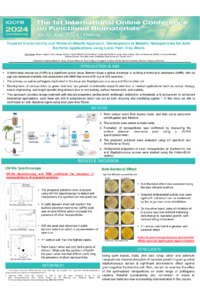
Poster_Towards Sustainability and Waste-to-Wealth Approach Development of Metallic Nanoparticles for Anti-Bacterial Applications using Local Palm Tree Waste.pdf
Reuseable and Efficient Catalytic Alginate Beads Encapsulated with Silver Nanoclusters synthesized using Mangosteen Peel
Antimicrobial activity of polymers-functionalized urinary catheters against Staphylococcus aureus