Event submissions
Published
This submission belongs to the session G. Bio-fabricated and 3D Printed Biomaterials of the event The 1st International Online Conference on Functional Biomaterials
Published date
08 Jul, 2024
Academic Editor
'%3e%3cpath%20d='M12.6657%2010.9104C12.4185%2010.325%2012.0599%209.79327%2011.6097%209.34482C11.1609%208.89508%2010.6293%208.5365%2010.0442%208.28888C10.0389%208.28626%2010.0337%208.28495%2010.0285%208.28233C10.8446%207.69279%2011.3752%206.73249%2011.3752%205.64904C11.3752%203.8542%209.92103%202.39999%208.1262%202.39999C6.33136%202.39999%204.87715%203.8542%204.87715%205.64904C4.87715%206.73249%205.40774%207.69279%206.22393%208.28364C6.21869%208.28626%206.21345%208.28757%206.20821%208.29019C5.62129%208.5378%205.09463%208.89284%204.64265%209.34613C4.1929%209.79493%203.83432%2010.3266%203.58671%2010.9117C3.34345%2011.4845%203.21226%2012.0987%203.20023%2012.7209C3.19988%2012.7349%203.20233%2012.7488%203.20744%2012.7619C3.21255%2012.7749%203.22022%2012.7867%203.22998%2012.7968C3.23975%2012.8068%203.25142%2012.8147%203.26431%2012.8202C3.2772%2012.8256%203.29105%2012.8284%203.30504%2012.8284H4.09109C4.14874%2012.8284%204.19459%2012.7825%204.1959%2012.7262C4.2221%2011.7148%204.62823%2010.7676%205.34617%2010.0497C6.08899%209.30683%207.0755%208.89808%208.1262%208.89808C9.17689%208.89808%2010.1634%209.30683%2010.9062%2010.0497C11.6242%2010.7676%2012.0303%2011.7148%2012.0565%2012.7262C12.0578%2012.7838%2012.1037%2012.8284%2012.1613%2012.8284H12.9474C12.9613%2012.8284%2012.9752%2012.8256%2012.9881%2012.8202C13.001%2012.8147%2013.0126%2012.8068%2013.0224%2012.7968C13.0322%2012.7867%2013.0398%2012.7749%2013.0449%2012.7619C13.0501%2012.7488%2013.0525%2012.7349%2013.0522%2012.7209C13.0391%2012.0947%2012.9094%2011.4855%2012.6657%2010.9104ZM8.1262%207.9024C7.52486%207.9024%206.9589%207.6679%206.53312%207.24211C6.10733%206.81633%205.87283%206.25037%205.87283%205.64904C5.87283%205.0477%206.10733%204.48174%206.53312%204.05596C6.9589%203.63018%207.52486%203.39567%208.1262%203.39567C8.72753%203.39567%209.29349%203.63018%209.71927%204.05596C10.1451%204.48174%2010.3796%205.0477%2010.3796%205.64904C10.3796%206.25037%2010.1451%206.81633%209.71927%207.24211C9.29349%207.6679%208.72753%207.9024%208.1262%207.9024Z'%20fill='%235D1EE1'/%3e%3c/g%3e%3c/svg%3e) Lidy Fratila-Apachitei
Lidy Fratila-ApachiteiCitation
Ivan Lednev, Sergey Zaitsev, Ekaterina Maltseva, Larisa Smirnova, Thermoplastic and biocompatible materials based on block copolymers of chitosan and polycaprolactone, in Proceedings of The 1st International Online Conference on Functional Biomaterials, 10 July–12 July 2024, MDPI: Basel, Switzerland
Share
Email
Facebook
Twitter
LinkedIn
Thermoplastic and biocompatible materials based on block copolymers of chitosan and polycaprolactone
'%3e%3cpath%20d='M12.6647%2010.9104C12.4176%2010.325%2012.0589%209.7933%2011.6088%209.34485C11.16%208.89511%2010.6283%208.53653%2010.0432%208.28891C10.038%208.28629%2010.0327%208.28498%2010.0275%208.28236C10.8437%207.69282%2011.3743%206.73252%2011.3743%205.64907C11.3743%203.85423%209.92005%202.40002%208.12522%202.40002C6.33038%202.40002%204.87618%203.85423%204.87618%205.64907C4.87618%206.73252%205.40677%207.69282%206.22296%208.28367C6.21772%208.28629%206.21248%208.2876%206.20724%208.29022C5.62031%208.53783%205.09365%208.89287%204.64167%209.34616C4.19192%209.79496%203.83334%2010.3266%203.58573%2010.9117C3.34247%2011.4846%203.21128%2012.0987%203.19925%2012.721C3.1989%2012.735%203.20135%2012.7489%203.20646%2012.7619C3.21157%2012.7749%203.21924%2012.7868%203.22901%2012.7968C3.23877%2012.8068%203.25045%2012.8148%203.26334%2012.8202C3.27623%2012.8256%203.29007%2012.8284%203.30406%2012.8284H4.09012C4.14776%2012.8284%204.19362%2012.7825%204.19493%2012.7262C4.22113%2011.7148%204.62726%2010.7676%205.34519%2010.0497C6.08802%209.30686%207.07452%208.89811%208.12522%208.89811C9.17592%208.89811%2010.1624%209.30686%2010.9052%2010.0497C11.6232%2010.7676%2012.0293%2011.7148%2012.0555%2012.7262C12.0568%2012.7839%2012.1027%2012.8284%2012.1603%2012.8284H12.9464C12.9604%2012.8284%2012.9742%2012.8256%2012.9871%2012.8202C13%2012.8148%2013.0117%2012.8068%2013.0214%2012.7968C13.0312%2012.7868%2013.0389%2012.7749%2013.044%2012.7619C13.0491%2012.7489%2013.0515%2012.735%2013.0512%2012.721C13.0381%2012.0947%2012.9084%2011.4856%2012.6647%2010.9104ZM8.12522%207.90243C7.52388%207.90243%206.95792%207.66793%206.53214%207.24215C6.10636%206.81636%205.87185%206.2504%205.87185%205.64907C5.87185%205.04773%206.10636%204.48177%206.53214%204.05599C6.95792%203.63021%207.52388%203.3957%208.12522%203.3957C8.72655%203.3957%209.29252%203.63021%209.7183%204.05599C10.1441%204.48177%2010.3786%205.04773%2010.3786%205.64907C10.3786%206.2504%2010.1441%206.81636%209.7183%207.24215C9.29252%207.66793%208.72655%207.90243%208.12522%207.90243Z'%20fill='%235D1EE1'/%3e%3c/g%3e%3c/svg%3e)
Ivan Lednev 1
Sergey Zaitsev 2
Ekaterina Maltseva 2
Larisa Smirnova 2
1. Department of Macromolecular Compounds and Colloidal Chemistry, Faculty of Chemistry, University Of Nizhny Novgorod, Nizhny Novgorod, Gagarin Avenue 23 building 5, Nizhny Novgorod, Russia, 603950
2. National Research Lobachevsky State University of Nizhny Novgorod
Abstract
The relevance of this study is related to the demand for biocompatible and thermoplastic polymer materials suitable for use in personalized regenerative medicine. Materials based on polycaprolactone and chitosan are recognized as promising candidates for the development of biodegradable materials that successfully combine the properties of synthetic and natural components. The basic idea is that polycaprolactone is convenient from a processing properties perspective, since materials based on it are thermoplastic and have good mechanical properties, but high hydrophobicity and low cellular adhesion limit the use for solving certain medical problems. This can be solved by combining it with chitosan in one composition.
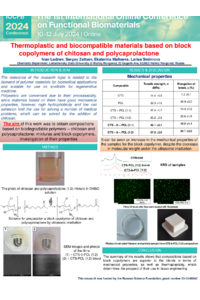
The copolymerization was performed in solution using ultrasonic irradiation. To obtain homogenous solution of chitosan with polycaprolactone, they were dissolved in DMSO and chloroform, respectively, after which both solutions were mixed and irradiated by ultrasonic treatment for 30 minutes at 25 ° C. The structure and properties of the synthesized block copolymers were studied by XRD analysis, gel-permeation chromatography (GPC) and differential scanning calorimetry (DSC). The study of samples by XRD analysis showed the amorphous structure of copolymers, in contrast to the original crystalline homopolymers. The results of DSC study showed a decrease in the melting point of polyester blocks and a decrease in the glass transition temperature of chitosan blocks in the copolymer. The fermentative depolymerization of chitosan blocks in the samples was performed, which made it possible to determine the molecular weight characteristics of the polycaprolactone blocks by GPC study. Films were obtained from block copolymer solutions by the solvent casting method, drying them at 65 ° C to a constant mass. The film samples were characterized by high mechanical properties (tensile strength ~ 70 MPa, with elongation at break ~ 35%). The biocompatibility of the composition was investigated and proven by the MTT assay.
This research was funded by the Russian Science Foundation, grant number 23-13-00342
Keywords
chitosan
ultrasonication
polycaprolactone
biomaterials
Poster
IOCFB 2024 - sciforum-092088.pdf
Incorporation of N-acetylcysteine into an experimental resin-based sealer
Three-dimensional (3D) printing of alkali-dissolved chitosan bioink and structural evaluation of bioprinted constructs for biomedical application