Event submissions
Published
This submission belongs to the session E. Biomaterials for Drug Delivery of the event The 1st International Online Conference on Functional Biomaterials
Published date
08 Jul, 2024
Academic Editor
'%3e%3cpath%20d='M12.6657%2010.9104C12.4185%2010.325%2012.0599%209.79327%2011.6097%209.34482C11.1609%208.89508%2010.6293%208.5365%2010.0442%208.28888C10.0389%208.28626%2010.0337%208.28495%2010.0285%208.28233C10.8446%207.69279%2011.3752%206.73249%2011.3752%205.64904C11.3752%203.8542%209.92103%202.39999%208.1262%202.39999C6.33136%202.39999%204.87715%203.8542%204.87715%205.64904C4.87715%206.73249%205.40774%207.69279%206.22393%208.28364C6.21869%208.28626%206.21345%208.28757%206.20821%208.29019C5.62129%208.5378%205.09463%208.89284%204.64265%209.34613C4.1929%209.79493%203.83432%2010.3266%203.58671%2010.9117C3.34345%2011.4845%203.21226%2012.0987%203.20023%2012.7209C3.19988%2012.7349%203.20233%2012.7488%203.20744%2012.7619C3.21255%2012.7749%203.22022%2012.7867%203.22998%2012.7968C3.23975%2012.8068%203.25142%2012.8147%203.26431%2012.8202C3.2772%2012.8256%203.29105%2012.8284%203.30504%2012.8284H4.09109C4.14874%2012.8284%204.19459%2012.7825%204.1959%2012.7262C4.2221%2011.7148%204.62823%2010.7676%205.34617%2010.0497C6.08899%209.30683%207.0755%208.89808%208.1262%208.89808C9.17689%208.89808%2010.1634%209.30683%2010.9062%2010.0497C11.6242%2010.7676%2012.0303%2011.7148%2012.0565%2012.7262C12.0578%2012.7838%2012.1037%2012.8284%2012.1613%2012.8284H12.9474C12.9613%2012.8284%2012.9752%2012.8256%2012.9881%2012.8202C13.001%2012.8147%2013.0126%2012.8068%2013.0224%2012.7968C13.0322%2012.7867%2013.0398%2012.7749%2013.0449%2012.7619C13.0501%2012.7488%2013.0525%2012.7349%2013.0522%2012.7209C13.0391%2012.0947%2012.9094%2011.4855%2012.6657%2010.9104ZM8.1262%207.9024C7.52486%207.9024%206.9589%207.6679%206.53312%207.24211C6.10733%206.81633%205.87283%206.25037%205.87283%205.64904C5.87283%205.0477%206.10733%204.48174%206.53312%204.05596C6.9589%203.63018%207.52486%203.39567%208.1262%203.39567C8.72753%203.39567%209.29349%203.63018%209.71927%204.05596C10.1451%204.48174%2010.3796%205.0477%2010.3796%205.64904C10.3796%206.25037%2010.1451%206.81633%209.71927%207.24211C9.29349%207.6679%208.72753%207.9024%208.1262%207.9024Z'%20fill='%235D1EE1'/%3e%3c/g%3e%3c/svg%3e) Alexander Andrianov
Alexander AndrianovCitation
Monika Rojewska, Emilia Jakubowska, Klaudia Szelejewska, Tomasz Osmałek, Krystyna Prochaska, Physicochemical study of mucoadhesive polymers and their interactions with mucin, in Proceedings of The 1st International Online Conference on Functional Biomaterials, 10 July–12 July 2024, MDPI: Basel, Switzerland
Share
Email
Facebook
Twitter
LinkedIn
Physicochemical study of mucoadhesive polymers and their interactions with mucin
'%3e%3cpath%20d='M12.6647%2010.9104C12.4176%2010.325%2012.0589%209.7933%2011.6088%209.34485C11.16%208.89511%2010.6283%208.53653%2010.0432%208.28891C10.038%208.28629%2010.0327%208.28498%2010.0275%208.28236C10.8437%207.69282%2011.3743%206.73252%2011.3743%205.64907C11.3743%203.85423%209.92005%202.40002%208.12522%202.40002C6.33038%202.40002%204.87618%203.85423%204.87618%205.64907C4.87618%206.73252%205.40677%207.69282%206.22296%208.28367C6.21772%208.28629%206.21248%208.2876%206.20724%208.29022C5.62031%208.53783%205.09365%208.89287%204.64167%209.34616C4.19192%209.79496%203.83334%2010.3266%203.58573%2010.9117C3.34247%2011.4846%203.21128%2012.0987%203.19925%2012.721C3.1989%2012.735%203.20135%2012.7489%203.20646%2012.7619C3.21157%2012.7749%203.21924%2012.7868%203.22901%2012.7968C3.23877%2012.8068%203.25045%2012.8148%203.26334%2012.8202C3.27623%2012.8256%203.29007%2012.8284%203.30406%2012.8284H4.09012C4.14776%2012.8284%204.19362%2012.7825%204.19493%2012.7262C4.22113%2011.7148%204.62726%2010.7676%205.34519%2010.0497C6.08802%209.30686%207.07452%208.89811%208.12522%208.89811C9.17592%208.89811%2010.1624%209.30686%2010.9052%2010.0497C11.6232%2010.7676%2012.0293%2011.7148%2012.0555%2012.7262C12.0568%2012.7839%2012.1027%2012.8284%2012.1603%2012.8284H12.9464C12.9604%2012.8284%2012.9742%2012.8256%2012.9871%2012.8202C13%2012.8148%2013.0117%2012.8068%2013.0214%2012.7968C13.0312%2012.7868%2013.0389%2012.7749%2013.044%2012.7619C13.0491%2012.7489%2013.0515%2012.735%2013.0512%2012.721C13.0381%2012.0947%2012.9084%2011.4856%2012.6647%2010.9104ZM8.12522%207.90243C7.52388%207.90243%206.95792%207.66793%206.53214%207.24215C6.10636%206.81636%205.87185%206.2504%205.87185%205.64907C5.87185%205.04773%206.10636%204.48177%206.53214%204.05599C6.95792%203.63021%207.52388%203.3957%208.12522%203.3957C8.72655%203.3957%209.29252%203.63021%209.7183%204.05599C10.1441%204.48177%2010.3786%205.04773%2010.3786%205.64907C10.3786%206.2504%2010.1441%206.81636%209.7183%207.24215C9.29252%207.66793%208.72655%207.90243%208.12522%207.90243Z'%20fill='%235D1EE1'/%3e%3c/g%3e%3c/svg%3e)
Monika Rojewska 1
Emilia Jakubowska 2
Klaudia Szelejewska 2
Tomasz Osmałek 2
Krystyna Prochaska 1
1. Institute of Chemical Technology and Engineering, Poznan University of Technology, 60-965 Poznan, Poland
2. Chair and Department of Pharmaceutical Technology, Industrial Pharmacy Division, Poznan University of Medical Sciences, 80-806 Poznan, Poland
Abstract
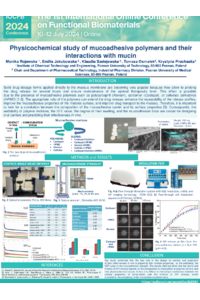
Solid drug dosage forms applied directly to the mucous membrane are becoming very popular because they allow to prolong the drug release for several hours and ensure maintainance of the optimal therapeutic level. This effect is possible due to the presence of mucoadhesive polymers. The mutual entanglement of polymer and mucin chains leads to form a gel structure which is a reservoir for the drug. Generally, the mucoadhesive forms contain hydrophilic polymers, such as polycarbophil, carbomer, chitosan, or cellulose derivatives (HPMC, HEC, etc.).
Scientific papers indicate that selecting the appropriate ratio of the polymers can extend the drug release, enhance the repeatability of the release profiles, improve the mucoadhesive properties of the material surface, and improve drug transport to the mucosa. Therefore, it is important to look for a correlation between the composition of the mucoadhesive carrier and its surface properties. Consequently, the wettability of polymer matrices, the degree of their swelling, the SFE value, and the mucoadhesion force are crucial for designing oral carriers and predicting their effectiveness in vivo. In our research, we measured the swelling and the contact angle on the polymer surface by the sessile drop method using various simulated biological fluids, water, and diiodomethane. The correlation between the physicochemical properties and release profiles obtained for antifungal drugs were evaluated.
Moreover, to explore the interactions between the polymer and mucin in the cell membrane environment, studies were carried out using the Langmuir monolayer technique. The obtained results allowed to better understand the mucoadhesion process and confirm the existence of interactions between mucin, mucoadhesive polymers, and model biological membranes. We have shown that these interactions depend on the type of mucoadhesive polymers, pH, and presence of mucin.
Keywords
mucodhesive polymers
wettability
swelling
surface free energy
release study
Langmuir technique
Poster
POSTER_IOCFB_2024_M Rojewska.pdf
Chitosan Nanoparticle-Loaded Essential Oils Electrosprayed onto Polycaprolactone Microfibers: A Novel Antifungal Therapy for Diabetic Foot Ulcers
The Influence of Aortic Valve Leaflet Material Models on Hemodynamic Features in Healthy and Pathological States