Event submissions
Published
This submission belongs to the session C. Antibacterial Biomaterials of the event The 1st International Online Conference on Functional Biomaterials
Published date
08 Jul, 2024
Academic Editor
'%3e%3cpath%20d='M12.6657%2010.9104C12.4185%2010.325%2012.0599%209.79327%2011.6097%209.34482C11.1609%208.89508%2010.6293%208.5365%2010.0442%208.28888C10.0389%208.28626%2010.0337%208.28495%2010.0285%208.28233C10.8446%207.69279%2011.3752%206.73249%2011.3752%205.64904C11.3752%203.8542%209.92103%202.39999%208.1262%202.39999C6.33136%202.39999%204.87715%203.8542%204.87715%205.64904C4.87715%206.73249%205.40774%207.69279%206.22393%208.28364C6.21869%208.28626%206.21345%208.28757%206.20821%208.29019C5.62129%208.5378%205.09463%208.89284%204.64265%209.34613C4.1929%209.79493%203.83432%2010.3266%203.58671%2010.9117C3.34345%2011.4845%203.21226%2012.0987%203.20023%2012.7209C3.19988%2012.7349%203.20233%2012.7488%203.20744%2012.7619C3.21255%2012.7749%203.22022%2012.7867%203.22998%2012.7968C3.23975%2012.8068%203.25142%2012.8147%203.26431%2012.8202C3.2772%2012.8256%203.29105%2012.8284%203.30504%2012.8284H4.09109C4.14874%2012.8284%204.19459%2012.7825%204.1959%2012.7262C4.2221%2011.7148%204.62823%2010.7676%205.34617%2010.0497C6.08899%209.30683%207.0755%208.89808%208.1262%208.89808C9.17689%208.89808%2010.1634%209.30683%2010.9062%2010.0497C11.6242%2010.7676%2012.0303%2011.7148%2012.0565%2012.7262C12.0578%2012.7838%2012.1037%2012.8284%2012.1613%2012.8284H12.9474C12.9613%2012.8284%2012.9752%2012.8256%2012.9881%2012.8202C13.001%2012.8147%2013.0126%2012.8068%2013.0224%2012.7968C13.0322%2012.7867%2013.0398%2012.7749%2013.0449%2012.7619C13.0501%2012.7488%2013.0525%2012.7349%2013.0522%2012.7209C13.0391%2012.0947%2012.9094%2011.4855%2012.6657%2010.9104ZM8.1262%207.9024C7.52486%207.9024%206.9589%207.6679%206.53312%207.24211C6.10733%206.81633%205.87283%206.25037%205.87283%205.64904C5.87283%205.0477%206.10733%204.48174%206.53312%204.05596C6.9589%203.63018%207.52486%203.39567%208.1262%203.39567C8.72753%203.39567%209.29349%203.63018%209.71927%204.05596C10.1451%204.48174%2010.3796%205.0477%2010.3796%205.64904C10.3796%206.25037%2010.1451%206.81633%209.71927%207.24211C9.29349%207.6679%208.72753%207.9024%208.1262%207.9024Z'%20fill='%235D1EE1'/%3e%3c/g%3e%3c/svg%3e) John Luong
John LuongCitation
Alina Matei, Gabriel Craciun, Vasilica Tucureanu, ZnO NP-BASED ADVANCED MATERIALS AND THEIR POTENTIAL BIOAPPLICATIONS, in Proceedings of The 1st International Online Conference on Functional Biomaterials, 10 July–12 July 2024, MDPI: Basel, Switzerland
Share
Email
Facebook
Twitter
LinkedIn
ZnO NP-BASED ADVANCED MATERIALS AND THEIR POTENTIAL BIOAPPLICATIONS
'%3e%3cpath%20d='M12.6647%2010.9104C12.4176%2010.325%2012.0589%209.7933%2011.6088%209.34485C11.16%208.89511%2010.6283%208.53653%2010.0432%208.28891C10.038%208.28629%2010.0327%208.28498%2010.0275%208.28236C10.8437%207.69282%2011.3743%206.73252%2011.3743%205.64907C11.3743%203.85423%209.92005%202.40002%208.12522%202.40002C6.33038%202.40002%204.87618%203.85423%204.87618%205.64907C4.87618%206.73252%205.40677%207.69282%206.22296%208.28367C6.21772%208.28629%206.21248%208.2876%206.20724%208.29022C5.62031%208.53783%205.09365%208.89287%204.64167%209.34616C4.19192%209.79496%203.83334%2010.3266%203.58573%2010.9117C3.34247%2011.4846%203.21128%2012.0987%203.19925%2012.721C3.1989%2012.735%203.20135%2012.7489%203.20646%2012.7619C3.21157%2012.7749%203.21924%2012.7868%203.22901%2012.7968C3.23877%2012.8068%203.25045%2012.8148%203.26334%2012.8202C3.27623%2012.8256%203.29007%2012.8284%203.30406%2012.8284H4.09012C4.14776%2012.8284%204.19362%2012.7825%204.19493%2012.7262C4.22113%2011.7148%204.62726%2010.7676%205.34519%2010.0497C6.08802%209.30686%207.07452%208.89811%208.12522%208.89811C9.17592%208.89811%2010.1624%209.30686%2010.9052%2010.0497C11.6232%2010.7676%2012.0293%2011.7148%2012.0555%2012.7262C12.0568%2012.7839%2012.1027%2012.8284%2012.1603%2012.8284H12.9464C12.9604%2012.8284%2012.9742%2012.8256%2012.9871%2012.8202C13%2012.8148%2013.0117%2012.8068%2013.0214%2012.7968C13.0312%2012.7868%2013.0389%2012.7749%2013.044%2012.7619C13.0491%2012.7489%2013.0515%2012.735%2013.0512%2012.721C13.0381%2012.0947%2012.9084%2011.4856%2012.6647%2010.9104ZM8.12522%207.90243C7.52388%207.90243%206.95792%207.66793%206.53214%207.24215C6.10636%206.81636%205.87185%206.2504%205.87185%205.64907C5.87185%205.04773%206.10636%204.48177%206.53214%204.05599C6.95792%203.63021%207.52388%203.3957%208.12522%203.3957C8.72655%203.3957%209.29252%203.63021%209.7183%204.05599C10.1441%204.48177%2010.3786%205.04773%2010.3786%205.64907C10.3786%206.2504%2010.1441%206.81636%209.7183%207.24215C9.29252%207.66793%208.72655%207.90243%208.12522%207.90243Z'%20fill='%235D1EE1'/%3e%3c/g%3e%3c/svg%3e)
Alina Matei 1
Gabriel Craciun 2
Vasilica Tucureanu 2
1. National Institute for Research and Development in Microtechnologies IMT-Bucharest, Romania
2. National Institute for Research and Development in Microtechnologies IMT-Bucharest
Abstract
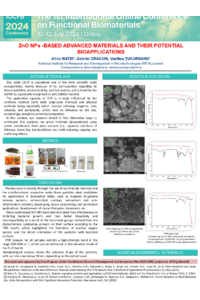
Zinc oxide (ZnO) is considered one of the most versatile oxide nanoparticles, mainly because of its particularities regarding its biocompatibility, photosolubility, and low toxicity, and is listed by the USFDA as a generally recognized as safe (GRAS) material. The applicative capacity of ZnO is strongly influenced by the synthesis method (with both large-scale chemical and physical methods being reported), which involves polluting reagents, toxic solvents, and surfactants, which have an influence on the size, morphology, and physicochemical properties.
In this context, our research aimed to find alternative ways to synthesize ZnO particles via green methods (biosynthesis) using active constituents from plant extracts (i.e., aqueous solutions of Hibiscus, Green Tea, Sea buckthorn, etc.) with reducing, capping, and stabilizing effects. These synthesized ZnO NPs have demonstrated their effectiveness in inhibiting bacterial growth and their better bioactivity and biocompatibility as a result of the functional groups derived from the phytochemical substances present on their surface according to the FTIR results, which highlighted the formation of reactive oxygen species and the direct interaction of the particles with bacterial surfaces. Also, a morphological analysis showed that the particles have a predominantly spherical shape, with particle sizes below 50 nm.
The decrease in toxicity through the use of eco-friendly methods and the multifunctional properties make these particles ideal candidates for applications in biomedical fields, such as targeted drug/gene delivery systems, antimicrobial coatings, antioxidant and anti-inflammatory activities, bioimaging, tissue engineering, skin protection applications, development of cancer therapies, biosensors, etc.
Acknowledgements:
This work was supported by Core Program within the National Research Development and Innovation Plan 2022-2027, carried out with the support of MCID, project no. 2307 (µNanoEl).
Keywords
ZnO nanoparticles
green synthesis
multifunctional properties
biomedical applications
Poster
Poster-IOCFB-sciforum 089808.pdf
Enhancing solid lipid nanoparticle performance: combining commercial lipids with biobased ionic liquids
Synergistic Enhancement of Electrospun Keratin Mats with Medicinal Plants and Green-Synthesized Silver Nanoparticles for Biomedical Applications