Event submissions
Published
This submission belongs to the session C. Antibacterial Biomaterials of the event The 1st International Online Conference on Functional Biomaterials
Published date
08 Jul, 2024
Academic Editor
'%3e%3cpath%20d='M12.6657%2010.9104C12.4185%2010.325%2012.0599%209.79327%2011.6097%209.34482C11.1609%208.89508%2010.6293%208.5365%2010.0442%208.28888C10.0389%208.28626%2010.0337%208.28495%2010.0285%208.28233C10.8446%207.69279%2011.3752%206.73249%2011.3752%205.64904C11.3752%203.8542%209.92103%202.39999%208.1262%202.39999C6.33136%202.39999%204.87715%203.8542%204.87715%205.64904C4.87715%206.73249%205.40774%207.69279%206.22393%208.28364C6.21869%208.28626%206.21345%208.28757%206.20821%208.29019C5.62129%208.5378%205.09463%208.89284%204.64265%209.34613C4.1929%209.79493%203.83432%2010.3266%203.58671%2010.9117C3.34345%2011.4845%203.21226%2012.0987%203.20023%2012.7209C3.19988%2012.7349%203.20233%2012.7488%203.20744%2012.7619C3.21255%2012.7749%203.22022%2012.7867%203.22998%2012.7968C3.23975%2012.8068%203.25142%2012.8147%203.26431%2012.8202C3.2772%2012.8256%203.29105%2012.8284%203.30504%2012.8284H4.09109C4.14874%2012.8284%204.19459%2012.7825%204.1959%2012.7262C4.2221%2011.7148%204.62823%2010.7676%205.34617%2010.0497C6.08899%209.30683%207.0755%208.89808%208.1262%208.89808C9.17689%208.89808%2010.1634%209.30683%2010.9062%2010.0497C11.6242%2010.7676%2012.0303%2011.7148%2012.0565%2012.7262C12.0578%2012.7838%2012.1037%2012.8284%2012.1613%2012.8284H12.9474C12.9613%2012.8284%2012.9752%2012.8256%2012.9881%2012.8202C13.001%2012.8147%2013.0126%2012.8068%2013.0224%2012.7968C13.0322%2012.7867%2013.0398%2012.7749%2013.0449%2012.7619C13.0501%2012.7488%2013.0525%2012.7349%2013.0522%2012.7209C13.0391%2012.0947%2012.9094%2011.4855%2012.6657%2010.9104ZM8.1262%207.9024C7.52486%207.9024%206.9589%207.6679%206.53312%207.24211C6.10733%206.81633%205.87283%206.25037%205.87283%205.64904C5.87283%205.0477%206.10733%204.48174%206.53312%204.05596C6.9589%203.63018%207.52486%203.39567%208.1262%203.39567C8.72753%203.39567%209.29349%203.63018%209.71927%204.05596C10.1451%204.48174%2010.3796%205.0477%2010.3796%205.64904C10.3796%206.25037%2010.1451%206.81633%209.71927%207.24211C9.29349%207.6679%208.72753%207.9024%208.1262%207.9024Z'%20fill='%235D1EE1'/%3e%3c/g%3e%3c/svg%3e) John Luong
John LuongCitation
Sahra Fonseca, Nicolas Fontaine, Marie-Pierre Cayer, Jonathan Robidoux, Denis Boudreau, Danny Brouard, Effect of mechanical and chemical process variation on antibacterial activity of polydopamine coating., in Proceedings of The 1st International Online Conference on Functional Biomaterials, 10 July–12 July 2024, MDPI: Basel, Switzerland
Share
Email
Facebook
Twitter
LinkedIn
Effect of mechanical and chemical process variation on antibacterial activity of polydopamine coating.
'%3e%3cpath%20d='M12.6647%2010.9104C12.4176%2010.325%2012.0589%209.7933%2011.6088%209.34485C11.16%208.89511%2010.6283%208.53653%2010.0432%208.28891C10.038%208.28629%2010.0327%208.28498%2010.0275%208.28236C10.8437%207.69282%2011.3743%206.73252%2011.3743%205.64907C11.3743%203.85423%209.92005%202.40002%208.12522%202.40002C6.33038%202.40002%204.87618%203.85423%204.87618%205.64907C4.87618%206.73252%205.40677%207.69282%206.22296%208.28367C6.21772%208.28629%206.21248%208.2876%206.20724%208.29022C5.62031%208.53783%205.09365%208.89287%204.64167%209.34616C4.19192%209.79496%203.83334%2010.3266%203.58573%2010.9117C3.34247%2011.4846%203.21128%2012.0987%203.19925%2012.721C3.1989%2012.735%203.20135%2012.7489%203.20646%2012.7619C3.21157%2012.7749%203.21924%2012.7868%203.22901%2012.7968C3.23877%2012.8068%203.25045%2012.8148%203.26334%2012.8202C3.27623%2012.8256%203.29007%2012.8284%203.30406%2012.8284H4.09012C4.14776%2012.8284%204.19362%2012.7825%204.19493%2012.7262C4.22113%2011.7148%204.62726%2010.7676%205.34519%2010.0497C6.08802%209.30686%207.07452%208.89811%208.12522%208.89811C9.17592%208.89811%2010.1624%209.30686%2010.9052%2010.0497C11.6232%2010.7676%2012.0293%2011.7148%2012.0555%2012.7262C12.0568%2012.7839%2012.1027%2012.8284%2012.1603%2012.8284H12.9464C12.9604%2012.8284%2012.9742%2012.8256%2012.9871%2012.8202C13%2012.8148%2013.0117%2012.8068%2013.0214%2012.7968C13.0312%2012.7868%2013.0389%2012.7749%2013.044%2012.7619C13.0491%2012.7489%2013.0515%2012.735%2013.0512%2012.721C13.0381%2012.0947%2012.9084%2011.4856%2012.6647%2010.9104ZM8.12522%207.90243C7.52388%207.90243%206.95792%207.66793%206.53214%207.24215C6.10636%206.81636%205.87185%206.2504%205.87185%205.64907C5.87185%205.04773%206.10636%204.48177%206.53214%204.05599C6.95792%203.63021%207.52388%203.3957%208.12522%203.3957C8.72655%203.3957%209.29252%203.63021%209.7183%204.05599C10.1441%204.48177%2010.3786%205.04773%2010.3786%205.64907C10.3786%206.2504%2010.1441%206.81636%209.7183%207.24215C9.29252%207.66793%208.72655%207.90243%208.12522%207.90243Z'%20fill='%235D1EE1'/%3e%3c/g%3e%3c/svg%3e)
Sahra Fonseca 1
Nicolas Fontaine 2
Marie-Pierre Cayer 1
Jonathan Robidoux 1
Denis Boudreau 2
Danny Brouard 1
1. Héma-Québec
2. Chemistry Department, Center for Optics, Photonics and Lasers (COPL), Université Laval
Abstract
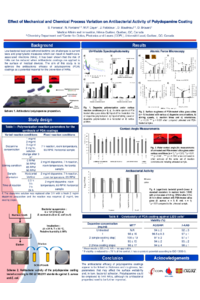
Low bacterial load and adhered biofilms are challenges to current tests and prophylactic measures, and can result in healthcare-associated infections (HAIs). It has been shown that the risk of HAIs can be reduced when antibacterial coatings are applied to the surface of medical devices. This study aims to optimize the antibacterial efficacy of polydopamine coating as a potential material for the prevention of HAIs.
Polydopamine coatings were characterized after varying the coating process. Modifications included the concentration of dopamine monomers, the sample position (horizontal vs vertical), the stirring speed (0 – 90 RPM) and the reaction time (0.5 – 24 h). The results were monitored via UV-visible, wettability and atomic force microscopy. The dopamine cytotoxicity was evaluated on the L929 cell line, in accordance with the ISO 10993-5 standard, and the antibacterial properties of polydopamine coatings were assessed using ISO 22196 standardization against Staphylococcus aureus and Escherichia coli.
Surface wettability, and therefore bacterial adhesion, are affected by the thickness and roughness of the polydopamine coating, playing a role in its antibacterial activity. Thicker and rough coatings had a better antibacterial effect against S. aureus (1.6 ± 0.4 log reduction), but not against E. coli (0.05 log reduction). The viability of L929 cells was ≥ 94 % in the presence of the polydopamine coating.
These results demonstrate that polydopamine is a promising non-toxic material for antibacterial coatings on medical devices. However, further tests are required to enhance its antibacterial properties.
Keywords
Biofilms
medical applications
silica glass
Staphylococcus aureus
Escherichia coli
Poster
Poster_vF.pdf
ANTIBACTERIAL-COATED SURGICAL SUTURES BY ATOMIC LAYER DEPOSITION OF TITANIUM OXIDE DOPED WITH VANADIUM FOR THE TREATMENT OF THE SURGICAL SITE INFECTION
Development of smart polymer nanomaterials that generate nitric oxide forantibacterial application.