Event submissions
Published
This submission belongs to the session C. Antibacterial Biomaterials of the event The 1st International Online Conference on Functional Biomaterials
Published date
08 Jul, 2024
Academic Editor
'%3e%3cpath%20d='M12.6657%2010.9104C12.4185%2010.325%2012.0599%209.79327%2011.6097%209.34482C11.1609%208.89508%2010.6293%208.5365%2010.0442%208.28888C10.0389%208.28626%2010.0337%208.28495%2010.0285%208.28233C10.8446%207.69279%2011.3752%206.73249%2011.3752%205.64904C11.3752%203.8542%209.92103%202.39999%208.1262%202.39999C6.33136%202.39999%204.87715%203.8542%204.87715%205.64904C4.87715%206.73249%205.40774%207.69279%206.22393%208.28364C6.21869%208.28626%206.21345%208.28757%206.20821%208.29019C5.62129%208.5378%205.09463%208.89284%204.64265%209.34613C4.1929%209.79493%203.83432%2010.3266%203.58671%2010.9117C3.34345%2011.4845%203.21226%2012.0987%203.20023%2012.7209C3.19988%2012.7349%203.20233%2012.7488%203.20744%2012.7619C3.21255%2012.7749%203.22022%2012.7867%203.22998%2012.7968C3.23975%2012.8068%203.25142%2012.8147%203.26431%2012.8202C3.2772%2012.8256%203.29105%2012.8284%203.30504%2012.8284H4.09109C4.14874%2012.8284%204.19459%2012.7825%204.1959%2012.7262C4.2221%2011.7148%204.62823%2010.7676%205.34617%2010.0497C6.08899%209.30683%207.0755%208.89808%208.1262%208.89808C9.17689%208.89808%2010.1634%209.30683%2010.9062%2010.0497C11.6242%2010.7676%2012.0303%2011.7148%2012.0565%2012.7262C12.0578%2012.7838%2012.1037%2012.8284%2012.1613%2012.8284H12.9474C12.9613%2012.8284%2012.9752%2012.8256%2012.9881%2012.8202C13.001%2012.8147%2013.0126%2012.8068%2013.0224%2012.7968C13.0322%2012.7867%2013.0398%2012.7749%2013.0449%2012.7619C13.0501%2012.7488%2013.0525%2012.7349%2013.0522%2012.7209C13.0391%2012.0947%2012.9094%2011.4855%2012.6657%2010.9104ZM8.1262%207.9024C7.52486%207.9024%206.9589%207.6679%206.53312%207.24211C6.10733%206.81633%205.87283%206.25037%205.87283%205.64904C5.87283%205.0477%206.10733%204.48174%206.53312%204.05596C6.9589%203.63018%207.52486%203.39567%208.1262%203.39567C8.72753%203.39567%209.29349%203.63018%209.71927%204.05596C10.1451%204.48174%2010.3796%205.0477%2010.3796%205.64904C10.3796%206.25037%2010.1451%206.81633%209.71927%207.24211C9.29349%207.6679%208.72753%207.9024%208.1262%207.9024Z'%20fill='%235D1EE1'/%3e%3c/g%3e%3c/svg%3e) John Luong
John LuongCitation
Yulia Makarets, Elizaveta Permyakova, Kristina Kotyakova, Saida Karshieva, Dmitry Shtansky, Development of antibacterial wound healing materials using polycaprolactone fibers and ZnO nanoparticles., in Proceedings of The 1st International Online Conference on Functional Biomaterials, 10 July–12 July 2024, MDPI: Basel, Switzerland
Share
Email
Facebook
Twitter
LinkedIn
Development of antibacterial wound healing materials using polycaprolactone fibers and ZnO nanoparticles.
'%3e%3cpath%20d='M12.6647%2010.9104C12.4176%2010.325%2012.0589%209.7933%2011.6088%209.34485C11.16%208.89511%2010.6283%208.53653%2010.0432%208.28891C10.038%208.28629%2010.0327%208.28498%2010.0275%208.28236C10.8437%207.69282%2011.3743%206.73252%2011.3743%205.64907C11.3743%203.85423%209.92005%202.40002%208.12522%202.40002C6.33038%202.40002%204.87618%203.85423%204.87618%205.64907C4.87618%206.73252%205.40677%207.69282%206.22296%208.28367C6.21772%208.28629%206.21248%208.2876%206.20724%208.29022C5.62031%208.53783%205.09365%208.89287%204.64167%209.34616C4.19192%209.79496%203.83334%2010.3266%203.58573%2010.9117C3.34247%2011.4846%203.21128%2012.0987%203.19925%2012.721C3.1989%2012.735%203.20135%2012.7489%203.20646%2012.7619C3.21157%2012.7749%203.21924%2012.7868%203.22901%2012.7968C3.23877%2012.8068%203.25045%2012.8148%203.26334%2012.8202C3.27623%2012.8256%203.29007%2012.8284%203.30406%2012.8284H4.09012C4.14776%2012.8284%204.19362%2012.7825%204.19493%2012.7262C4.22113%2011.7148%204.62726%2010.7676%205.34519%2010.0497C6.08802%209.30686%207.07452%208.89811%208.12522%208.89811C9.17592%208.89811%2010.1624%209.30686%2010.9052%2010.0497C11.6232%2010.7676%2012.0293%2011.7148%2012.0555%2012.7262C12.0568%2012.7839%2012.1027%2012.8284%2012.1603%2012.8284H12.9464C12.9604%2012.8284%2012.9742%2012.8256%2012.9871%2012.8202C13%2012.8148%2013.0117%2012.8068%2013.0214%2012.7968C13.0312%2012.7868%2013.0389%2012.7749%2013.044%2012.7619C13.0491%2012.7489%2013.0515%2012.735%2013.0512%2012.721C13.0381%2012.0947%2012.9084%2011.4856%2012.6647%2010.9104ZM8.12522%207.90243C7.52388%207.90243%206.95792%207.66793%206.53214%207.24215C6.10636%206.81636%205.87185%206.2504%205.87185%205.64907C5.87185%205.04773%206.10636%204.48177%206.53214%204.05599C6.95792%203.63021%207.52388%203.3957%208.12522%203.3957C8.72655%203.3957%209.29252%203.63021%209.7183%204.05599C10.1441%204.48177%2010.3786%205.04773%2010.3786%205.64907C10.3786%206.2504%2010.1441%206.81636%209.7183%207.24215C9.29252%207.66793%208.72655%207.90243%208.12522%207.90243Z'%20fill='%235D1EE1'/%3e%3c/g%3e%3c/svg%3e)
Yulia Makarets 1

Elizaveta Permyakova 1

Kristina Kotyakova 1
Saida Karshieva 1
Dmitry Shtansky 1
1. National University of Science and Technology MISIS, 4s1 Leninsky prospekt, Moscow, 119049, Russia
Abstract
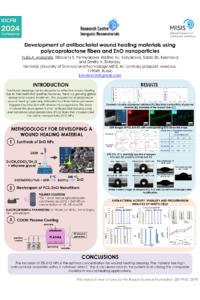
Introduction. Traditional dressings are inadequate for effective wound healing due to their restricted qualities; however, there is a growing global demand for wound treatment. The occurrence of problems in wound healing is primarily attributed to inflammatory processes triggered by infection with diverse microorganisms. This study involved the development of an antibacterial dressing using electroformed polycaprolactone (PCL) fibers that incorporated zinc oxide nanoparticles (ZnO NPs).
Materials and methods. The nanofibers were obtained in a mixture of acetic and formic acids with a concentration of PCL 25%. ZnO NPs, prepared by autoclave synthesis, were added to the acid mixture in varying amounts of 1, 3, and 5 wt.%. The structure and chemical composition of the ZnO NPs and PCL composite fibers were analyzed using SEM, EDX, and FTIR spectroscopy. The antibacterial activity was assessed against multiple strains of bacteria and fungus. The biocompatibility of the samples was assessed using the Lonza human dermal fibroblast cell line.
Results. The size of the produced ZnO NPs varied between 10 and 12 nanometers. The composite fibers have a size that varies between 300 nm and 1 µm. The EDX examination verifies that the primary constituents of the fibers consist of carbon, oxygen, and zinc. Furthermore, it is demonstrated that with an increase in the wt.% of ZnO, the atomic concentration likewise increases to 1.1%, 2.7%, and 3.9%, respectively. The successful implementation of ZnO nanoparticles was confirmed by the use of FTIR spectroscopy. The materials showed 100% antibacterial activity. When cell survival was evaluated, samples with 1% and 3% were shown to have low cytotoxicity in contrast to 5%.
Conclusions A novel composite fiber material with high potential for wound healing has been created. This platform exhibits enhanced bactericidal and proliferative activities. This study demonstrates the potential of utilizing the composite material in wound healing applications.
This research was funded by the Russian Science Foundation ( 20-19-00120-P).
Keywords
polycaprolactone nanofibers
ZnO nanoparticles
wound dressings
antibacterial activity
Poster
Makarets_YA.pdf
Development of smart polymer nanomaterials that generate nitric oxide forantibacterial application.
Development of nanocapillary electrochemical biosensors for glucose detection