Event submissions
Published
This submission belongs to the session F. Biomaterials for Diagnostics, Therapy and Healthcare of the event The 1st International Online Conference on Functional Biomaterials
Published date
08 Jul, 2024
Academic Editor
'%3e%3cpath%20d='M12.6657%2010.9104C12.4185%2010.325%2012.0599%209.79327%2011.6097%209.34482C11.1609%208.89508%2010.6293%208.5365%2010.0442%208.28888C10.0389%208.28626%2010.0337%208.28495%2010.0285%208.28233C10.8446%207.69279%2011.3752%206.73249%2011.3752%205.64904C11.3752%203.8542%209.92103%202.39999%208.1262%202.39999C6.33136%202.39999%204.87715%203.8542%204.87715%205.64904C4.87715%206.73249%205.40774%207.69279%206.22393%208.28364C6.21869%208.28626%206.21345%208.28757%206.20821%208.29019C5.62129%208.5378%205.09463%208.89284%204.64265%209.34613C4.1929%209.79493%203.83432%2010.3266%203.58671%2010.9117C3.34345%2011.4845%203.21226%2012.0987%203.20023%2012.7209C3.19988%2012.7349%203.20233%2012.7488%203.20744%2012.7619C3.21255%2012.7749%203.22022%2012.7867%203.22998%2012.7968C3.23975%2012.8068%203.25142%2012.8147%203.26431%2012.8202C3.2772%2012.8256%203.29105%2012.8284%203.30504%2012.8284H4.09109C4.14874%2012.8284%204.19459%2012.7825%204.1959%2012.7262C4.2221%2011.7148%204.62823%2010.7676%205.34617%2010.0497C6.08899%209.30683%207.0755%208.89808%208.1262%208.89808C9.17689%208.89808%2010.1634%209.30683%2010.9062%2010.0497C11.6242%2010.7676%2012.0303%2011.7148%2012.0565%2012.7262C12.0578%2012.7838%2012.1037%2012.8284%2012.1613%2012.8284H12.9474C12.9613%2012.8284%2012.9752%2012.8256%2012.9881%2012.8202C13.001%2012.8147%2013.0126%2012.8068%2013.0224%2012.7968C13.0322%2012.7867%2013.0398%2012.7749%2013.0449%2012.7619C13.0501%2012.7488%2013.0525%2012.7349%2013.0522%2012.7209C13.0391%2012.0947%2012.9094%2011.4855%2012.6657%2010.9104ZM8.1262%207.9024C7.52486%207.9024%206.9589%207.6679%206.53312%207.24211C6.10733%206.81633%205.87283%206.25037%205.87283%205.64904C5.87283%205.0477%206.10733%204.48174%206.53312%204.05596C6.9589%203.63018%207.52486%203.39567%208.1262%203.39567C8.72753%203.39567%209.29349%203.63018%209.71927%204.05596C10.1451%204.48174%2010.3796%205.0477%2010.3796%205.64904C10.3796%206.25037%2010.1451%206.81633%209.71927%207.24211C9.29349%207.6679%208.72753%207.9024%208.1262%207.9024Z'%20fill='%235D1EE1'/%3e%3c/g%3e%3c/svg%3e) Pankaj Vadgama
Pankaj VadgamaCitation
Al Khulood Al Zakwani, G. Roshan Deen, Spinach-Mediated Synthesis of Silver Nanoparticles/Nanoclusters and Fabrication of Reuseable Polymer Beads and Membranes for Antimicrobial and Photocatalytic Applications, in Proceedings of The 1st International Online Conference on Functional Biomaterials, 10 July–12 July 2024, MDPI: Basel, Switzerland
Share
Email
Facebook
Twitter
LinkedIn
Spinach-Mediated Synthesis of Silver Nanoparticles/Nanoclusters and Fabrication of Reuseable Polymer Beads and Membranes for
Antimicrobial and Photocatalytic Applications
Antimicrobial and Photocatalytic Applications
'%3e%3cpath%20d='M12.6647%2010.9104C12.4176%2010.325%2012.0589%209.7933%2011.6088%209.34485C11.16%208.89511%2010.6283%208.53653%2010.0432%208.28891C10.038%208.28629%2010.0327%208.28498%2010.0275%208.28236C10.8437%207.69282%2011.3743%206.73252%2011.3743%205.64907C11.3743%203.85423%209.92005%202.40002%208.12522%202.40002C6.33038%202.40002%204.87618%203.85423%204.87618%205.64907C4.87618%206.73252%205.40677%207.69282%206.22296%208.28367C6.21772%208.28629%206.21248%208.2876%206.20724%208.29022C5.62031%208.53783%205.09365%208.89287%204.64167%209.34616C4.19192%209.79496%203.83334%2010.3266%203.58573%2010.9117C3.34247%2011.4846%203.21128%2012.0987%203.19925%2012.721C3.1989%2012.735%203.20135%2012.7489%203.20646%2012.7619C3.21157%2012.7749%203.21924%2012.7868%203.22901%2012.7968C3.23877%2012.8068%203.25045%2012.8148%203.26334%2012.8202C3.27623%2012.8256%203.29007%2012.8284%203.30406%2012.8284H4.09012C4.14776%2012.8284%204.19362%2012.7825%204.19493%2012.7262C4.22113%2011.7148%204.62726%2010.7676%205.34519%2010.0497C6.08802%209.30686%207.07452%208.89811%208.12522%208.89811C9.17592%208.89811%2010.1624%209.30686%2010.9052%2010.0497C11.6232%2010.7676%2012.0293%2011.7148%2012.0555%2012.7262C12.0568%2012.7839%2012.1027%2012.8284%2012.1603%2012.8284H12.9464C12.9604%2012.8284%2012.9742%2012.8256%2012.9871%2012.8202C13%2012.8148%2013.0117%2012.8068%2013.0214%2012.7968C13.0312%2012.7868%2013.0389%2012.7749%2013.044%2012.7619C13.0491%2012.7489%2013.0515%2012.735%2013.0512%2012.721C13.0381%2012.0947%2012.9084%2011.4856%2012.6647%2010.9104ZM8.12522%207.90243C7.52388%207.90243%206.95792%207.66793%206.53214%207.24215C6.10636%206.81636%205.87185%206.2504%205.87185%205.64907C5.87185%205.04773%206.10636%204.48177%206.53214%204.05599C6.95792%203.63021%207.52388%203.3957%208.12522%203.3957C8.72655%203.3957%209.29252%203.63021%209.7183%204.05599C10.1441%204.48177%2010.3786%205.04773%2010.3786%205.64907C10.3786%206.2504%2010.1441%206.81636%209.7183%207.24215C9.29252%207.66793%208.72655%207.90243%208.12522%207.90243Z'%20fill='%235D1EE1'/%3e%3c/g%3e%3c/svg%3e)
Al Khulood Al Zakwani 1

G. Roshan Deen 1
1. Medicine Research Group, School of Medicine, Royal College of Surgeons in Ireland, Medical University of Bahrain, Kingdom of Bahrain
Abstract
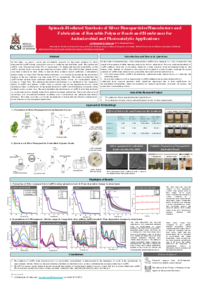
Recently, the phytosynthesis of metallic nanoparticles using extracts of plants and plant products has gained considerable importance in biomedical applications due to its environmentally friendly approach. In this study, we developed stable silver nanoparticles and silver nanoclusters using the extract of green spinach as a chemical reducing and stabilizing agent. Upon the addition of the extract to a silver nitrate solution, silver nanoparticles formed immediately, as evidenced by a color change in the solution. A characteristic surface plasmon resonance peak at around 400 nm confirmed the formation of silver nanoparticles.
The silver nanoparticles were encapsulated in alginate beads through a single-step method involving ionotropic crosslinking using calcium chloride (5 wt%). The resulting beads were compact and black in color. The beads were porous and contained plate-like silver nanoclusters, as revealed by Scanning Electron Microscopy studies. The photocatalytic characteristics of the beads were evaluated using two important organic molecules/pollutants, namely 2-nitrophenol and methyl orange. The beads exhibited excellent photocatalytic properties by degrading the pollutants into non-toxic substances in less than 30 minutes. The enhanced degradation performance was attributed to the synergistic effects of silver nanoclusters and alginate. The nanoclusters acted as catalytic sites for the degradation process, while alginate provided a stable matrix for the immobilization of the nanoclusters and facilitated the mass transfer of the pollutants to the catalytic sites. This study highlights the effectiveness of silver nanocluster-loaded alginate beads as a promising and eco-friendly material for the treatment of medical waste in the future.
Reuseable polymer films of alginate and polyvinyl alcohol containing silver nanoparticles were also developed using a spray method. The films were robust and exhibited excellent antibacterial properties against various strains of bacteria. This research project paves the way for the development of sustainable and effective nanomaterial-based solutions for biomedical and environmental remediation.
Keywords
Nanoparticles
Silver Nanoparticles
Spinach
sodiumborohydried
Poster
Al Khulood Al Zakwani IOCFB 2024 .pdf
Synthesis and Characterization of Mesoporous Silica Nanoparticles for Delivery of Anticancer Drugs
The impact of binary bioglass on the biodegradation and bio-mineralization of PCL electrospun fibers for guided bone regeneration