Event submissions
Published
This submission belongs to the session A. Dental Biomaterials of the event The 1st International Online Conference on Functional Biomaterials
Published date
08 Jul, 2024
Academic Editor
'%3e%3cpath%20d='M12.6657%2010.9104C12.4185%2010.325%2012.0599%209.79327%2011.6097%209.34482C11.1609%208.89508%2010.6293%208.5365%2010.0442%208.28888C10.0389%208.28626%2010.0337%208.28495%2010.0285%208.28233C10.8446%207.69279%2011.3752%206.73249%2011.3752%205.64904C11.3752%203.8542%209.92103%202.39999%208.1262%202.39999C6.33136%202.39999%204.87715%203.8542%204.87715%205.64904C4.87715%206.73249%205.40774%207.69279%206.22393%208.28364C6.21869%208.28626%206.21345%208.28757%206.20821%208.29019C5.62129%208.5378%205.09463%208.89284%204.64265%209.34613C4.1929%209.79493%203.83432%2010.3266%203.58671%2010.9117C3.34345%2011.4845%203.21226%2012.0987%203.20023%2012.7209C3.19988%2012.7349%203.20233%2012.7488%203.20744%2012.7619C3.21255%2012.7749%203.22022%2012.7867%203.22998%2012.7968C3.23975%2012.8068%203.25142%2012.8147%203.26431%2012.8202C3.2772%2012.8256%203.29105%2012.8284%203.30504%2012.8284H4.09109C4.14874%2012.8284%204.19459%2012.7825%204.1959%2012.7262C4.2221%2011.7148%204.62823%2010.7676%205.34617%2010.0497C6.08899%209.30683%207.0755%208.89808%208.1262%208.89808C9.17689%208.89808%2010.1634%209.30683%2010.9062%2010.0497C11.6242%2010.7676%2012.0303%2011.7148%2012.0565%2012.7262C12.0578%2012.7838%2012.1037%2012.8284%2012.1613%2012.8284H12.9474C12.9613%2012.8284%2012.9752%2012.8256%2012.9881%2012.8202C13.001%2012.8147%2013.0126%2012.8068%2013.0224%2012.7968C13.0322%2012.7867%2013.0398%2012.7749%2013.0449%2012.7619C13.0501%2012.7488%2013.0525%2012.7349%2013.0522%2012.7209C13.0391%2012.0947%2012.9094%2011.4855%2012.6657%2010.9104ZM8.1262%207.9024C7.52486%207.9024%206.9589%207.6679%206.53312%207.24211C6.10733%206.81633%205.87283%206.25037%205.87283%205.64904C5.87283%205.0477%206.10733%204.48174%206.53312%204.05596C6.9589%203.63018%207.52486%203.39567%208.1262%203.39567C8.72753%203.39567%209.29349%203.63018%209.71927%204.05596C10.1451%204.48174%2010.3796%205.0477%2010.3796%205.64904C10.3796%206.25037%2010.1451%206.81633%209.71927%207.24211C9.29349%207.6679%208.72753%207.9024%208.1262%207.9024Z'%20fill='%235D1EE1'/%3e%3c/g%3e%3c/svg%3e) Gianrico Spagnuolo
Gianrico SpagnuoloCitation
Tamer M. Hamdy, Acrylic Bone Cement Reinforced with Halloysite Clay Nanotubes, in Proceedings of The 1st International Online Conference on Functional Biomaterials, 10 July–12 July 2024, MDPI: Basel, Switzerland
Share
Email
Facebook
Twitter
LinkedIn
Acrylic Bone Cement Reinforced with Halloysite Clay Nanotubes

Tamer M. Hamdy 1
1. Restorative and Dental Materials Department, Oral and Dental Research Institute, National Research Centre (NRC), El Bohouth St., 12622 Dokki, Giza, Egypt
Abstract
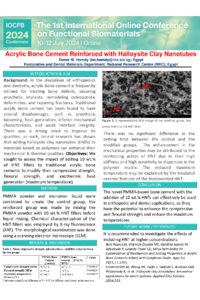
Background: In the disciplines of orthopedics and dentistry, acrylic bone cement is frequently utilized for treating bone defects, securing prosthetic implants, remodeling osteoporotic deformities, and repairing fractures. Traditional acrylic bone cement has been found to have several disadvantages, such as prosthesis loosening, heat generation, inferior mechanical characteristics, and weak interface integrity. There was a strong need to improve its qualities; as such, recent research has shown that adding halloysite clay nanotubes (HNTs) to materials based on polymers can enhance their mechanical and thermal qualities. Objectives: We sought to assess the impact of adding 10 weight percent of HNT fillers to traditional acrylic bone cements in order to modify their compressive strength, flexural strength, and exothermic heat generation. Methods: The monomer liquid was combined with acrylic powder to create the control group. The creatively reinforced group was made by combining the acrylic powder with liquid before adding 10 weight percent of HNT fillers. XRF was used to carry out the chemical characterization of the fillers that were used. Measurements were made of the setting temperature, compressive strength, and flexural strength. Independent sample t-tests were used to statistically analyze the data and compare the mean values (p < 0.05). Results: The results showed that when compared to the traditional acrylic bone cement control group, the novel modified acrylic bone cement with 10 weight % HNT fillers had greater mean compressive strength, greater flexural strength, and lower setting temperatures (P≤0.05). Conclusion: It was possible to employ the modified reinforced acrylic bone cement with 10% HNT fillers as an alternative to acrylic bone cement.
Keywords
acrylic bone cement
PMMA
halloysite clay nanotubes
compressive strength,
flexural strength
setting temperature
Poster
sciforum-088349- Tamer M. Hamdy.pdf
Magnesium as a tissue engineering material in plastic surgery: In-vitro biocompatibility studies with human dermal fibroblasts
Does the restorative design and material affect marginal, internal fit, interfacial volume, and fatigue behavior of indirect restorations?