Event submissions
Published
This submission belongs to the session B. Bone Biomaterials of the event The 1st International Online Conference on Functional Biomaterials
Published date
08 Jul, 2024
Academic Editor
'%3e%3cpath%20d='M12.6657%2010.9104C12.4185%2010.325%2012.0599%209.79327%2011.6097%209.34482C11.1609%208.89508%2010.6293%208.5365%2010.0442%208.28888C10.0389%208.28626%2010.0337%208.28495%2010.0285%208.28233C10.8446%207.69279%2011.3752%206.73249%2011.3752%205.64904C11.3752%203.8542%209.92103%202.39999%208.1262%202.39999C6.33136%202.39999%204.87715%203.8542%204.87715%205.64904C4.87715%206.73249%205.40774%207.69279%206.22393%208.28364C6.21869%208.28626%206.21345%208.28757%206.20821%208.29019C5.62129%208.5378%205.09463%208.89284%204.64265%209.34613C4.1929%209.79493%203.83432%2010.3266%203.58671%2010.9117C3.34345%2011.4845%203.21226%2012.0987%203.20023%2012.7209C3.19988%2012.7349%203.20233%2012.7488%203.20744%2012.7619C3.21255%2012.7749%203.22022%2012.7867%203.22998%2012.7968C3.23975%2012.8068%203.25142%2012.8147%203.26431%2012.8202C3.2772%2012.8256%203.29105%2012.8284%203.30504%2012.8284H4.09109C4.14874%2012.8284%204.19459%2012.7825%204.1959%2012.7262C4.2221%2011.7148%204.62823%2010.7676%205.34617%2010.0497C6.08899%209.30683%207.0755%208.89808%208.1262%208.89808C9.17689%208.89808%2010.1634%209.30683%2010.9062%2010.0497C11.6242%2010.7676%2012.0303%2011.7148%2012.0565%2012.7262C12.0578%2012.7838%2012.1037%2012.8284%2012.1613%2012.8284H12.9474C12.9613%2012.8284%2012.9752%2012.8256%2012.9881%2012.8202C13.001%2012.8147%2013.0126%2012.8068%2013.0224%2012.7968C13.0322%2012.7867%2013.0398%2012.7749%2013.0449%2012.7619C13.0501%2012.7488%2013.0525%2012.7349%2013.0522%2012.7209C13.0391%2012.0947%2012.9094%2011.4855%2012.6657%2010.9104ZM8.1262%207.9024C7.52486%207.9024%206.9589%207.6679%206.53312%207.24211C6.10733%206.81633%205.87283%206.25037%205.87283%205.64904C5.87283%205.0477%206.10733%204.48174%206.53312%204.05596C6.9589%203.63018%207.52486%203.39567%208.1262%203.39567C8.72753%203.39567%209.29349%203.63018%209.71927%204.05596C10.1451%204.48174%2010.3796%205.0477%2010.3796%205.64904C10.3796%206.25037%2010.1451%206.81633%209.71927%207.24211C9.29349%207.6679%208.72753%207.9024%208.1262%207.9024Z'%20fill='%235D1EE1'/%3e%3c/g%3e%3c/svg%3e) Pankaj Vadgama
Pankaj VadgamaCitation
Iurii Nasieka, Volodymyr Lozinskii, Olexandr Gudymenko, Volodymyr Yukhymchuk, Volodymyr Temchenko, Oksana Isaieva, Igor Vorona, Mykhailo Valakh, Alexander Belyaev, Formation of calcium phosphate coatings on titanium and polymer substrates using gas-detonation deposition, in Proceedings of The 1st International Online Conference on Functional Biomaterials, 10 July–12 July 2024, MDPI: Basel, Switzerland
Share
Email
Facebook
Twitter
LinkedIn
Formation of calcium phosphate coatings on titanium and polymer substrates using gas-detonation deposition
'%3e%3cpath%20d='M12.6647%2010.9104C12.4176%2010.325%2012.0589%209.7933%2011.6088%209.34485C11.16%208.89511%2010.6283%208.53653%2010.0432%208.28891C10.038%208.28629%2010.0327%208.28498%2010.0275%208.28236C10.8437%207.69282%2011.3743%206.73252%2011.3743%205.64907C11.3743%203.85423%209.92005%202.40002%208.12522%202.40002C6.33038%202.40002%204.87618%203.85423%204.87618%205.64907C4.87618%206.73252%205.40677%207.69282%206.22296%208.28367C6.21772%208.28629%206.21248%208.2876%206.20724%208.29022C5.62031%208.53783%205.09365%208.89287%204.64167%209.34616C4.19192%209.79496%203.83334%2010.3266%203.58573%2010.9117C3.34247%2011.4846%203.21128%2012.0987%203.19925%2012.721C3.1989%2012.735%203.20135%2012.7489%203.20646%2012.7619C3.21157%2012.7749%203.21924%2012.7868%203.22901%2012.7968C3.23877%2012.8068%203.25045%2012.8148%203.26334%2012.8202C3.27623%2012.8256%203.29007%2012.8284%203.30406%2012.8284H4.09012C4.14776%2012.8284%204.19362%2012.7825%204.19493%2012.7262C4.22113%2011.7148%204.62726%2010.7676%205.34519%2010.0497C6.08802%209.30686%207.07452%208.89811%208.12522%208.89811C9.17592%208.89811%2010.1624%209.30686%2010.9052%2010.0497C11.6232%2010.7676%2012.0293%2011.7148%2012.0555%2012.7262C12.0568%2012.7839%2012.1027%2012.8284%2012.1603%2012.8284H12.9464C12.9604%2012.8284%2012.9742%2012.8256%2012.9871%2012.8202C13%2012.8148%2013.0117%2012.8068%2013.0214%2012.7968C13.0312%2012.7868%2013.0389%2012.7749%2013.044%2012.7619C13.0491%2012.7489%2013.0515%2012.735%2013.0512%2012.721C13.0381%2012.0947%2012.9084%2011.4856%2012.6647%2010.9104ZM8.12522%207.90243C7.52388%207.90243%206.95792%207.66793%206.53214%207.24215C6.10636%206.81636%205.87185%206.2504%205.87185%205.64907C5.87185%205.04773%206.10636%204.48177%206.53214%204.05599C6.95792%203.63021%207.52388%203.3957%208.12522%203.3957C8.72655%203.3957%209.29252%203.63021%209.7183%204.05599C10.1441%204.48177%2010.3786%205.04773%2010.3786%205.64907C10.3786%206.2504%2010.1441%206.81636%209.7183%207.24215C9.29252%207.66793%208.72655%207.90243%208.12522%207.90243Z'%20fill='%235D1EE1'/%3e%3c/g%3e%3c/svg%3e)
Iurii Nasieka 1
Volodymyr Lozinskii 1
Olexandr Gudymenko 1
Volodymyr Yukhymchuk 1
Volodymyr Temchenko 1
Oksana Isaieva 1
Igor Vorona 1
Mykhailo Valakh 1
Alexander Belyaev 1
1. V. Ye. Lashkaryov Institute of semiconductor physics of National academy of sciences of Ukraine
Abstract
The use of medical implants is becoming more widespread, which is attracting great interest in the development of new technologies for their production. Titanium-based implants are the most common now, but the polymer polyetheretherketone (PEEK) is studied as a substitute. Despite the biotolerance to titanium and PEEK, their implantation in the human body is often accompanied by some negative effects. This problem is solved by depositing biocompatible coatings on the implant's surface, in particular, calcium phosphates (CPs). CP coatings on implants are produced by different techniques, each of which has its own disadvantages related to both the quality of the formed coatings and their cost.
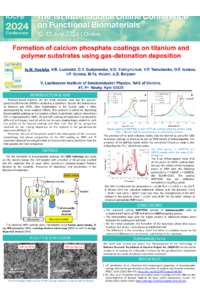
Biocompatible coatings based on hydroxyapatite (HAP) on metal and polymer implants were obtained by gas-detonation deposition (GDD). This method consists ofthe acceleration of HAP powder by a detonation wave resulting from the explosion of a mixture of acetylene and oxygen. HAP powder particles are introduced into the detonation wave and accelerate to high speeds and form a coating on the implants. Among the main advantages of GDD are its high productivity, the ability to form layers of different thickness on large-area substrates in a few minutes, the possibility of varying the coating composition, the high adhesion with low energy consumption of the process and, accordingly, the low cost.
HAP coatings with a thickness ~ 200 microns on titanium and PEEK substrates were studied by Raman spectroscopy, XRD and microscopic analysis. This study showed the formation of a porous coating on the titanium substrate, which consisted of crystalline and partially amorphous HAP. The latter was transformed into a crystalline one during annealing at 600 oC. The HAP coating on PEEK was shown to consist of HAP with a small admixture of tricalcium phosphate. The appearance of the latter is explained by the partial transformation of HAP microparticles into tricalcium phosphate when they collide with the surface.
Keywords
Polyetheretherketone
Hydroxyapatite
Titanium-based implants
Gas-detonation deposition
Raman spectroscopy.
Poster
Nasieka_poster_sciforum-090157.pdf
Compressive strength, microhardness, and solubility of Zinc-Oxide Eugenol Cement Modified with E-Glass fiber fillers
Mathematical and experimental modeling of calcium phosphate resorption in physiological conditions.