Event submissions
Published
This submission belongs to the session B. Bone Biomaterials of the event The 1st International Online Conference on Functional Biomaterials
Published date
08 Jul, 2024
Academic Editor
'%3e%3cpath%20d='M12.6657%2010.9104C12.4185%2010.325%2012.0599%209.79327%2011.6097%209.34482C11.1609%208.89508%2010.6293%208.5365%2010.0442%208.28888C10.0389%208.28626%2010.0337%208.28495%2010.0285%208.28233C10.8446%207.69279%2011.3752%206.73249%2011.3752%205.64904C11.3752%203.8542%209.92103%202.39999%208.1262%202.39999C6.33136%202.39999%204.87715%203.8542%204.87715%205.64904C4.87715%206.73249%205.40774%207.69279%206.22393%208.28364C6.21869%208.28626%206.21345%208.28757%206.20821%208.29019C5.62129%208.5378%205.09463%208.89284%204.64265%209.34613C4.1929%209.79493%203.83432%2010.3266%203.58671%2010.9117C3.34345%2011.4845%203.21226%2012.0987%203.20023%2012.7209C3.19988%2012.7349%203.20233%2012.7488%203.20744%2012.7619C3.21255%2012.7749%203.22022%2012.7867%203.22998%2012.7968C3.23975%2012.8068%203.25142%2012.8147%203.26431%2012.8202C3.2772%2012.8256%203.29105%2012.8284%203.30504%2012.8284H4.09109C4.14874%2012.8284%204.19459%2012.7825%204.1959%2012.7262C4.2221%2011.7148%204.62823%2010.7676%205.34617%2010.0497C6.08899%209.30683%207.0755%208.89808%208.1262%208.89808C9.17689%208.89808%2010.1634%209.30683%2010.9062%2010.0497C11.6242%2010.7676%2012.0303%2011.7148%2012.0565%2012.7262C12.0578%2012.7838%2012.1037%2012.8284%2012.1613%2012.8284H12.9474C12.9613%2012.8284%2012.9752%2012.8256%2012.9881%2012.8202C13.001%2012.8147%2013.0126%2012.8068%2013.0224%2012.7968C13.0322%2012.7867%2013.0398%2012.7749%2013.0449%2012.7619C13.0501%2012.7488%2013.0525%2012.7349%2013.0522%2012.7209C13.0391%2012.0947%2012.9094%2011.4855%2012.6657%2010.9104ZM8.1262%207.9024C7.52486%207.9024%206.9589%207.6679%206.53312%207.24211C6.10733%206.81633%205.87283%206.25037%205.87283%205.64904C5.87283%205.0477%206.10733%204.48174%206.53312%204.05596C6.9589%203.63018%207.52486%203.39567%208.1262%203.39567C8.72753%203.39567%209.29349%203.63018%209.71927%204.05596C10.1451%204.48174%2010.3796%205.0477%2010.3796%205.64904C10.3796%206.25037%2010.1451%206.81633%209.71927%207.24211C9.29349%207.6679%208.72753%207.9024%208.1262%207.9024Z'%20fill='%235D1EE1'/%3e%3c/g%3e%3c/svg%3e) Pankaj Vadgama
Pankaj VadgamaCitation
Ekaterina Sergeevna Chikanova, Arina Vladislavovna Korotkova, Dmitry Vladimirovich Shtansky, Anna Petrovna Solonenko, New composite materials based on chitosan, carboxymethylcellulose, hydroxyapatite and wollastonite for bone regeneration, in Proceedings of The 1st International Online Conference on Functional Biomaterials, 10 July–12 July 2024, MDPI: Basel, Switzerland
Share
Email
Facebook
Twitter
LinkedIn
New composite materials based on chitosan, carboxymethylcellulose, hydroxyapatite and wollastonite for bone regeneration
'%3e%3cpath%20d='M12.6647%2010.9104C12.4176%2010.325%2012.0589%209.7933%2011.6088%209.34485C11.16%208.89511%2010.6283%208.53653%2010.0432%208.28891C10.038%208.28629%2010.0327%208.28498%2010.0275%208.28236C10.8437%207.69282%2011.3743%206.73252%2011.3743%205.64907C11.3743%203.85423%209.92005%202.40002%208.12522%202.40002C6.33038%202.40002%204.87618%203.85423%204.87618%205.64907C4.87618%206.73252%205.40677%207.69282%206.22296%208.28367C6.21772%208.28629%206.21248%208.2876%206.20724%208.29022C5.62031%208.53783%205.09365%208.89287%204.64167%209.34616C4.19192%209.79496%203.83334%2010.3266%203.58573%2010.9117C3.34247%2011.4846%203.21128%2012.0987%203.19925%2012.721C3.1989%2012.735%203.20135%2012.7489%203.20646%2012.7619C3.21157%2012.7749%203.21924%2012.7868%203.22901%2012.7968C3.23877%2012.8068%203.25045%2012.8148%203.26334%2012.8202C3.27623%2012.8256%203.29007%2012.8284%203.30406%2012.8284H4.09012C4.14776%2012.8284%204.19362%2012.7825%204.19493%2012.7262C4.22113%2011.7148%204.62726%2010.7676%205.34519%2010.0497C6.08802%209.30686%207.07452%208.89811%208.12522%208.89811C9.17592%208.89811%2010.1624%209.30686%2010.9052%2010.0497C11.6232%2010.7676%2012.0293%2011.7148%2012.0555%2012.7262C12.0568%2012.7839%2012.1027%2012.8284%2012.1603%2012.8284H12.9464C12.9604%2012.8284%2012.9742%2012.8256%2012.9871%2012.8202C13%2012.8148%2013.0117%2012.8068%2013.0214%2012.7968C13.0312%2012.7868%2013.0389%2012.7749%2013.044%2012.7619C13.0491%2012.7489%2013.0515%2012.735%2013.0512%2012.721C13.0381%2012.0947%2012.9084%2011.4856%2012.6647%2010.9104ZM8.12522%207.90243C7.52388%207.90243%206.95792%207.66793%206.53214%207.24215C6.10636%206.81636%205.87185%206.2504%205.87185%205.64907C5.87185%205.04773%206.10636%204.48177%206.53214%204.05599C6.95792%203.63021%207.52388%203.3957%208.12522%203.3957C8.72655%203.3957%209.29252%203.63021%209.7183%204.05599C10.1441%204.48177%2010.3786%205.04773%2010.3786%205.64907C10.3786%206.2504%2010.1441%206.81636%209.7183%207.24215C9.29252%207.66793%208.72655%207.90243%208.12522%207.90243Z'%20fill='%235D1EE1'/%3e%3c/g%3e%3c/svg%3e)
Ekaterina Sergeevna Chikanova 1
Arina Vladislavovna Korotkova 2
Dmitry Vladimirovich Shtansky 3
Anna Petrovna Solonenko 4
1. National University of Science and Technology “MISIS”, Moscow 119049, Russia
2. National University of Science and Technology “MISIS”, Moscow
119049, Russia
3. National University of Science and Technology “MISIS”, Moscow 119049,
Russia;
4. Omsk State Medical University, Lenina str., 12, Omsk 644099, Russia
Abstract
Introduction: Composite materials are used in medicine for a wide range of practical tasks to improve human health. In traumatology and orthopedics, materials are used that combine biodegradable polymers with inorganic salts, most often calcium phosphates. Currently, the selection of multicomponent compositions of inorganic fillers that perform different functions and improve the characteristics of transplants is considered promising. In particular, the combination of phosphates and calcium silicates is of interest.
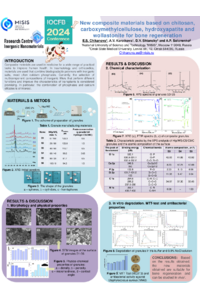
Methods: In this work, porous materials were made from powders containing synthetic hydroxyapatite (HA, Ca10(PO4)6(OH)2) and wollastonite (WT, β-CaCiO3) in the ratios 0/100, 20/80, 40/60, 60/40, 80/20 and 100/0; chitosan gel (200 kDa, 90%); and carboxymethylcellulose. Granules were produced in various shapes—cylinders, spheres and hemispheres with a diameter of 4 mm. All samples were examined by XRD, FTIR, XPS, SEM and EDS analysis systems. The Vickers microhardness at HV0.2 load, the density and the porosity of the granules were studied. Their dissolution in tris-buffer, an isotonic solution, was studied. Their cytotoxicity was determined using the MTT test.
Results: The resulting materials are porous, rough and hydrophilic. The pore sizes are mainly 0.2–1.0 microns. The density of the samples ranges from 2.76 to 3.48 g/cm3, depending on the composition. The microhardness of the granules varies from 3.04 to 5.38 0.2HV. According to XRD and FTIR data, it was determined that no structural phase transitions of inorganic powders occur during the synthesis process. It was found that the highest rate of dissolution is observed in the tris-buffer, where samples of HA/W 60/40 degrade faster. It was determined that the granules do not have a cytotoxic effect.
Conclusions: Based on the results obtained, the new materials obtained are suitable for bone regeneration and can be studied in vivo.
Keywords
biomaterials
chitosan
carboxymethylcellulose
hydroxyapatite
wollastonite
Poster
Poster Sciforum_ChikanovaES.pdf
Biomaterials based on Ti6V4Al4 and hydroxyapatite obtained using 3D Binder Jet printing.
Low-Concentration Hematology Behaviour of NIR-sensitive Silver Nanoplates: Isotropic against Anisotropic Morphologies