Event submissions
Published
This submission belongs to the session D. Biomaterials for Tissue Engineering of the event The 1st International Online Conference on Functional Biomaterials
Published date
08 Jul, 2024
Academic Editor
'%3e%3cpath%20d='M12.6657%2010.9104C12.4185%2010.325%2012.0599%209.79327%2011.6097%209.34482C11.1609%208.89508%2010.6293%208.5365%2010.0442%208.28888C10.0389%208.28626%2010.0337%208.28495%2010.0285%208.28233C10.8446%207.69279%2011.3752%206.73249%2011.3752%205.64904C11.3752%203.8542%209.92103%202.39999%208.1262%202.39999C6.33136%202.39999%204.87715%203.8542%204.87715%205.64904C4.87715%206.73249%205.40774%207.69279%206.22393%208.28364C6.21869%208.28626%206.21345%208.28757%206.20821%208.29019C5.62129%208.5378%205.09463%208.89284%204.64265%209.34613C4.1929%209.79493%203.83432%2010.3266%203.58671%2010.9117C3.34345%2011.4845%203.21226%2012.0987%203.20023%2012.7209C3.19988%2012.7349%203.20233%2012.7488%203.20744%2012.7619C3.21255%2012.7749%203.22022%2012.7867%203.22998%2012.7968C3.23975%2012.8068%203.25142%2012.8147%203.26431%2012.8202C3.2772%2012.8256%203.29105%2012.8284%203.30504%2012.8284H4.09109C4.14874%2012.8284%204.19459%2012.7825%204.1959%2012.7262C4.2221%2011.7148%204.62823%2010.7676%205.34617%2010.0497C6.08899%209.30683%207.0755%208.89808%208.1262%208.89808C9.17689%208.89808%2010.1634%209.30683%2010.9062%2010.0497C11.6242%2010.7676%2012.0303%2011.7148%2012.0565%2012.7262C12.0578%2012.7838%2012.1037%2012.8284%2012.1613%2012.8284H12.9474C12.9613%2012.8284%2012.9752%2012.8256%2012.9881%2012.8202C13.001%2012.8147%2013.0126%2012.8068%2013.0224%2012.7968C13.0322%2012.7867%2013.0398%2012.7749%2013.0449%2012.7619C13.0501%2012.7488%2013.0525%2012.7349%2013.0522%2012.7209C13.0391%2012.0947%2012.9094%2011.4855%2012.6657%2010.9104ZM8.1262%207.9024C7.52486%207.9024%206.9589%207.6679%206.53312%207.24211C6.10733%206.81633%205.87283%206.25037%205.87283%205.64904C5.87283%205.0477%206.10733%204.48174%206.53312%204.05596C6.9589%203.63018%207.52486%203.39567%208.1262%203.39567C8.72753%203.39567%209.29349%203.63018%209.71927%204.05596C10.1451%204.48174%2010.3796%205.0477%2010.3796%205.64904C10.3796%206.25037%2010.1451%206.81633%209.71927%207.24211C9.29349%207.6679%208.72753%207.9024%208.1262%207.9024Z'%20fill='%235D1EE1'/%3e%3c/g%3e%3c/svg%3e) Filippo Rossi
Filippo RossiCitation
Ana-Maria Roman, Mihai-Adrian Bernevig, Gheorghe Bădărău, Ramona Cimpoeșu, Leandru-Gheorghe Bujoreanu, Nicanor Cimpoeșu, Investigation of the corrosion mechanism of bifunctional FeMnSi-based alloys for medical applications, in Proceedings of The 1st International Online Conference on Functional Biomaterials, 10 July–12 July 2024, MDPI: Basel, Switzerland
Share
Email
Facebook
Twitter
LinkedIn
Investigation of the corrosion mechanism of bifunctional FeMnSi-based alloys for medical applications
'%3e%3cpath%20d='M12.6647%2010.9104C12.4176%2010.325%2012.0589%209.7933%2011.6088%209.34485C11.16%208.89511%2010.6283%208.53653%2010.0432%208.28891C10.038%208.28629%2010.0327%208.28498%2010.0275%208.28236C10.8437%207.69282%2011.3743%206.73252%2011.3743%205.64907C11.3743%203.85423%209.92005%202.40002%208.12522%202.40002C6.33038%202.40002%204.87618%203.85423%204.87618%205.64907C4.87618%206.73252%205.40677%207.69282%206.22296%208.28367C6.21772%208.28629%206.21248%208.2876%206.20724%208.29022C5.62031%208.53783%205.09365%208.89287%204.64167%209.34616C4.19192%209.79496%203.83334%2010.3266%203.58573%2010.9117C3.34247%2011.4846%203.21128%2012.0987%203.19925%2012.721C3.1989%2012.735%203.20135%2012.7489%203.20646%2012.7619C3.21157%2012.7749%203.21924%2012.7868%203.22901%2012.7968C3.23877%2012.8068%203.25045%2012.8148%203.26334%2012.8202C3.27623%2012.8256%203.29007%2012.8284%203.30406%2012.8284H4.09012C4.14776%2012.8284%204.19362%2012.7825%204.19493%2012.7262C4.22113%2011.7148%204.62726%2010.7676%205.34519%2010.0497C6.08802%209.30686%207.07452%208.89811%208.12522%208.89811C9.17592%208.89811%2010.1624%209.30686%2010.9052%2010.0497C11.6232%2010.7676%2012.0293%2011.7148%2012.0555%2012.7262C12.0568%2012.7839%2012.1027%2012.8284%2012.1603%2012.8284H12.9464C12.9604%2012.8284%2012.9742%2012.8256%2012.9871%2012.8202C13%2012.8148%2013.0117%2012.8068%2013.0214%2012.7968C13.0312%2012.7868%2013.0389%2012.7749%2013.044%2012.7619C13.0491%2012.7489%2013.0515%2012.735%2013.0512%2012.721C13.0381%2012.0947%2012.9084%2011.4856%2012.6647%2010.9104ZM8.12522%207.90243C7.52388%207.90243%206.95792%207.66793%206.53214%207.24215C6.10636%206.81636%205.87185%206.2504%205.87185%205.64907C5.87185%205.04773%206.10636%204.48177%206.53214%204.05599C6.95792%203.63021%207.52388%203.3957%208.12522%203.3957C8.72655%203.3957%209.29252%203.63021%209.7183%204.05599C10.1441%204.48177%2010.3786%205.04773%2010.3786%205.64907C10.3786%206.2504%2010.1441%206.81636%209.7183%207.24215C9.29252%207.66793%208.72655%207.90243%208.12522%207.90243Z'%20fill='%235D1EE1'/%3e%3c/g%3e%3c/svg%3e)
Ana-Maria Roman 1
Mihai-Adrian Bernevig 2
Gheorghe Bădărău 3

Ramona Cimpoeșu 3

Leandru-Gheorghe Bujoreanu 2

Nicanor Cimpoeșu 3
1. Faculty of Materials Science and Engineering, ”Gheorghe Asachi” Technical University of Iasi, 41 Prof. D. Mangeron Blvd., 700050, Iasi, Romania
2. Faculty of Materials Science and Engineering, “Gheorghe Asachi” Technical University of Iași, Blvd. Dimitrie Mangeron 71A, 700050 Iași, Romania
3. Faculty of Materials Science and Engineering, Gheorghe Asachi Technical University of Iasi, 41 Prof. D. Mangeron Blvd., 700050, Iasi, Romania
Abstract
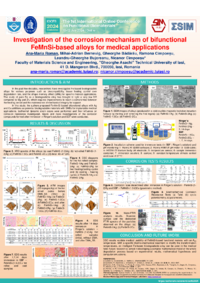
In the past few decades, researchers have investigated Fe-based biodegradable alloys for various purposes such as biocompatibility, tissue healing control over degradation rate, and the shape memory effect (SME) for specific medical applications. Within this study, the authors proposed bifunctional Fe–Mn–Si-based alloys with additions of Ag and Cu as potential biodegradable materials with a SME. In vitro studies were conducted by immersing the samples in physiological solutions, Ringer’s and simulated body fluid (SBF), for different time intervals at 37 ℃. Corrosion rates were determined according to the mass loss, via cyclic and linear potentiometry, and electrochemical impedance spectroscopy (EIS). Microstructural analyses were performed using optical microscopy (OM) and scanning electron microscopy (SEM). Initial and post-immersion chemical analyses were performed using energy-dispersive spectroscopy (EDS), aiming to investigate the formation of salts, chlorides, and carbonates. The samples were subjected to dynamic mechanical analysis (DMA) and were evaluated before and after immersion at different applied frequencies. The surface morphology was examined using atomic force microscopy (AFM) for the initial samples and those subjected to DMA experiments. Fourier transform infrared spectroscopy (FT-IR) and nano-FTIR experiments were performed to identify and confirm the corrosion compounds formed on the surface. A generalized type of corrosion was identified, and an increase in mass was observed in the first 3-5 days due to the compounds formed due to metal–solution contact. A phase change in the solid state was observed using differential scanning calorimetry (DSC) during cooling, which was associated with a martensitic transformation. Its critical start temperature (Ms) was similar to the human body temperature, indicating that this material has potential for medical applications. The results suggested that a shape memory Fe-based biodegradable alloy has the potential to be used in the medical industry, with a suitable thermomechanical treatment to adjust the transition temperatures.
Keywords
FeMnSi biodegradable alloys
corrosion rates
SMAs
DSC
EIS
SEM
EDS
DMA
nano-FTIR
Poster
sciforum-090143_poster.pdf
Production and Characterization of Biological Grafts Derived from a Decellularized Uterus Aiming for Tissue-Engineering Applications
Tracing immune cells around biomaterials with spatial anchors during large-scale wound regeneration