Event submissions
Published
This submission belongs to the session E. Biomaterials for Drug Delivery of the event The 1st International Online Conference on Functional Biomaterials
Published date
08 Jul, 2024
Academic Editor
'%3e%3cpath%20d='M12.6657%2010.9104C12.4185%2010.325%2012.0599%209.79327%2011.6097%209.34482C11.1609%208.89508%2010.6293%208.5365%2010.0442%208.28888C10.0389%208.28626%2010.0337%208.28495%2010.0285%208.28233C10.8446%207.69279%2011.3752%206.73249%2011.3752%205.64904C11.3752%203.8542%209.92103%202.39999%208.1262%202.39999C6.33136%202.39999%204.87715%203.8542%204.87715%205.64904C4.87715%206.73249%205.40774%207.69279%206.22393%208.28364C6.21869%208.28626%206.21345%208.28757%206.20821%208.29019C5.62129%208.5378%205.09463%208.89284%204.64265%209.34613C4.1929%209.79493%203.83432%2010.3266%203.58671%2010.9117C3.34345%2011.4845%203.21226%2012.0987%203.20023%2012.7209C3.19988%2012.7349%203.20233%2012.7488%203.20744%2012.7619C3.21255%2012.7749%203.22022%2012.7867%203.22998%2012.7968C3.23975%2012.8068%203.25142%2012.8147%203.26431%2012.8202C3.2772%2012.8256%203.29105%2012.8284%203.30504%2012.8284H4.09109C4.14874%2012.8284%204.19459%2012.7825%204.1959%2012.7262C4.2221%2011.7148%204.62823%2010.7676%205.34617%2010.0497C6.08899%209.30683%207.0755%208.89808%208.1262%208.89808C9.17689%208.89808%2010.1634%209.30683%2010.9062%2010.0497C11.6242%2010.7676%2012.0303%2011.7148%2012.0565%2012.7262C12.0578%2012.7838%2012.1037%2012.8284%2012.1613%2012.8284H12.9474C12.9613%2012.8284%2012.9752%2012.8256%2012.9881%2012.8202C13.001%2012.8147%2013.0126%2012.8068%2013.0224%2012.7968C13.0322%2012.7867%2013.0398%2012.7749%2013.0449%2012.7619C13.0501%2012.7488%2013.0525%2012.7349%2013.0522%2012.7209C13.0391%2012.0947%2012.9094%2011.4855%2012.6657%2010.9104ZM8.1262%207.9024C7.52486%207.9024%206.9589%207.6679%206.53312%207.24211C6.10733%206.81633%205.87283%206.25037%205.87283%205.64904C5.87283%205.0477%206.10733%204.48174%206.53312%204.05596C6.9589%203.63018%207.52486%203.39567%208.1262%203.39567C8.72753%203.39567%209.29349%203.63018%209.71927%204.05596C10.1451%204.48174%2010.3796%205.0477%2010.3796%205.64904C10.3796%206.25037%2010.1451%206.81633%209.71927%207.24211C9.29349%207.6679%208.72753%207.9024%208.1262%207.9024Z'%20fill='%235D1EE1'/%3e%3c/g%3e%3c/svg%3e) Alexander Andrianov
Alexander AndrianovCitation
Eduard Alexander Córdoba, Natalia A Agudelo, Claudia Elena Echeverri-Cuartas, Injectable hydrogel based on carboxymethyl chitosan/oxidized agarose for potential application in local drug delivery, in Proceedings of The 1st International Online Conference on Functional Biomaterials, 10 July–12 July 2024, MDPI: Basel, Switzerland
Share
Email
Facebook
Twitter
LinkedIn
Injectable hydrogel based on carboxymethyl chitosan/oxidized agarose for potential application in local drug delivery
'%3e%3cpath%20d='M12.6647%2010.9104C12.4176%2010.325%2012.0589%209.7933%2011.6088%209.34485C11.16%208.89511%2010.6283%208.53653%2010.0432%208.28891C10.038%208.28629%2010.0327%208.28498%2010.0275%208.28236C10.8437%207.69282%2011.3743%206.73252%2011.3743%205.64907C11.3743%203.85423%209.92005%202.40002%208.12522%202.40002C6.33038%202.40002%204.87618%203.85423%204.87618%205.64907C4.87618%206.73252%205.40677%207.69282%206.22296%208.28367C6.21772%208.28629%206.21248%208.2876%206.20724%208.29022C5.62031%208.53783%205.09365%208.89287%204.64167%209.34616C4.19192%209.79496%203.83334%2010.3266%203.58573%2010.9117C3.34247%2011.4846%203.21128%2012.0987%203.19925%2012.721C3.1989%2012.735%203.20135%2012.7489%203.20646%2012.7619C3.21157%2012.7749%203.21924%2012.7868%203.22901%2012.7968C3.23877%2012.8068%203.25045%2012.8148%203.26334%2012.8202C3.27623%2012.8256%203.29007%2012.8284%203.30406%2012.8284H4.09012C4.14776%2012.8284%204.19362%2012.7825%204.19493%2012.7262C4.22113%2011.7148%204.62726%2010.7676%205.34519%2010.0497C6.08802%209.30686%207.07452%208.89811%208.12522%208.89811C9.17592%208.89811%2010.1624%209.30686%2010.9052%2010.0497C11.6232%2010.7676%2012.0293%2011.7148%2012.0555%2012.7262C12.0568%2012.7839%2012.1027%2012.8284%2012.1603%2012.8284H12.9464C12.9604%2012.8284%2012.9742%2012.8256%2012.9871%2012.8202C13%2012.8148%2013.0117%2012.8068%2013.0214%2012.7968C13.0312%2012.7868%2013.0389%2012.7749%2013.044%2012.7619C13.0491%2012.7489%2013.0515%2012.735%2013.0512%2012.721C13.0381%2012.0947%2012.9084%2011.4856%2012.6647%2010.9104ZM8.12522%207.90243C7.52388%207.90243%206.95792%207.66793%206.53214%207.24215C6.10636%206.81636%205.87185%206.2504%205.87185%205.64907C5.87185%205.04773%206.10636%204.48177%206.53214%204.05599C6.95792%203.63021%207.52388%203.3957%208.12522%203.3957C8.72655%203.3957%209.29252%203.63021%209.7183%204.05599C10.1441%204.48177%2010.3786%205.04773%2010.3786%205.64907C10.3786%206.2504%2010.1441%206.81636%209.7183%207.24215C9.29252%207.66793%208.72655%207.90243%208.12522%207.90243Z'%20fill='%235D1EE1'/%3e%3c/g%3e%3c/svg%3e)
Eduard Alexander Córdoba 1
Natalia A Agudelo 1
Claudia Elena Echeverri-Cuartas 2
1. Grupo de investigación en Síntesis Orgánica, de Polímeros y Biotecnología Aplicada (SINBIOTEC), Escuela de ingeniería y ciencias básicas, Universidad EIA, Envigado, Colombia
2. Grupo de investigación en Ingeniería Biomédica (GIBEC), Escuela de ciencias de la vida, Universidad EIA, Envigado, Colombia
Abstract
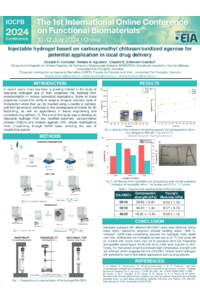
An injectable hydrogel based on oxidized agarose (OA) and carboxymethyl chitosan (CMCh) was developed with OA/CMCh variable proportions (60:40, 50:50, and 40:60) and evaluated. Its characterization was carried out through time gelation, injectability, syringeability, compression mechanical properties, swelling, and degradation. For all proportions, it was found that the hydrogel gelled before reaching 37 °C, and it proved to be suitable for injection through a 21 G gauge needle. Also, a direct relationship was identified between the CMCh amount added to the mixture and the evaluated properties of the hydrogel. The injectability (maximum injection force) for the 60:40 ratio was 12.84 N and increased by 62 % for the 40:60 ratio. Nevertheless, these were less than 30 N, which is the maximum force accepted for manual injection. Likewise, the 60:40 proportion presented a compressive strength of 26.92 kPa and increased by 72 % in the 40:60 proportion. Likewise, the swelling capacity increased from 1972 % to 3102 % for the same proportions, respectively. Furthermore, the increase in CMCh percentage was also associated with a decrease in the degradation rate; for example, the 40:60 ratio (14.28 %) was 32 % lower than the 60:40 ratio. In conclusion, for mixtures with higher CMCh content, the hydrogel's injectability, compressive strength, and swelling capacity increased. These results suggest that changing the proportion of OA:CMCh can modulate the material's properties, indicating its versatility and adaptability. It is a promising option for biomedical applications such as the local administration of active ingredients.
Keywords
hydrogel
injectable
carboxymethyl chitosan
oxidized agarose
Poster
Poster Eduard Córdoba - sciforum-090382 _ Modificated.pdf
Conducting Polymer Microspheres for Targeting Neuroblastoma
Silicon nanoneedles for sustained treatment of choroidal angiogenesis