Event submissions
Published
This submission belongs to the session E. Biomaterials for Drug Delivery of the event The 1st International Online Conference on Functional Biomaterials
Published date
08 Jul, 2024
Academic Editor
'%3e%3cpath%20d='M12.6657%2010.9104C12.4185%2010.325%2012.0599%209.79327%2011.6097%209.34482C11.1609%208.89508%2010.6293%208.5365%2010.0442%208.28888C10.0389%208.28626%2010.0337%208.28495%2010.0285%208.28233C10.8446%207.69279%2011.3752%206.73249%2011.3752%205.64904C11.3752%203.8542%209.92103%202.39999%208.1262%202.39999C6.33136%202.39999%204.87715%203.8542%204.87715%205.64904C4.87715%206.73249%205.40774%207.69279%206.22393%208.28364C6.21869%208.28626%206.21345%208.28757%206.20821%208.29019C5.62129%208.5378%205.09463%208.89284%204.64265%209.34613C4.1929%209.79493%203.83432%2010.3266%203.58671%2010.9117C3.34345%2011.4845%203.21226%2012.0987%203.20023%2012.7209C3.19988%2012.7349%203.20233%2012.7488%203.20744%2012.7619C3.21255%2012.7749%203.22022%2012.7867%203.22998%2012.7968C3.23975%2012.8068%203.25142%2012.8147%203.26431%2012.8202C3.2772%2012.8256%203.29105%2012.8284%203.30504%2012.8284H4.09109C4.14874%2012.8284%204.19459%2012.7825%204.1959%2012.7262C4.2221%2011.7148%204.62823%2010.7676%205.34617%2010.0497C6.08899%209.30683%207.0755%208.89808%208.1262%208.89808C9.17689%208.89808%2010.1634%209.30683%2010.9062%2010.0497C11.6242%2010.7676%2012.0303%2011.7148%2012.0565%2012.7262C12.0578%2012.7838%2012.1037%2012.8284%2012.1613%2012.8284H12.9474C12.9613%2012.8284%2012.9752%2012.8256%2012.9881%2012.8202C13.001%2012.8147%2013.0126%2012.8068%2013.0224%2012.7968C13.0322%2012.7867%2013.0398%2012.7749%2013.0449%2012.7619C13.0501%2012.7488%2013.0525%2012.7349%2013.0522%2012.7209C13.0391%2012.0947%2012.9094%2011.4855%2012.6657%2010.9104ZM8.1262%207.9024C7.52486%207.9024%206.9589%207.6679%206.53312%207.24211C6.10733%206.81633%205.87283%206.25037%205.87283%205.64904C5.87283%205.0477%206.10733%204.48174%206.53312%204.05596C6.9589%203.63018%207.52486%203.39567%208.1262%203.39567C8.72753%203.39567%209.29349%203.63018%209.71927%204.05596C10.1451%204.48174%2010.3796%205.0477%2010.3796%205.64904C10.3796%206.25037%2010.1451%206.81633%209.71927%207.24211C9.29349%207.6679%208.72753%207.9024%208.1262%207.9024Z'%20fill='%235D1EE1'/%3e%3c/g%3e%3c/svg%3e) Alexander Andrianov
Alexander AndrianovCitation
Amina Voznyuk, Elizaveta Koudan, Local chemotherapy platform with controlled and prolonged drug release for the prevention of local tumor recurrence, in Proceedings of The 1st International Online Conference on Functional Biomaterials, 10 July–12 July 2024, MDPI: Basel, Switzerland
Share
Email
Facebook
Twitter
LinkedIn
Local chemotherapy platform with controlled and prolonged drug release for the prevention of local tumor recurrence
'%3e%3cpath%20d='M12.6647%2010.9104C12.4176%2010.325%2012.0589%209.7933%2011.6088%209.34485C11.16%208.89511%2010.6283%208.53653%2010.0432%208.28891C10.038%208.28629%2010.0327%208.28498%2010.0275%208.28236C10.8437%207.69282%2011.3743%206.73252%2011.3743%205.64907C11.3743%203.85423%209.92005%202.40002%208.12522%202.40002C6.33038%202.40002%204.87618%203.85423%204.87618%205.64907C4.87618%206.73252%205.40677%207.69282%206.22296%208.28367C6.21772%208.28629%206.21248%208.2876%206.20724%208.29022C5.62031%208.53783%205.09365%208.89287%204.64167%209.34616C4.19192%209.79496%203.83334%2010.3266%203.58573%2010.9117C3.34247%2011.4846%203.21128%2012.0987%203.19925%2012.721C3.1989%2012.735%203.20135%2012.7489%203.20646%2012.7619C3.21157%2012.7749%203.21924%2012.7868%203.22901%2012.7968C3.23877%2012.8068%203.25045%2012.8148%203.26334%2012.8202C3.27623%2012.8256%203.29007%2012.8284%203.30406%2012.8284H4.09012C4.14776%2012.8284%204.19362%2012.7825%204.19493%2012.7262C4.22113%2011.7148%204.62726%2010.7676%205.34519%2010.0497C6.08802%209.30686%207.07452%208.89811%208.12522%208.89811C9.17592%208.89811%2010.1624%209.30686%2010.9052%2010.0497C11.6232%2010.7676%2012.0293%2011.7148%2012.0555%2012.7262C12.0568%2012.7839%2012.1027%2012.8284%2012.1603%2012.8284H12.9464C12.9604%2012.8284%2012.9742%2012.8256%2012.9871%2012.8202C13%2012.8148%2013.0117%2012.8068%2013.0214%2012.7968C13.0312%2012.7868%2013.0389%2012.7749%2013.044%2012.7619C13.0491%2012.7489%2013.0515%2012.735%2013.0512%2012.721C13.0381%2012.0947%2012.9084%2011.4856%2012.6647%2010.9104ZM8.12522%207.90243C7.52388%207.90243%206.95792%207.66793%206.53214%207.24215C6.10636%206.81636%205.87185%206.2504%205.87185%205.64907C5.87185%205.04773%206.10636%204.48177%206.53214%204.05599C6.95792%203.63021%207.52388%203.3957%208.12522%203.3957C8.72655%203.3957%209.29252%203.63021%209.7183%204.05599C10.1441%204.48177%2010.3786%205.04773%2010.3786%205.64907C10.3786%206.2504%2010.1441%206.81636%209.7183%207.24215C9.29252%207.66793%208.72655%207.90243%208.12522%207.90243Z'%20fill='%235D1EE1'/%3e%3c/g%3e%3c/svg%3e)
Amina Voznyuk 1
Elizaveta Koudan 1
1. National University of Science and Technology MISIS, 119049, Leninskiy pr. 4, Moscow, Russia
Abstract
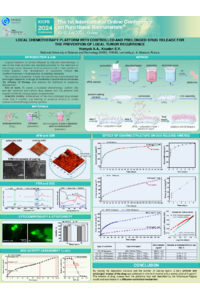
Introduction: Local recurrence in oncology is a significant issue, often due to chemotherapy limitations like drug concentration fluctuations in the tumor localization and non-specific action, leading to unstable therapeutic effects and reduced effectiveness. This research aimed to develop a biodegradable local chemotherapy platform for multi-month, controlled drug release.
Methods: A polycaprolactone (PCL) substrate was prepared using the solvent casting method followed by aminolysis on one side for the subsequent deposition of a multilayer coating containing doxorubicin (DOX). The substrate was analyzed using FTIR spectroscopy, SEM, colorimetrics, and wetting angle measurements. To stabilize the release of DOX, an ionic complex between poly-γ-glutamic acid (PGA) and DOX was formed. A coating was applied to the platform by layer-by-layer assembly of polyelectrolytes. Various coating deposition methods, different polycations, and the presence of empty polyelectrolyte bilayers were tested. The platform was analyzed using SEM, AFM and DSC. The empty platform was also tested for cytotoxicity and cytocompatibility using ovarian cancer cells (SKOV-3) and primary human fibroblasts. The in vitro activity of the released DOX was assessed using SKOV-3 cells.
Results: The amount of amino groups on the substrate surface after aminolysis was 118.1 μg/ml. The ionic complex between DOX and PGA was obtained with 99% efficiency and contained 99 μg/mg DOX. The total load of DOX in the platforms was 570 ng/cm2. The release of DOX from the resulting platforms lasted for more than 5 months and was characterized by minimal explosive kinetics and uniformity. According to the results of in vitro studies, the platform showed no cytotoxicity, was characterized by good cytocompatibility and did not interfere with the antitumor activity of DOX.
Conclusions: This work is promising for drug delivery systems and therapeutics, as it compensates for the explosive nature of antineoplastic agents release in similar studies and has the highest prolonged release.
Keywords
cancer therapy
local chemotherapy
controlled drug release
biodegradable materials
doxorubicin
layer-by-layer assembly
multilayer coating.
Poster
poster Voznyuk A.A..pdf
Silicon nanoneedles for sustained treatment of choroidal angiogenesis
Optical responses in biofunctionalized spherical semiconductor quantum dots