Event submissions
Published
This submission belongs to the session F. Biomaterials for Diagnostics, Therapy and Healthcare of the event The 1st International Online Conference on Functional Biomaterials
Published date
08 Jul, 2024
Academic Editor
'%3e%3cpath%20d='M12.6657%2010.9104C12.4185%2010.325%2012.0599%209.79327%2011.6097%209.34482C11.1609%208.89508%2010.6293%208.5365%2010.0442%208.28888C10.0389%208.28626%2010.0337%208.28495%2010.0285%208.28233C10.8446%207.69279%2011.3752%206.73249%2011.3752%205.64904C11.3752%203.8542%209.92103%202.39999%208.1262%202.39999C6.33136%202.39999%204.87715%203.8542%204.87715%205.64904C4.87715%206.73249%205.40774%207.69279%206.22393%208.28364C6.21869%208.28626%206.21345%208.28757%206.20821%208.29019C5.62129%208.5378%205.09463%208.89284%204.64265%209.34613C4.1929%209.79493%203.83432%2010.3266%203.58671%2010.9117C3.34345%2011.4845%203.21226%2012.0987%203.20023%2012.7209C3.19988%2012.7349%203.20233%2012.7488%203.20744%2012.7619C3.21255%2012.7749%203.22022%2012.7867%203.22998%2012.7968C3.23975%2012.8068%203.25142%2012.8147%203.26431%2012.8202C3.2772%2012.8256%203.29105%2012.8284%203.30504%2012.8284H4.09109C4.14874%2012.8284%204.19459%2012.7825%204.1959%2012.7262C4.2221%2011.7148%204.62823%2010.7676%205.34617%2010.0497C6.08899%209.30683%207.0755%208.89808%208.1262%208.89808C9.17689%208.89808%2010.1634%209.30683%2010.9062%2010.0497C11.6242%2010.7676%2012.0303%2011.7148%2012.0565%2012.7262C12.0578%2012.7838%2012.1037%2012.8284%2012.1613%2012.8284H12.9474C12.9613%2012.8284%2012.9752%2012.8256%2012.9881%2012.8202C13.001%2012.8147%2013.0126%2012.8068%2013.0224%2012.7968C13.0322%2012.7867%2013.0398%2012.7749%2013.0449%2012.7619C13.0501%2012.7488%2013.0525%2012.7349%2013.0522%2012.7209C13.0391%2012.0947%2012.9094%2011.4855%2012.6657%2010.9104ZM8.1262%207.9024C7.52486%207.9024%206.9589%207.6679%206.53312%207.24211C6.10733%206.81633%205.87283%206.25037%205.87283%205.64904C5.87283%205.0477%206.10733%204.48174%206.53312%204.05596C6.9589%203.63018%207.52486%203.39567%208.1262%203.39567C8.72753%203.39567%209.29349%203.63018%209.71927%204.05596C10.1451%204.48174%2010.3796%205.0477%2010.3796%205.64904C10.3796%206.25037%2010.1451%206.81633%209.71927%207.24211C9.29349%207.6679%208.72753%207.9024%208.1262%207.9024Z'%20fill='%235D1EE1'/%3e%3c/g%3e%3c/svg%3e) Pankaj Vadgama
Pankaj VadgamaCitation
Gabriela Albuquerque, Rebeca Melo, Mércia Freire, Carlos F. G. C. Geraldes, Giovannia A.L. Pereira, Maria Goreti Carvalho Pereira, Multimodal Nanosensors Comprising Hydrophilic Silver-Based Quantum Dots and Gd-DOTA Complexes, in Proceedings of The 1st International Online Conference on Functional Biomaterials, 10 July–12 July 2024, MDPI: Basel, Switzerland
Share
Email
Facebook
Twitter
LinkedIn
Multimodal Nanosensors Comprising Hydrophilic Silver-Based Quantum Dots and Gd-DOTA Complexes
'%3e%3cpath%20d='M12.6647%2010.9104C12.4176%2010.325%2012.0589%209.7933%2011.6088%209.34485C11.16%208.89511%2010.6283%208.53653%2010.0432%208.28891C10.038%208.28629%2010.0327%208.28498%2010.0275%208.28236C10.8437%207.69282%2011.3743%206.73252%2011.3743%205.64907C11.3743%203.85423%209.92005%202.40002%208.12522%202.40002C6.33038%202.40002%204.87618%203.85423%204.87618%205.64907C4.87618%206.73252%205.40677%207.69282%206.22296%208.28367C6.21772%208.28629%206.21248%208.2876%206.20724%208.29022C5.62031%208.53783%205.09365%208.89287%204.64167%209.34616C4.19192%209.79496%203.83334%2010.3266%203.58573%2010.9117C3.34247%2011.4846%203.21128%2012.0987%203.19925%2012.721C3.1989%2012.735%203.20135%2012.7489%203.20646%2012.7619C3.21157%2012.7749%203.21924%2012.7868%203.22901%2012.7968C3.23877%2012.8068%203.25045%2012.8148%203.26334%2012.8202C3.27623%2012.8256%203.29007%2012.8284%203.30406%2012.8284H4.09012C4.14776%2012.8284%204.19362%2012.7825%204.19493%2012.7262C4.22113%2011.7148%204.62726%2010.7676%205.34519%2010.0497C6.08802%209.30686%207.07452%208.89811%208.12522%208.89811C9.17592%208.89811%2010.1624%209.30686%2010.9052%2010.0497C11.6232%2010.7676%2012.0293%2011.7148%2012.0555%2012.7262C12.0568%2012.7839%2012.1027%2012.8284%2012.1603%2012.8284H12.9464C12.9604%2012.8284%2012.9742%2012.8256%2012.9871%2012.8202C13%2012.8148%2013.0117%2012.8068%2013.0214%2012.7968C13.0312%2012.7868%2013.0389%2012.7749%2013.044%2012.7619C13.0491%2012.7489%2013.0515%2012.735%2013.0512%2012.721C13.0381%2012.0947%2012.9084%2011.4856%2012.6647%2010.9104ZM8.12522%207.90243C7.52388%207.90243%206.95792%207.66793%206.53214%207.24215C6.10636%206.81636%205.87185%206.2504%205.87185%205.64907C5.87185%205.04773%206.10636%204.48177%206.53214%204.05599C6.95792%203.63021%207.52388%203.3957%208.12522%203.3957C8.72655%203.3957%209.29252%203.63021%209.7183%204.05599C10.1441%204.48177%2010.3786%205.04773%2010.3786%205.64907C10.3786%206.2504%2010.1441%206.81636%209.7183%207.24215C9.29252%207.66793%208.72655%207.90243%208.12522%207.90243Z'%20fill='%235D1EE1'/%3e%3c/g%3e%3c/svg%3e)
Gabriela Albuquerque 1
Rebeca Melo 2
Mércia Freire 1

Carlos F. G. C. Geraldes 3
Giovannia A.L. Pereira 2

Maria Goreti Carvalho Pereira 4,5
1. Materials Science Department, Federal University of Pernambuco, Brazil
2. Fundamental Chemistry Department, Federal University of Pernambuco, Brazil
3. Life Sciences Department, University of Coimbra, Portugal
4. Federal University of Pernambuco
5. Center of Environmental and Marine Studies, University of Aveiro, Portugal
Abstract
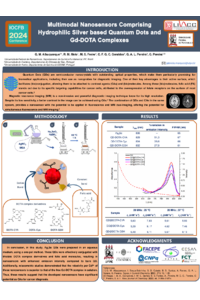
Magnetic resonance imaging (MRI) is a non-invasive technique that offers advantages compared to others diagnostic methods. Due their low sensitivity, contrast agents (CAs) are employed to improve image contrast by reducing the relaxation times of water molecules within the medium. The main commercial CAs are Gd-based complexes, due to the presence of seven unpaired pairs of electrons in Gd3+ ion. Among them, those composed by the DOTA ligand are notable for their high thermodynamic and kinetic stability. Despite the efficiency of the Gd-DOTA complexes in enhancing contrast, nanoparticulate CAs have been used to further amplify the MRI signal. Gd-complexes have been attached to Quantum Dots (QDs), offering a secondary signal for optical imaging, combining the advantages of both techniques into a single system [1]. QDs are semiconductor nanocrystals characterized by a size range from 2 to 10 nm, possessing size-tunable optical properties and an active surface. These properties make them interesting for multiple fields of application, such as nanoprobes for diagnostic imaging. However, the majority of works published so far with this aim use Cd-based QDs or material that is synthesized via organic methods [2]. In order to utilize the material in biological applications, in this work, we synthesized Ag2Se QDs in aqueous medium, and conjugated them to Gd-DOTA complexes through thiol–metal binding. The optical characterization showed an increase up to 43% of the emission intensity of the QDs after the conjugation procedures. Moreover, relaxometric studies showed an relaxivity values improvement of these nanosensors, compared with the clinical Gd-DOTA complex. These results demonstrated the potential of the systems based on Ag2Se QDs and Gd-DOTA complex to serve as non-toxic optical probes in biomedical applications.
References:
[1] Albuquerque, G. M., et al. Topics in Current Chemistry, 2021, 379, 12, 1-35.
[2] Viegas, I. M. A., et al. New Journal of Chemistry, 2022, 46, 21864-21874.
Keywords
Semiconductor nanocrystals
Cd-free QDs
biological applications
nanoprobes.
Poster
Poster IOCFB 2024_090162.pdf
The Fabrication of pH-Responsive Multilayer Hydrogel Patches for Enhanced Burn Wound Treatment
Development of theranostic nanoplatforms based on colloidal silver nanoprisms and paramagnetic chelates