Event submissions
Published
This submission belongs to the session F. Biomaterials for Diagnostics, Therapy and Healthcare of the event The 1st International Online Conference on Functional Biomaterials
Published date
08 Jul, 2024
Academic Editor
'%3e%3cpath%20d='M12.6657%2010.9104C12.4185%2010.325%2012.0599%209.79327%2011.6097%209.34482C11.1609%208.89508%2010.6293%208.5365%2010.0442%208.28888C10.0389%208.28626%2010.0337%208.28495%2010.0285%208.28233C10.8446%207.69279%2011.3752%206.73249%2011.3752%205.64904C11.3752%203.8542%209.92103%202.39999%208.1262%202.39999C6.33136%202.39999%204.87715%203.8542%204.87715%205.64904C4.87715%206.73249%205.40774%207.69279%206.22393%208.28364C6.21869%208.28626%206.21345%208.28757%206.20821%208.29019C5.62129%208.5378%205.09463%208.89284%204.64265%209.34613C4.1929%209.79493%203.83432%2010.3266%203.58671%2010.9117C3.34345%2011.4845%203.21226%2012.0987%203.20023%2012.7209C3.19988%2012.7349%203.20233%2012.7488%203.20744%2012.7619C3.21255%2012.7749%203.22022%2012.7867%203.22998%2012.7968C3.23975%2012.8068%203.25142%2012.8147%203.26431%2012.8202C3.2772%2012.8256%203.29105%2012.8284%203.30504%2012.8284H4.09109C4.14874%2012.8284%204.19459%2012.7825%204.1959%2012.7262C4.2221%2011.7148%204.62823%2010.7676%205.34617%2010.0497C6.08899%209.30683%207.0755%208.89808%208.1262%208.89808C9.17689%208.89808%2010.1634%209.30683%2010.9062%2010.0497C11.6242%2010.7676%2012.0303%2011.7148%2012.0565%2012.7262C12.0578%2012.7838%2012.1037%2012.8284%2012.1613%2012.8284H12.9474C12.9613%2012.8284%2012.9752%2012.8256%2012.9881%2012.8202C13.001%2012.8147%2013.0126%2012.8068%2013.0224%2012.7968C13.0322%2012.7867%2013.0398%2012.7749%2013.0449%2012.7619C13.0501%2012.7488%2013.0525%2012.7349%2013.0522%2012.7209C13.0391%2012.0947%2012.9094%2011.4855%2012.6657%2010.9104ZM8.1262%207.9024C7.52486%207.9024%206.9589%207.6679%206.53312%207.24211C6.10733%206.81633%205.87283%206.25037%205.87283%205.64904C5.87283%205.0477%206.10733%204.48174%206.53312%204.05596C6.9589%203.63018%207.52486%203.39567%208.1262%203.39567C8.72753%203.39567%209.29349%203.63018%209.71927%204.05596C10.1451%204.48174%2010.3796%205.0477%2010.3796%205.64904C10.3796%206.25037%2010.1451%206.81633%209.71927%207.24211C9.29349%207.6679%208.72753%207.9024%208.1262%207.9024Z'%20fill='%235D1EE1'/%3e%3c/g%3e%3c/svg%3e) Antonio Vassallo
Antonio VassalloCitation
Ekaterina Brodovskaya, Mikhail Zharkov, Irina Khutorskaya, Denis Yakobson, Larisa Tararina, Vasilisa Shlyapkina, Amina Al-khadj Aioub, Nikolay Pyataev, In vitro study of polyelectrolyte microcapsules loaded with chlorin E6 and iron oxide nanoparticles for photodynamic therapy, in Proceedings of The 1st International Online Conference on Functional Biomaterials, 10 July–12 July 2024, MDPI: Basel, Switzerland
Share
Email
Facebook
Twitter
LinkedIn
In vitro study of polyelectrolyte microcapsules loaded with chlorin E6 and iron oxide nanoparticles for photodynamic therapy
'%3e%3cpath%20d='M12.6647%2010.9104C12.4176%2010.325%2012.0589%209.7933%2011.6088%209.34485C11.16%208.89511%2010.6283%208.53653%2010.0432%208.28891C10.038%208.28629%2010.0327%208.28498%2010.0275%208.28236C10.8437%207.69282%2011.3743%206.73252%2011.3743%205.64907C11.3743%203.85423%209.92005%202.40002%208.12522%202.40002C6.33038%202.40002%204.87618%203.85423%204.87618%205.64907C4.87618%206.73252%205.40677%207.69282%206.22296%208.28367C6.21772%208.28629%206.21248%208.2876%206.20724%208.29022C5.62031%208.53783%205.09365%208.89287%204.64167%209.34616C4.19192%209.79496%203.83334%2010.3266%203.58573%2010.9117C3.34247%2011.4846%203.21128%2012.0987%203.19925%2012.721C3.1989%2012.735%203.20135%2012.7489%203.20646%2012.7619C3.21157%2012.7749%203.21924%2012.7868%203.22901%2012.7968C3.23877%2012.8068%203.25045%2012.8148%203.26334%2012.8202C3.27623%2012.8256%203.29007%2012.8284%203.30406%2012.8284H4.09012C4.14776%2012.8284%204.19362%2012.7825%204.19493%2012.7262C4.22113%2011.7148%204.62726%2010.7676%205.34519%2010.0497C6.08802%209.30686%207.07452%208.89811%208.12522%208.89811C9.17592%208.89811%2010.1624%209.30686%2010.9052%2010.0497C11.6232%2010.7676%2012.0293%2011.7148%2012.0555%2012.7262C12.0568%2012.7839%2012.1027%2012.8284%2012.1603%2012.8284H12.9464C12.9604%2012.8284%2012.9742%2012.8256%2012.9871%2012.8202C13%2012.8148%2013.0117%2012.8068%2013.0214%2012.7968C13.0312%2012.7868%2013.0389%2012.7749%2013.044%2012.7619C13.0491%2012.7489%2013.0515%2012.735%2013.0512%2012.721C13.0381%2012.0947%2012.9084%2011.4856%2012.6647%2010.9104ZM8.12522%207.90243C7.52388%207.90243%206.95792%207.66793%206.53214%207.24215C6.10636%206.81636%205.87185%206.2504%205.87185%205.64907C5.87185%205.04773%206.10636%204.48177%206.53214%204.05599C6.95792%203.63021%207.52388%203.3957%208.12522%203.3957C8.72655%203.3957%209.29252%203.63021%209.7183%204.05599C10.1441%204.48177%2010.3786%205.04773%2010.3786%205.64907C10.3786%206.2504%2010.1441%206.81636%209.7183%207.24215C9.29252%207.66793%208.72655%207.90243%208.12522%207.90243Z'%20fill='%235D1EE1'/%3e%3c/g%3e%3c/svg%3e)
Ekaterina Brodovskaya 1
Mikhail Zharkov 2
Irina Khutorskaya 2
Denis Yakobson 2
Larisa Tararina 3
Vasilisa Shlyapkina 2
Amina Al-khadj Aioub 2
Nikolay Pyataev 1
1. National Research Ogarev Mordovia State University
2. National Research Mordovia State University
3. A.I.Yevdokimov Moscow State University of Medicine and Dentistry, Moscow, Russia
Abstract
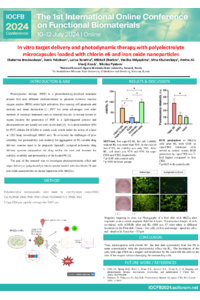
The goal of the research was to investigate the photocytotoxicity effect and target delivery of polyelectrolyte microcapsules loaded with the photosensitizer chlorin E6 (ClE6) and iron oxide nanoparticles on mouse hepatoma cells (Mh22a). Microcapsules were made by layer by layer (caps-ClE6). Polyelectrolyte layers (PAH and PSS) and iron oxide nanoparticles were alternately deposited on the spherical cores loaded with ClE6. After 24 h incubation of Mh22a with caps-ClE6 (20 caps/cell) and free ClE6 (11.2 μg/mL), the cells were irradiated by red light (660 nm and 60W) for 15 min (RL). The photocytotoxicity was evaluated using MTT colometric tests. The targeting in vitro was determined in a Petri dish after 24 h incubation of cells with caps-CLE6 on a permanent magnet and RL 15 min. The cell death was assessed using double staining (acridine orange and ethidium bromide). For caps-CLE6, the cell viability without RL was more than 70%. In the case of free ClE6, the viability was only 26%. After RL, cell death was 92% and 95% for caps-ClE6 and ClE6,respectively. ROS generation by caps-ClE6 was 2-fold higher compared to free ClE6. After incubation of Mh22a with caps-CLE6 on a permanent magnet and RL, fluorescence microscopy showed almost complete cell death by necrosis and apoptosis and no cell death outside the magnet. Thus, Caps-CLE6 had less dark cytotoxicity with the phototoxicity effect via RL, and could be concentrated with magnets.
Keywords
photocytoxicity
clorin E6
polyelectrolyte microcapsules
photodynamic therapy
Poster
BrodovskayaEP.pdf
Silylation of cellulose using a cyclotetrasiloxane and its polymerization
Development of targeted combined structures based on phospholipid nanosystems for lung cancer therapy