Event submissions
Published
This submission belongs to the session F. Biomaterials for Diagnostics, Therapy and Healthcare of the event The 1st International Online Conference on Functional Biomaterials
Published date
11 Jul, 2024
Academic Editor
'%3e%3cpath%20d='M12.6657%2010.9104C12.4185%2010.325%2012.0599%209.79327%2011.6097%209.34482C11.1609%208.89508%2010.6293%208.5365%2010.0442%208.28888C10.0389%208.28626%2010.0337%208.28495%2010.0285%208.28233C10.8446%207.69279%2011.3752%206.73249%2011.3752%205.64904C11.3752%203.8542%209.92103%202.39999%208.1262%202.39999C6.33136%202.39999%204.87715%203.8542%204.87715%205.64904C4.87715%206.73249%205.40774%207.69279%206.22393%208.28364C6.21869%208.28626%206.21345%208.28757%206.20821%208.29019C5.62129%208.5378%205.09463%208.89284%204.64265%209.34613C4.1929%209.79493%203.83432%2010.3266%203.58671%2010.9117C3.34345%2011.4845%203.21226%2012.0987%203.20023%2012.7209C3.19988%2012.7349%203.20233%2012.7488%203.20744%2012.7619C3.21255%2012.7749%203.22022%2012.7867%203.22998%2012.7968C3.23975%2012.8068%203.25142%2012.8147%203.26431%2012.8202C3.2772%2012.8256%203.29105%2012.8284%203.30504%2012.8284H4.09109C4.14874%2012.8284%204.19459%2012.7825%204.1959%2012.7262C4.2221%2011.7148%204.62823%2010.7676%205.34617%2010.0497C6.08899%209.30683%207.0755%208.89808%208.1262%208.89808C9.17689%208.89808%2010.1634%209.30683%2010.9062%2010.0497C11.6242%2010.7676%2012.0303%2011.7148%2012.0565%2012.7262C12.0578%2012.7838%2012.1037%2012.8284%2012.1613%2012.8284H12.9474C12.9613%2012.8284%2012.9752%2012.8256%2012.9881%2012.8202C13.001%2012.8147%2013.0126%2012.8068%2013.0224%2012.7968C13.0322%2012.7867%2013.0398%2012.7749%2013.0449%2012.7619C13.0501%2012.7488%2013.0525%2012.7349%2013.0522%2012.7209C13.0391%2012.0947%2012.9094%2011.4855%2012.6657%2010.9104ZM8.1262%207.9024C7.52486%207.9024%206.9589%207.6679%206.53312%207.24211C6.10733%206.81633%205.87283%206.25037%205.87283%205.64904C5.87283%205.0477%206.10733%204.48174%206.53312%204.05596C6.9589%203.63018%207.52486%203.39567%208.1262%203.39567C8.72753%203.39567%209.29349%203.63018%209.71927%204.05596C10.1451%204.48174%2010.3796%205.0477%2010.3796%205.64904C10.3796%206.25037%2010.1451%206.81633%209.71927%207.24211C9.29349%207.6679%208.72753%207.9024%208.1262%207.9024Z'%20fill='%235D1EE1'/%3e%3c/g%3e%3c/svg%3e) Antonio Vassallo
Antonio VassalloCitation
Darya Kalugina, Polina Fedorova, Irina Chikileva, Roman Timoshenko, Kristina Kotyakova, Andrei Matveev, Dmitry Shtansky, A new strategy based on methylene blue and boron nitride for local photodynamic therapy, in Proceedings of The 1st International Online Conference on Functional Biomaterials, 10 July–12 July 2024, MDPI: Basel, Switzerland
Share
Email
Facebook
Twitter
LinkedIn
A new strategy based on methylene blue and boron nitride for local photodynamic therapy
'%3e%3cpath%20d='M12.6647%2010.9104C12.4176%2010.325%2012.0589%209.7933%2011.6088%209.34485C11.16%208.89511%2010.6283%208.53653%2010.0432%208.28891C10.038%208.28629%2010.0327%208.28498%2010.0275%208.28236C10.8437%207.69282%2011.3743%206.73252%2011.3743%205.64907C11.3743%203.85423%209.92005%202.40002%208.12522%202.40002C6.33038%202.40002%204.87618%203.85423%204.87618%205.64907C4.87618%206.73252%205.40677%207.69282%206.22296%208.28367C6.21772%208.28629%206.21248%208.2876%206.20724%208.29022C5.62031%208.53783%205.09365%208.89287%204.64167%209.34616C4.19192%209.79496%203.83334%2010.3266%203.58573%2010.9117C3.34247%2011.4846%203.21128%2012.0987%203.19925%2012.721C3.1989%2012.735%203.20135%2012.7489%203.20646%2012.7619C3.21157%2012.7749%203.21924%2012.7868%203.22901%2012.7968C3.23877%2012.8068%203.25045%2012.8148%203.26334%2012.8202C3.27623%2012.8256%203.29007%2012.8284%203.30406%2012.8284H4.09012C4.14776%2012.8284%204.19362%2012.7825%204.19493%2012.7262C4.22113%2011.7148%204.62726%2010.7676%205.34519%2010.0497C6.08802%209.30686%207.07452%208.89811%208.12522%208.89811C9.17592%208.89811%2010.1624%209.30686%2010.9052%2010.0497C11.6232%2010.7676%2012.0293%2011.7148%2012.0555%2012.7262C12.0568%2012.7839%2012.1027%2012.8284%2012.1603%2012.8284H12.9464C12.9604%2012.8284%2012.9742%2012.8256%2012.9871%2012.8202C13%2012.8148%2013.0117%2012.8068%2013.0214%2012.7968C13.0312%2012.7868%2013.0389%2012.7749%2013.044%2012.7619C13.0491%2012.7489%2013.0515%2012.735%2013.0512%2012.721C13.0381%2012.0947%2012.9084%2011.4856%2012.6647%2010.9104ZM8.12522%207.90243C7.52388%207.90243%206.95792%207.66793%206.53214%207.24215C6.10636%206.81636%205.87185%206.2504%205.87185%205.64907C5.87185%205.04773%206.10636%204.48177%206.53214%204.05599C6.95792%203.63021%207.52388%203.3957%208.12522%203.3957C8.72655%203.3957%209.29252%203.63021%209.7183%204.05599C10.1441%204.48177%2010.3786%205.04773%2010.3786%205.64907C10.3786%206.2504%2010.1441%206.81636%209.7183%207.24215C9.29252%207.66793%208.72655%207.90243%208.12522%207.90243Z'%20fill='%235D1EE1'/%3e%3c/g%3e%3c/svg%3e)
Darya Kalugina 1
Polina Fedorova 2,3
Irina Chikileva 4
Roman Timoshenko 1

Kristina Kotyakova 1
Andrei Matveev 1
Dmitry Shtansky 1
1. National University of Science and Technology MISIS, 4s1 Leninsky prospekt, Moscow, 119049, Russia
2. Federal State Budgetary Scientific Institution «Research Institute of Vaccines and Serums them. I.I. Mechnikov», 5Ас9 Maly Kazyonny Lane, Moscow, 105064, Russia
3. Federal State Autonomous Educational Institution of Higher Education I.M. Sechenov First Moscow State Medical University of the Ministry of Health of the Russian Federation (Sechenov University), 8-2 Trubetskaya street, Moscow, 119991, Russia
4. Research Institute of Experimental Therapy and Diagnostics of Tumor, NN Blokhin National Medical Center of Oncology, 23 Kashirskoe highway, Moscow, 115478, Russia
Abstract
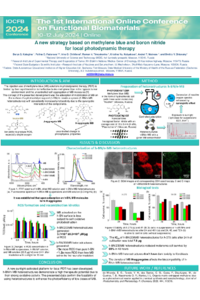
Introduction. The application of the photosensitizer methylene blue (MB) in photodynamic therapy (PDT) is limited by the high risk of side effects. This restricts the possibility of using MB for highly effective PDT. This study presents the development of a new strategy for local PDT based on MB adsorbed on a photocatalyst—hexagonal boron nitride nanoparticles (h-BN).
Materials and Methods. h-BN/n•MB heterostructures with a specified concentration (n) of MB were obtained by immobilizing MB on h-BN NPs using a controlled adsorption method. Characterization of h-BN/n•MB heterostructures was carried out using SEM, EDX, UV-Vis spectrophotometry, and fluorescence and FTIR spectroscopy. The level of ROS mediated by h-BN/n•MB heterostructures was determined via an amperometric method. The cytotoxicity of the material was assessed on human skin melanoma (A-375) and human fibroblast (Wi-38) cell lines.
Results. h-BN/MB heterostructures with MB concentrations of 100, 200, and 300 mg/g were fabricated. The results of fluorescence and FTIR spectroscopy indicate π-π stacking of MB and h-BN in these heterostructures. According to spectrophotometry, the desorption of MB is no more than 7 mass %, which confirms the high stability of the heterostructures. All h-BN/n•MB heterostructures generated a high level of ROS—up to 3.8 ×10⁻² ±0.3×10⁻² µM/µg within 24 hours after exposure to sunlight. Biological studies indicate the pronounced antitumor activity of the material, as well as its selective cytotoxicity to normal and cancer cells.
Conclusions. A new sunlight-activated platform for local PDT has been developed. h-BN/n•MB heterostructures demonstrate a high therapeutic potential due to their strong oxidative activity. The presented data confirm the feasibility of using heterostructures to enhance the photoefficiency of low doses of MB.
This research was funded by the Russian Science Foundation ( 20-19-00120-P).
Keywords
hexagonal boron nitride
methylene blue
reactive oxygen species
photodynamic therapy
Poster
IOCFB2024 h-BN-MB.pdf
Development of targeted combined structures based on phospholipid nanosystems for lung cancer therapy