Event submissions
Published
This submission belongs to the session S3. Inorganic Crystalline Materials of the event The 4th International Online Conference on Crystals
Published date
18 Sep, 2024
Academic Editor
'%3e%3cpath%20d='M12.6657%2010.9104C12.4185%2010.325%2012.0599%209.79327%2011.6097%209.34482C11.1609%208.89508%2010.6293%208.5365%2010.0442%208.28888C10.0389%208.28626%2010.0337%208.28495%2010.0285%208.28233C10.8446%207.69279%2011.3752%206.73249%2011.3752%205.64904C11.3752%203.8542%209.92103%202.39999%208.1262%202.39999C6.33136%202.39999%204.87715%203.8542%204.87715%205.64904C4.87715%206.73249%205.40774%207.69279%206.22393%208.28364C6.21869%208.28626%206.21345%208.28757%206.20821%208.29019C5.62129%208.5378%205.09463%208.89284%204.64265%209.34613C4.1929%209.79493%203.83432%2010.3266%203.58671%2010.9117C3.34345%2011.4845%203.21226%2012.0987%203.20023%2012.7209C3.19988%2012.7349%203.20233%2012.7488%203.20744%2012.7619C3.21255%2012.7749%203.22022%2012.7867%203.22998%2012.7968C3.23975%2012.8068%203.25142%2012.8147%203.26431%2012.8202C3.2772%2012.8256%203.29105%2012.8284%203.30504%2012.8284H4.09109C4.14874%2012.8284%204.19459%2012.7825%204.1959%2012.7262C4.2221%2011.7148%204.62823%2010.7676%205.34617%2010.0497C6.08899%209.30683%207.0755%208.89808%208.1262%208.89808C9.17689%208.89808%2010.1634%209.30683%2010.9062%2010.0497C11.6242%2010.7676%2012.0303%2011.7148%2012.0565%2012.7262C12.0578%2012.7838%2012.1037%2012.8284%2012.1613%2012.8284H12.9474C12.9613%2012.8284%2012.9752%2012.8256%2012.9881%2012.8202C13.001%2012.8147%2013.0126%2012.8068%2013.0224%2012.7968C13.0322%2012.7867%2013.0398%2012.7749%2013.0449%2012.7619C13.0501%2012.7488%2013.0525%2012.7349%2013.0522%2012.7209C13.0391%2012.0947%2012.9094%2011.4855%2012.6657%2010.9104ZM8.1262%207.9024C7.52486%207.9024%206.9589%207.6679%206.53312%207.24211C6.10733%206.81633%205.87283%206.25037%205.87283%205.64904C5.87283%205.0477%206.10733%204.48174%206.53312%204.05596C6.9589%203.63018%207.52486%203.39567%208.1262%203.39567C8.72753%203.39567%209.29349%203.63018%209.71927%204.05596C10.1451%204.48174%2010.3796%205.0477%2010.3796%205.64904C10.3796%206.25037%2010.1451%206.81633%209.71927%207.24211C9.29349%207.6679%208.72753%207.9024%208.1262%207.9024Z'%20fill='%235D1EE1'/%3e%3c/g%3e%3c/svg%3e) Vladimir Fedin
Vladimir FedinCitation
Isaya Thaveesangsakulthai, Sorrawit Songsathitmetha, Study of synthesized molecular chiral lactam structures for volatile compound profile enrichment using gas chromatography–mass spectrometry (GC-MS) technique, in Proceedings of The 4th International Online Conference on Crystals, 18 September–20 September 2024, MDPI: Basel, Switzerland
Share
Email
Facebook
Twitter
LinkedIn
Study of synthesized molecular chiral lactam structures for volatile compound profile enrichment using gas chromatography–mass spectrometry (GC-MS) technique
'%3e%3cpath%20d='M12.6647%2010.9104C12.4176%2010.325%2012.0589%209.7933%2011.6088%209.34485C11.16%208.89511%2010.6283%208.53653%2010.0432%208.28891C10.038%208.28629%2010.0327%208.28498%2010.0275%208.28236C10.8437%207.69282%2011.3743%206.73252%2011.3743%205.64907C11.3743%203.85423%209.92005%202.40002%208.12522%202.40002C6.33038%202.40002%204.87618%203.85423%204.87618%205.64907C4.87618%206.73252%205.40677%207.69282%206.22296%208.28367C6.21772%208.28629%206.21248%208.2876%206.20724%208.29022C5.62031%208.53783%205.09365%208.89287%204.64167%209.34616C4.19192%209.79496%203.83334%2010.3266%203.58573%2010.9117C3.34247%2011.4846%203.21128%2012.0987%203.19925%2012.721C3.1989%2012.735%203.20135%2012.7489%203.20646%2012.7619C3.21157%2012.7749%203.21924%2012.7868%203.22901%2012.7968C3.23877%2012.8068%203.25045%2012.8148%203.26334%2012.8202C3.27623%2012.8256%203.29007%2012.8284%203.30406%2012.8284H4.09012C4.14776%2012.8284%204.19362%2012.7825%204.19493%2012.7262C4.22113%2011.7148%204.62726%2010.7676%205.34519%2010.0497C6.08802%209.30686%207.07452%208.89811%208.12522%208.89811C9.17592%208.89811%2010.1624%209.30686%2010.9052%2010.0497C11.6232%2010.7676%2012.0293%2011.7148%2012.0555%2012.7262C12.0568%2012.7839%2012.1027%2012.8284%2012.1603%2012.8284H12.9464C12.9604%2012.8284%2012.9742%2012.8256%2012.9871%2012.8202C13%2012.8148%2013.0117%2012.8068%2013.0214%2012.7968C13.0312%2012.7868%2013.0389%2012.7749%2013.044%2012.7619C13.0491%2012.7489%2013.0515%2012.735%2013.0512%2012.721C13.0381%2012.0947%2012.9084%2011.4856%2012.6647%2010.9104ZM8.12522%207.90243C7.52388%207.90243%206.95792%207.66793%206.53214%207.24215C6.10636%206.81636%205.87185%206.2504%205.87185%205.64907C5.87185%205.04773%206.10636%204.48177%206.53214%204.05599C6.95792%203.63021%207.52388%203.3957%208.12522%203.3957C8.72655%203.3957%209.29252%203.63021%209.7183%204.05599C10.1441%204.48177%2010.3786%205.04773%2010.3786%205.64907C10.3786%206.2504%2010.1441%206.81636%209.7183%207.24215C9.29252%207.66793%208.72655%207.90243%208.12522%207.90243Z'%20fill='%235D1EE1'/%3e%3c/g%3e%3c/svg%3e)
Isaya Thaveesangsakulthai 1
Sorrawit Songsathitmetha 2
1. Department of Obstretics, Gynaecology, and Reproduction, Faculty of Veterinary Science, Chulalongkorn University, Bangkok, Thailand
2. Department of Pathology, Faculty of Veterinary Science, Chulalongkorn University, Bangkok, Thailand
Abstract
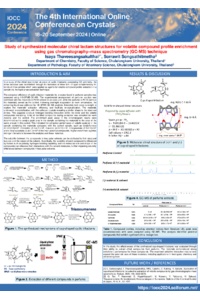
In a study of the chiral enantiomer structure of cyclic trilactams possessing C3 symmetry, the dimer structure was established through the formation of three NH···O type complementary H-bonds at three amides which were applied as agents for volatile compound profile extraction in a sample via the liquid phase extraction technique.
The extraction efficiency of cyclic trilactam materials for analytes found in perfume samples was assessed using HS-SPME-GC-MS. The experimental arrangement of perfume solution was combined with the materials in EtOH solvent in an open vial, while the perfume in EtOH (without the materials) served as the control. Following overnight evaporation at room temperature, the remaining liquid was collected for HS-SPME-GC-MS analysis. Extraction took place overnight to explore the materials' extraction efficiency and facilitate re-crystallization. The materials underwent re-crystallization, with the collected crystals revealing a similar shape to the observed dimers. This suggests a robust hydrogen bonding interaction within the dimer and the volatile compounds interacting. A list of identified compounds during extraction was compiled for each material and the control. The enrichment peak areas in the chromatogram results were determined as the analyte peak area in the sample containing the materials to the area of the same analyte in the control. This indicated the extraction performance of volatile analytes in the sample containing the materials compared with the control sample, such as Linalylformate (5.1±0.015)×107, Citronellol (5.1±4.2)×106, Carvone (4.2±3.5)×105, Linalylacetate (2.5±2.2)×107 and α-Terpinylacetate (2.3±1.7)×105 of the main potential compounds. Higher enrichment signifies stronger interactions between the analytes and these materials.
The solubility between the compounds in less polar solvents can be attributed to their structural features and the nature of the solvent. Specifically, the solubility of each compound is influenced by factors such as polarity, hydrogen bonding capability, and the molecular size and shape of the compounds can influence their interactions with the solvent molecules, further impacting solubility differences between compounds in less polar solvents.
Keywords
Chiral structure
VOCs
HS-SPME-GC-MS
crystal structure
Poster
Crystals MDPI Poster-Isaya-Sorrawit.pdf
C-H/O interactions of aromatic ligands in organometallic compounds—crystallographic and density functional study
Sorbents and catalysts based on mesostructured silica for pollutant removal and Carbon Capture and Utilization technologies